Introduction
Do you have a sketchbook sitting on a shelf, mostly empty, with big intentions attached to it? If you nodded yes, you are in good company. Most of us start a sketchbook with excitement, draw for two or three days, and then quietly abandon it when life gets busy.
The good news is that drawing every day does not require talent, hours of free time, or a perfectly organized art corner.
It requires a habit that is small enough to survive a chaotic week. This guide will show you how to build a daily drawing practice that actually sticks — even on the days when you only have five minutes between school pickup and dinner.
Think of this less as a strict program and more as a gentle invitation. You already have everything you need to begin. Let's talk about why this habit matters, and then we will build it together, one small sketch at a time.
Why a Daily Sketchbook Habit Matters
Drawing every day is not about producing a masterpiece. It is about showing up. When you draw regularly, even for a few minutes, your hand and your eye start to work together more smoothly. Lines become more confident. Shapes become easier to see.
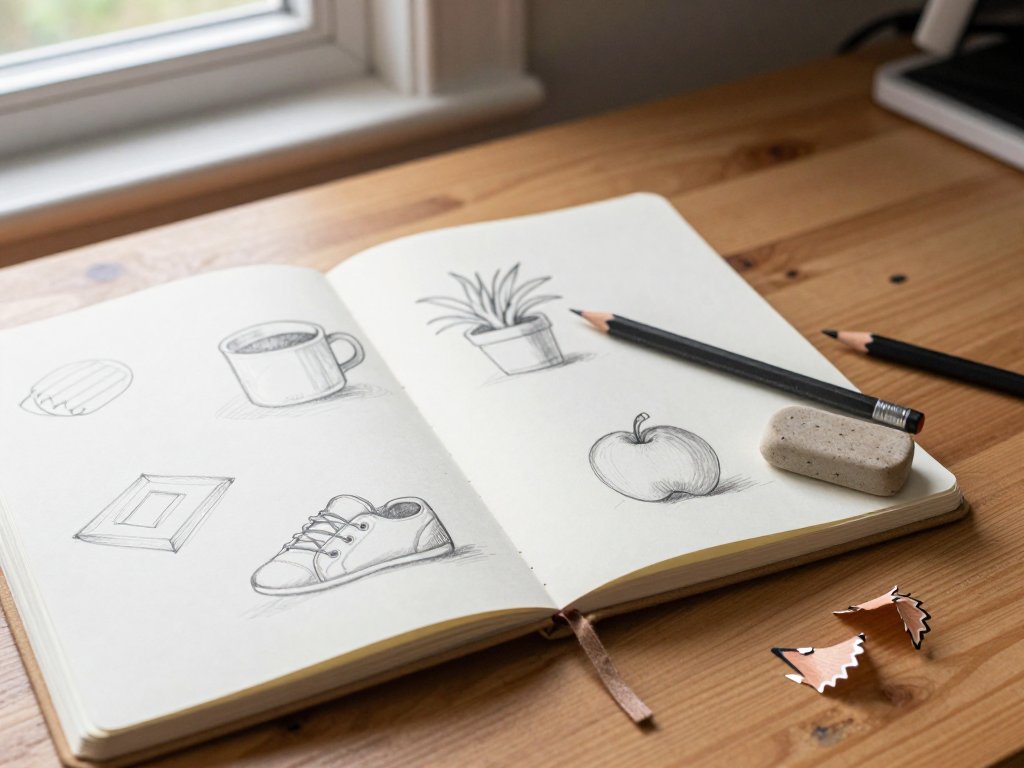
There is also something quietly wonderful about having a visual diary of your days. A sketch of the mug on your kitchen counter, the plant by the window, or the kids' shoes by the door becomes a little time capsule.
Months later, you flip through the pages and remember exactly where you were in life.
And here is the part that surprised me most: daily drawing is deeply calming. It pulls you out of your to-do list and into the present moment.
For a few minutes, the only thing that matters is the pencil moving across the page.
That kind of focused quiet is rare for busy moms — and it is yours for the price of a sketchbook.
Choose a Sketchbook You Will Actually Use
The perfect sketchbook is not the fanciest one in the store. It is the one you do not feel afraid to mark up. If a beautiful, expensive journal makes you hesitate before every stroke, it is working against you. Choose something friendly instead.
Look for a sketchbook with paper that can handle a little erasing and layering. A midweight paper around 90 to 100 pounds (or 190 to 210 gsm) is a lovely sweet spot for pencil, pen, and light watercolor washes.
Size matters too. A book that fits in your bag — or even in the car's glove compartment — will travel with you, and a sketchbook that travels gets used.
Some artists swear by spiral-bound books because they lie flat and pages tear out cleanly. Others love sewn bindings that open like a book. There is no wrong choice. If you already own a half-used notebook, that works beautifully too. The goal is to start, not to shop.
Keep Your Supplies Simple
Here is a secret that takes most people years to learn: you do not need a full art supply store to draw every day.
A single pencil and your sketchbook are enough to build a lasting habit. Everything else is a bonus you can add later, one piece at a time.
That said, a few small upgrades can make the practice more pleasant. An HB pencil is a dependable all-rounder, while a 2B is softer and darker for expressive lines.
A basic eraser and a handheld sharpener cost almost nothing and keep frustration low. If you enjoy pen, any smooth ballpoint or fineliner works — many artists find that pen removes the urge to erase and frees up their lines.
Keep these supplies in one place. A small pouch, a tray, or even a zippered pocket in your bag means you never have to hunt for your pencil at sketch time. When the supplies are easy to reach, the habit is easy to keep.
Start with Five Minutes
Here is the most important advice in this entire guide: start smaller than you think you need to. Five minutes a day is enough. Seriously. A five-minute sketch every day for a month will teach you more than a three-hour drawing session once a month.
Why does tiny work so well? Because the size of the habit is what makes it repeatable.
On a good day, five minutes turns into twenty because you are enjoying yourself. On a hard day, five minutes is still doable — and showing up for even five minutes keeps the habit alive.
The streak matters more than the session length.
Set a gentle reminder on your phone if that helps. When it goes off, take a deep breath and pick up your pencil. No pressure to produce anything impressive. Just let your hand move. Some of the best sketches in the world started as five-minute scribbles.
Make Drawing Part of Your Routine
Habits stick best when they are attached to something you already do every day. Think about your natural rhythms and find a moment where a sketchbook fits without rearranging your whole life.
Morning people might sketch while their coffee brews, capturing the quiet of the house before everyone wakes.
Night owls often enjoy a few minutes on the couch after the kids are asleep, winding down with pencil and paper.
Others sketch during lunch breaks, at soccer practice, or while waiting in the school pickup line.
The key is to pair drawing with an existing anchor. Coffee cup, kitchen table, pickup line — when you connect your sketchbook to a moment you already have, you stop needing willpower. The habit simply becomes part of your day, like brushing your teeth.
Draw What Is Around You
You do not need to find an inspiring subject. It is already on your kitchen counter. Everyday objects make wonderful drawing practice because they are full of interesting shapes, and because you can draw them over and over to watch your skills grow.
Try starting with the mug next to you. Notice its curve, its handle, the little shadow it casts.
Then move on to a spoon, a piece of fruit, a shoe, a houseplant, or the way the light falls across your table.
Children's toys, folded laundry, and half-read books all make honest, lovely subjects.
Observational drawing — drawing what you actually see rather than what you think something looks like — is the fastest way to improve.
Look at the object more than you look at your paper. Let your eye travel slowly along its edges and let your hand follow.
You will be amazed at how much your drawings improve when you truly look.
If you are not sure what to notice, try asking yourself three little questions before you start: What is the overall shape?
Where is the light coming from? What is the darkest part? Answering those questions gives your sketch a simple structure and keeps your eyes moving between the object and the page.
Use Prompts on Stuck Days
Some days the page feels blank and intimidating, and your mind goes blank right along with it. That is completely normal. A simple prompt can rescue you in seconds, so keep a few in your back pocket for those moments.
Here are some favorites that always work: draw your left hand, draw what you ate for breakfast, draw the view from your window, draw something blue, draw a favorite memory in three quick sketches, or draw the first thing you see when you open your front door.
You can also pick a theme for the week, like mugs, leaves, or doors, and explore it a little each day.
If you like community, many artists share daily prompt lists online — but you do not need them. Your own life is full of material. When in doubt, draw the nearest object and give it your full attention. That is always enough.
Sketch with Your Kids
One of the sweetest ways to keep a drawing habit alive is to share it.
Kids love to draw, and when you pull out your sketchbook alongside them, you are not just practicing your own art — you are showing them that making things is a normal, joyful part of grown-up life too.
Set up two sketchbooks at the kitchen table after dinner and draw whatever is in front of you.
Compare your versions and laugh at the differences. Give each other silly prompts, like drawing a dinosaur drinking tea or a cat wearing boots.
You might be surprised by how much your children's fearless marks loosen up your own careful hand.
Sketching together also solves the time problem. You are not stealing minutes away from your family to draw; you are drawing with them. The practice becomes a togetherness ritual instead of a solitary chore, and those quiet, pencil-scratching evenings may end up among your favorite memories.
Track Your Progress Kindly
There is a special satisfaction in watching a sketchbook fill up. The pages turn from white to marked, from tentative to confident. Tracking your habit can feed that satisfaction, but it needs to be done kindly — the moment a tracker becomes a judge, it stops helping.
Some people enjoy a simple calendar where they put an X on each day they sketch. Others prefer to just flip through their sketchbook and feel the growing thickness of the pages. Both work. The important thing is to celebrate showing up, not to punish the days you missed.
And you will miss days. Life happens — sickness, travel, holidays, exhaustion. When you miss a day or a week, resist the urge to give up entirely.
Just pick up your pencil again today. The habit is not broken because you skipped a day.
It is only broken if you decide it is.
Let Imperfection Be Part of the Plan
Here is a truth every artist eventually learns: bad drawings are not failures. They are data. Every wobbly line and awkward proportion teaches your hand something, and your next sketch will be a little better because of it.
When you flip through a filled sketchbook, you will see pages you love and pages you want to forget. That mix is the point. The sketchbook is a place for practice, experiments, and honest messes — not a gallery. If every page were perfect, you would be learning nothing.
Give yourself permission to make ugly drawings. Draw quickly. Draw badly on purpose. Draw the same object ten times and watch it improve. Your sketchbook is your private playground, and no one else gets to grade it.
Keep It Going: What Comes Next
Once daily sketching becomes comfortable, you might feel the itch to stretch. That is a lovely sign — it means the habit is working. Here are a few gentle next steps that build naturally on what you have started.
Try adding a second medium, like a fineliner pen or a small watercolor set, to play with color.
Challenge yourself to draw the same subject in different styles across a week. Fill an entire page with tiny sketches of one object.
Or set a monthly theme, like "kitchen tools" or "things that make me smile," and let it guide your pages.
You might also enjoy sketching from life in public places — a park bench, a café corner, a museum bench. Drawing strangers and scenes teaches you speed and observation. Just keep the same rule: no pressure, no judgment, only showing up.
Whatever path you choose, let it stay playful. The moment drawing starts to feel like homework, shrink it back down to five minutes and a single object. The habit is yours — it should serve you, not the other way around.
Conclusion
A daily drawing habit is not about becoming a professional artist. It is about giving yourself a few quiet minutes each day to notice the world, to play with a pencil, and to fill a book with the small beautiful moments of ordinary life.
Start tonight, or tomorrow morning, with five minutes and whatever pencil you can find. Draw your coffee mug.
Draw your child's shoe. Draw the view out your window. Then do it again the next day.
That is the whole secret — not talent, not time, just showing up, a little bit at a time.
Your sketchbook is waiting, and it is not judging you. Happy drawing.