Paint and sip nights look effortless in photographs. A long table, six easels, and everyone smiling at a canvas that somehow turned out better than they expected.
The photographs leave out the planning. They leave out the host who bought the wrong canvas and the guest who nearly gave up at the twenty-minute mark.
Here is exactly what you need to run one at home: the supply list, the order to buy things, the painting, and the words to say when someone freezes.
No studio rental, no instructor, and no talent required from you either.
Why a Planned Paint Night Beats an Improvised One
An improvised paint night sounds relaxed and turns into a scavenger hunt. Someone is hunting for a brush, someone else is mixing on a dinner plate, and you are in the kitchen looking for more cups.
Planning does not mean formal. It means every guest sits down to the same small, complete setup, so the only decision left is what colour goes where.
A planned night also protects your house. Paint ends up on the table, not the tablecloth, when there is a plate, a towel, and a water cup already in place.
And it protects the mood. Beginners get quiet and apologetic when supplies are short. They relax when nothing is missing.
Give yourself one hour of prep the day before and thirty minutes on the night. That is the whole commitment.
Choosing the Guest List and Setting the Table
Six is the sweet number. Four is cozy, eight is a party, and anything past eight turns into a classroom you did not sign up to teach.
Invite people who are roughly at the same comfort level. One experienced painter is lovely. Three of them can make the beginners feel like they are holding the brush wrong.
Tell guests up front that it is a beginner night and that nobody is expected to produce anything frame-worthy. That single sentence lowers the temperature of the room.
Ask them to wear something they do not love. You will still provide aprons, but sleeves are the first casualty of acrylic paint.
Now the table. You want roughly two feet of width per painter and enough room between easels that elbows do not collide.
Cover the whole surface before anything else goes down. A plastic tablecloth, a cut-open trash bag, or a painter's drop cloth all work. Tape the edges so it does not slide.
Seat right-handed and left-handed guests so their brush arms face outward. It sounds fussy. It prevents a surprising number of bumped water cups.
Put the food and drinks on a separate side table, behind the painters rather than beside their hands. More on that below.
Light the room well. Overhead light is fine, but a lamp placed to the side of the table shows the wet sheen on the canvas and helps people see what they are doing.
Finally, decide where wet paintings will live. A spare room, a laundry counter, or a stretch of floor along a wall. Clear that space before anyone arrives.
The Per-Guest Supply List
This is the list I would hand another mom who texted me the day before. It is deliberately short, and everything on it is easy to find.
Canvas: panels, not stretched
Buy canvas panels rather than stretched canvas for a beginner night. Panels are rigid boards with canvas glued to the front, and they cost roughly a third as much.
An 8x10 panel usually runs about a dollar or two. A stretched 8x10 is closer to four or five, and an 11x14 stretched canvas can be seven dollars or more.
Panels also sit flat on a table without wobbling, which matters when six people are painting at once.
Choose 11x14 panels if your budget allows. The extra surface is forgiving, and beginners fill a small canvas too fast and then fuss at it.
One caveat: panels can warp if you flood them with water. Keep the paint thick and the water cup for brushes only.
Paint: five colours plus white
You do not need a rainbow. Five colours plus a large tube of white will mix almost everything a beginner needs.
The five: a yellow, a red, a blue, burnt sienna, and yellow ochre. Buy "hue" versions of the cadmiums, which cost less and behave well.
Buy white in the biggest tube you can find. Beginners use white constantly, for sky, for highlights, and for softening a colour that got too strong.
One set of tubes per two guests is plenty. Squeeze out portions onto plates rather than letting everyone handle the tubes.
If you want the paint to stay open a little longer during a slow paint-along, a drop of acrylic mediums in the puddle keeps it workable without thinning the colour to water.
Brushes: two sizes, two per guest
Two brushes per painter is the whole kit. A flat brush about three-quarters of an inch wide, and a round brush around size six.
The flat brush does skies, water, and backgrounds. The round brush does the sun, the horizon line, and any small detail.
Buy cheap synthetic brushes and accept that some will be ruined. A pack of twenty costs less than a single nice brush and covers the whole table.
Skip the foam brushes. They shed, and a shed bristle in a wet sky is a small tragedy at nine o'clock at night.
Palettes, water, and towels
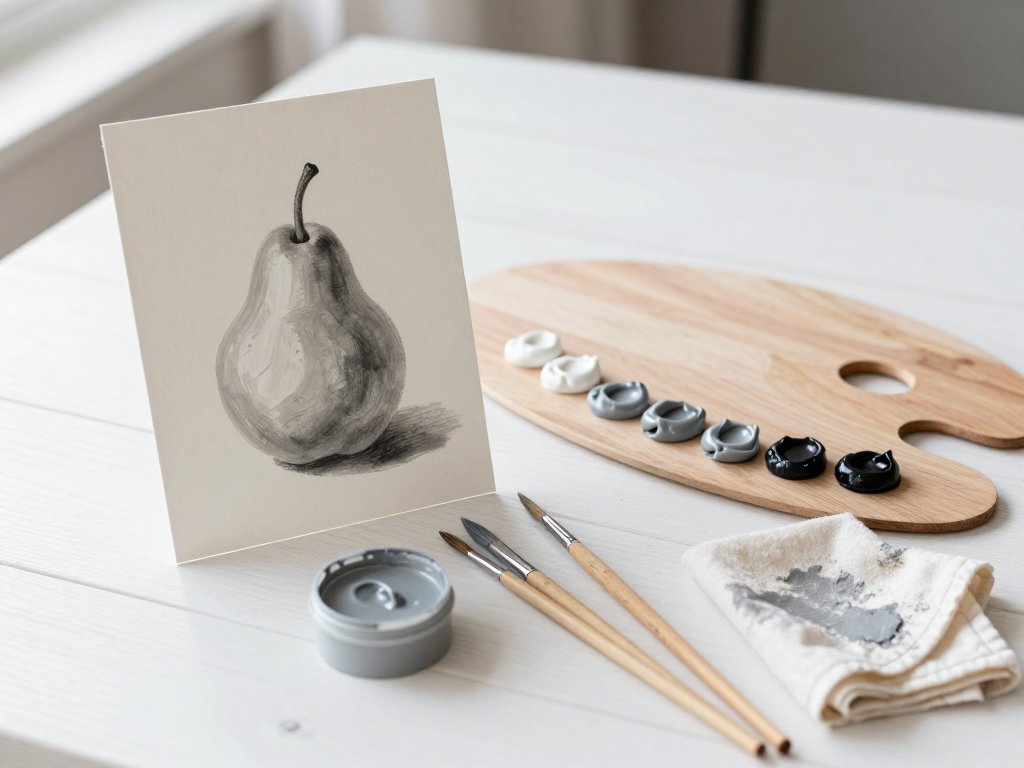
Paper plates are the palette. The cheap uncoated kind, one per guest, with the paint squeezed around the rim and the middle left clear for mixing.
Water cups: one per two guests, filled halfway. Plastic cups are fine, and short wide ones tip over less than tall ones.
Paper towels, a full roll per three guests. They are for wiping brushes, dabbing mistakes, and drying hands, in that order of importance.
Put a folded paper towel under each water cup. It catches the drips that would otherwise run across the tablecloth and onto someone's sleeve.
Aprons and easels
Aprons or old shirts, one per guest. Ask around before you buy; most families have a stack of oversized t-shirts that have already been through their best years.
Easels are optional. A propped board works just as well: lean the canvas against a stack of books, a plastic bin, or the back of a chair.
What matters is the angle. A canvas tilted toward the painter at about twenty degrees is easier to reach than one lying flat on the table.
If you do buy table easels, the small folding wire ones are usually five to eight dollars and fold into a drawer afterward.
What to Paint: One Sunset That Always Works
Pick one design and commit. A room full of beginners painting the same thing together feels like an event. A room full of people painting different things feels like a test.
The design that never fails is a layered sunset over water. It is built from horizontal bands, so nobody has to draw a shape correctly.
Every step is a colour decision, not a drawing decision. That is the entire reason it works for people who say they cannot draw.
Do not offer a second option halfway through the night. Choices are lovely in theory and paralyzing in practice.
Paint your own version while you demo, on the same size canvas, so guests can see what "finished" looks like from where they sit.
The Paint-Along in Six Steps
These are the steps you call out, one at a time. Wait until most of the room has caught up before moving on, and say the step number out loud so people can rejoin if they drifted.
- Sky wash. Load the flat brush with yellow and sweep it across the top third of the canvas, side to side. Keep the strokes horizontal and stop before the middle.
- Orange band. Without rinsing, pick up a little red and paint a band directly under the yellow. Where the two meet, drag the brush sideways so the edge softens instead of turning into a stripe.
- The horizon. Mix blue with a touch of burnt sienna and paint one straight horizontal line across the middle of the canvas. One confident stroke, not five nervous ones.
- Water. Pull the sky colours straight down from the horizon in short vertical strokes. Add a little blue as you go down so the water gets darker toward the bottom edge.
- Sun and reflection. Paint a circle of pale yellow near the horizon, then press horizontal dashes of the same colour below it. Dashes, not a solid column.
- Foreground. Mix the darkest colour on your plate and paint a narrow strip along the bottom edge. Let it be uneven. A wobbly shoreline reads as a shoreline.
That is the whole painting. Six steps, about ninety minutes with drying time between the sky and the water.
If someone finishes early, give them a smaller brush and let them add a few birds or a thin dark branch. Small additions keep busy hands out of wet paint.
The Timeline for the Evening
A paint night has a shape, and the shape is roughly two and a half hours. Here is the schedule I use, written as clock times for a seven o'clock start.
- 6:30 p.m. — setup. Table covered, easels set, plates loaded, water poured, aprons folded at each place. Thirty minutes, and it is enough if you laid supplies out the night before.
- 7:00 p.m. — arrival. Drinks, snacks, and ten minutes of everyone insisting they are not artistic.
- 7:15 p.m. — demo. Fifteen minutes at the head of the table. Paint the whole thing quickly and badly on purpose so nobody expects precision.
- 7:30 p.m. — painting. Ninety minutes, step by step, with a five-minute stretch break around the halfway point.
- 9:00 p.m. — drying and photos. Twenty minutes. Canvases go flat on the floor or a counter, and everyone takes the photo that makes the evening look effortless.
Two rules keep the timeline honest. Do not start the demo late for a straggler, and do not let the painting segment run past ninety minutes.
Beginners fatigue around the ninety-minute mark. The last twenty minutes of fussing is where paintings get overworked and guests get discouraged.
Announce the drying time as a feature, not a cutoff. "We stop at nine so nothing smears on the way home" sounds like care, because it is.
How to Teach Without Hovering
You are not teaching a class. You are calling out steps and keeping an eye on the room, which is a much smaller job.
Hovering is the fastest way to make an adult feel like a child. Stand back, answer questions, and only step in when someone asks or when a canvas is about to be ruined by panic.
Three phrases do most of the work.
"Nothing looks right at this stage. Keep going." Say it early, before the first wobble. It gives people permission to be in the ugly middle.
"That's a value problem, not a talent problem." Value just means light versus dark. If a painting looks flat, the fix is usually a darker dark or a lighter light, not more skill.
"Let's fix one thing." When someone is spiraling, name the single change that will help most. One thing. Not a list, not a critique.
Then show, do not take over. Load a brush, hand it to them, and point at the spot. The painting has to stay theirs or the evening stops being fun.
Watch for the guest who has gone quiet and is painting the same corner over and over. That is the signal for the second phrase, delivered lightly, with a hand on the chair back.
And praise specifically. "Your horizon line is straight and your water got darker at the bottom" lands better than "that's so good."
Drinks and Snacks That Won't Ruin the Table
Keep drinks non-alcoholic or low-key, and keep them stemless. A wine glass with a stem is a tipped glass waiting to happen next to a water cup.
Good options: sparkling water with orange slices, a pitcher of iced tea, a non-alcoholic sangria with grape juice and cut fruit, or plain lemonade in a jug.
Serve in short stemless glasses or mason jars, and set them on the side table, not at the easels. Guests will walk three steps for a drink. They will not walk three steps to save a canvas.
Food should be one-bite and low-mess. Cheese cubes, grapes, pretzel rods, crackers, and cut vegetables all behave.
Skip anything orange or powdery. Cheese puffs and flavoured chips leave residue on fingers that goes straight onto a pale sky.
Put snacks on the far side of the side table, behind the drinks, so people turn away from the paintings to eat.
Keep a damp cloth and a small trash bowl on that table too. It gives people somewhere to put a sticky napkin other than your tablecloth.
If you do serve wine, serve it white or rosé, in stemless glasses, poured away from the table. Red wine and a wet white sky are a bad combination.
The Budget Math, Per Guest
Here is a realistic per-person breakdown for a six-guest night, using mid-range prices and supplies you can buy at any craft store.
- Canvas panel, 11x14: about $2.00.
- Paint share: about $1.50 per person when six people split a starter set of six tubes.
- Brushes: about $0.75 per person from a twenty-pack.
- Paper plate palette and paper towels: about $0.40.
- Water cup: about $0.15, or free if you use what you have.
- Apron: free if borrowed, about $1.50 if you buy inexpensive ones.
- Snacks and drinks: about $4.00 per person for a simple spread.
That lands near ten dollars per guest, or twelve with purchased aprons. Six guests, roughly sixty to seventy-five dollars total.
Table easels add five to eight dollars each if you buy them, but they are a one-time cost you reuse every month.
Compare that with a studio paint and sip, which usually runs thirty-five to fifty-five dollars per person before drinks. The home version is not a compromise; it is the same evening for a fifth of the price.
One honest note: the first night costs more than the second. Brushes, aprons, and easels carry over, so the repeat cost drops to canvas, paint, and snacks.
Cleanup in the Right Order
Cleanup goes quickly if you do it in the right sequence. Do it in the wrong sequence and you will be scrubbing dried acrylic at eleven o'clock.
- Brushes first. Gather every brush into one cup of warm water and swish them. Acrylic dries hard in the ferrule and ruins a brush permanently.
- Plates and palettes second. Wipe each paper plate with a paper towel before it goes in the trash, so the bag does not leak.
- Water cups third. Pour them down the sink and rinse. Do not dump paint solids into the drain in volume.
- The table fourth. Roll the plastic cloth inward, trapping crumbs and dried paint flecks inside, then wipe the table underneath.
- Canvases fifth. Lay them flat, face up, somewhere nothing will touch them for twenty-four hours.
- The floor last. A damp paper towel takes up the few flecks that always land near the easels.
Brushes get one more wash after the guests leave. Work a drop of dish soap into the bristles, rinse until the water runs clear, and dry them flat.
Keep a small "paint night" box with the aprons, easels, and brush roll. Next month's setup becomes ten minutes instead of thirty.
Make It a Monthly Thing
The first night is the hard one. After that, the box is packed, the table covering is folded, and the only decision is which Friday.
Pick the date before people leave. "Same time next month?" asked while everyone is holding a wet canvas gets a yes far more often than a group text two weeks later.
Change one thing each time. A different sunset palette in October, birch trunks in January, a bowl of lemons to paint in June. One change keeps it fresh without turning it into a project.
Rotate houses if you can. Hosting every month is a lot; hosting every third month is a rhythm.
And keep the paintings. Hang them in a hallway together, unevenly, and let the wall look like a group of people who had a good time rather than a group of people who can paint.
That is the real point of a paint and sip night at home. Not the canvas. The two hours where nobody was needed by anyone and everyone made something with their hands.
Set the date. Buy the panels. The rest is a plate, a cup, and one good sunset.