Introduction
I bought twelve 16 × 20 stretched canvases in one bulk order because the per-canvas price looked unbeatable. I had a whole series planned, and I felt genuinely smug about that purchase for about one week. It felt responsible.
By the third painting, the corners were dimpling badly. The surface bounced under my brush like a trampoline, and every thick stroke left a soft dent that never fully came back. I was fighting the canvas instead of painting on it.
I finished six, abandoned four, and replaced the rest with rigid panels. That stack cost me twice: once at checkout, and again in wasted paint, wasted evenings, and do-overs I would rather forget. That is the part nobody photographs.
This is the article I wish I had read before that order. Not which brand is cheapest, because another guide covers that, but which kind of surface fits the way you actually paint. Fit beats price every time.
The One Difference That Explains Everything
A stretched canvas is fabric held under tension on a wooden frame. A panel is a rigid board. That is the entire distinction, and nearly every practical difference between them follows from it, from texture to cost to how the work handles.
Fabric under tension behaves like a drum head. It flexes when you press, it moves with the weather, and it develops soft spots where the weave has stretched. A board does none of those things. It is a physical relationship.
That one property decides texture, absorbency, warping, weight, longevity, and your effective cost per painting. Once you see tension versus rigidity, the rest of the comparison stops being mysterious. Your habits are the deciding factor.
Neither surface is the correct one. A canvas is not a cheap panel, and a panel is not an upgraded canvas. They are different tools that reward different kinds of brushwork. Choose for your hand, not the sale bin.
Canvas: Fabric, Primer, and Profile
Most beginner canvas is cotton duck, a plain-weave fabric sold by weight per square yard. Seven-ounce duck feels light and springy, while ten- or twelve-ounce duck is denser, less see-through, and much harder to dent with a brush handle. Weight is the first thing to check on the label.
Linen uses longer fibers, so it is stronger and resists rot better over decades, but it costs two to three times as much as cotton. It also reacts faster to humidity, which matters in a bedroom studio that swings between damp air and forced heat.
Pre-primed canvas carries two or three coats of acrylic gesso, adding about an ounce and a half per square yard. Cheap canvas skimps here, and thin paint reveals the weave shadow. A double-primed ten-ounce duck is the sensible middle ground for a first serious body of work.
Stretcher bars come in standard ¾-inch depth or gallery profile at 1½ inches and deeper. Standard bars are built for frames; a gallery wrap carries paint around the sides and can hang bare. Deeper bars resist bowing, and anything over 30 inches should have a center brace.
Canvas: Tension, Humidity, and Dents
Tension is the whole game. A properly stretched canvas feels firm and gives a clean, high note when you tap it. Slack canvas swallows your pressure, dulls every edge, and makes a loaded brush feel like it is painting through a blanket. A dull thud means trouble.
Canvas pliers grip the fabric and pull it evenly around the bar during stretching. Wooden keys are small wedges tapped into slots at the inside corners; driving them deeper spreads the frame and tightens the weave. Both are cheap and worth owning.
Humidity changes tension constantly. Damp summer air swells the cotton fibers and the canvas goes slack, while dry winter heat shrinks them until the bars creak and the corners pull tight. A canvas can change personality overnight.
A shallow dent often lifts if you mist the back with clean water and let it dry overnight, because cotton shrinks as it dries and pulls the weave taut. Sharp creases or stretched-out corners usually need the canvas removed and re-stretched with pliers. Mist lightly rather than soaking it.
Panels: Birch, Hardboard, and MDF
Birch plywood is the standard artist panel: light for its thickness, dimensionally stable, and smooth enough for fine work after a few coats of gesso. Look for void-free stock with a clean face, because knots and gaps telegraph through paint. The face matters more than the core.
Hardboard and MDF
Hardboard, often sold as Masonite, is denser and cheaper than plywood. Tempered hardboard has an oiled surface that resists gesso, so scuff it with 120-grit first or the primer will bead and pull away in patches. Scuffing takes two minutes and saves the whole panel.
MDF is smooth, cheap, and heavy, and it swells badly if water reaches an unsealed edge. Seal all six faces before using it with acrylics or mixed media, or the board will grow a fuzzy, raised rim around the sides. Seal the edges with acrylic medium or primer.
Thickness and Support
Panel thickness runs from ⅛ inch to ¾ inch. Thin boards need support, while thick boards get heavy and expensive, which is why most painters settle around ¼ inch mounted over a cradle rather than a solid slab. Ask what the panel is mounted on before buying.
Panels: Cradled, Flat, and Aluminum
A flat panel is a thin board that needs a frame or a backing, because thin boards cup over time. A cradled panel mounts that board on a 1½- to 2-inch wooden frame, which turns a flexible sheet into a rigid box. A flat panel has no built-in spine.
That cradle makes the piece rigid, lighter than solid wood, and finished enough to hang unframed. You can paint the sides, wax them, or leave them raw, and the work reads as a complete object rather than a canvas waiting for molding. The object feels substantial in the hand.
Aluminum Composite and Raw Panel Prep
Aluminum composite panel sandwiches a plastic core between two aluminum skins. It will not warp with humidity, stays light at large sizes, and needs a scuff plus a metal primer before gesso will bond reliably. It is also the least forgiving surface to dent.
Raw panel needs prep, and skipping it is a false economy. Sand with 220-grit, dust off, then build thin gesso coats rather than one thick layer, because thick gesso dries unevenly and cracks. Rushing this stage shows up later in the paint.
- Sand the face and edges with 220-grit until the surface feels even.
- Wipe with a tack cloth, then brush on a thin gesso coat in one direction.
- Let it dry, sand with 320-grit, and repeat for two or three coats.
- Finish with 400-grit and a final tack cloth before painting.
Cost Per Square Inch and the Money Math
A 16 × 20 pre-primed canvas often costs eight to fourteen dollars, roughly four to six cents per square inch. A comparable cradled birch panel runs twelve to twenty, or eight to fourteen cents, so canvas wins the shelf-price comparison almost every time. Canvas is the cheaper experiment, hands down.
Raw hardboard is the bargain at three to six dollars for a small board, but it needs sealing and a cradle if you want it to last. Panel cost also climbs faster with size than canvas does, because thickness and bracing add up. Small boards are the exception.
Sticker price is not cost per painting. A canvas that goes slack, dents, or gets replaced is the most expensive surface in the room, no matter what the tag said. Count the finished pieces you are willing to hang, not the units you carried home.
Panels can be sanded back to gesso and repainted, while failed canvases usually become drop cloths. Buy cheap canvas for studies and panels for anything you intend to keep, sell, or give away, and the budget mostly sorts itself out. That split is the whole strategy.
Texture and Absorbency
Canvas has a weave, and the weave shows. Fine cotton duck leaves a visible grid under thin paint, while heavier duck leaves a pronounced tooth that you either love or sand away after priming. That texture is half the reason people paint on it. Some sand it smooth anyway.
Panels are smooth unless you build texture yourself, which makes them better for sharp edges, fine linework, and any surface where paint must sit exactly where you put it. A smooth board also makes it easier to wipe back a mistake. Smooth is a decision, not a default.
Absorbency differs too. Canvas drinks more primer and paint, so thin washes sink and dull. A well-sealed panel keeps paint on top, so colors read stronger and more saturated, and your expensive tube of blue goes further. Thin paint behaves very differently on each.
Slippery panels have their own problem: paint can slide rather than grip. Sand the final gesso coat lightly, or apply gesso with a roller and leave the peaks, which gives you a canvas-like tooth without the flex underneath. A light scuff is usually enough.
Warping and Longevity
Canvas fails at the edges and corners. Paint films are less flexible than fabric, so a canvas that flexes in transit can develop hairline cracks along the stretcher bars over years, especially where the paint is thickest. Flex is the enemy of a brittle film.
Thin panels fail by bowing. A ⅛-inch board on a 24 × 36 frame will cup if it is not cradled or braced, and no amount of gesso fixes a board that has already moved. Bracing is cheaper than replacing the piece.
Cradled panels and aluminum composite sit at the stable end of the spectrum. Cradled birch can last generations, and oil on panel is how a great deal of museum work from the last five centuries survived intact while canvases were relined. Rigidity is a longevity strategy.
Storage matters as much as material. Stack canvases face-to-face with spacers, stand panels on edge rather than flat, and keep both out of damp basements and hot attics, where humidity and heat do their quiet damage over a single season. Both materials reward a little planning.
Weight, Portability, and Size Limits
A 24 × 36 stretched canvas weighs two or three pounds. The same size cradled panel can weigh six to eight, and that difference matters when you are carrying wet work across a field or up a flight of stairs after class. Your shoulder will notice first.
For plein air painting, canvas wins on portability. It is light, it stacks in a carrier, and a wet canvas can travel face-out in a box without touching anything. Panels are sturdier but heavier, and a loaded carrier gets old by the second mile. That convenience is real.
Panels win on durability in the car. They do not dent, they do not go slack in humid air, and a cradled panel can be set down on its edge without bruising the surface. Canvas needs a box and a little luck. Canvas asks for more care in transit.
Beyond about 36 × 48, panel weight and bracing become a construction project, while a large canvas stays manageable. Under 12 × 12, the reverse is true: a small panel is light enough to toss in a bag and rigid enough to survive the trip. Size changes the answer entirely.
Which Medium Wants Which Surface
Oil on panel is the classic pairing. Rigid support means no flex under a loaded brush, which suits impasto, palette knife work, and any surface you plan to scrape back. The paint film stays where you put it instead of riding a moving fabric.
Cold wax makes rigidity non-negotiable. Wax and oil layers stay soft for weeks, and a soft film on a moving surface will craze and lift. That is why cold wax oil painting is almost always taught on a cradled panel that will not give under a squeegee.
Acrylic, Watercolor, and Mixed Media
Acrylic on canvas makes sense because acrylic forms a flexible film that tolerates small movements. Watercolor belongs on paper, where it can pool and lift as intended; on canvas or panel it fights the surface and dries flat and muddy. Know the rules before you break them.
Mixed media likes panel best. Collage, sanding, masking tape, and plaster all prefer a surface that does not bounce, and a cradle gives you deep edges to work against. Canvas is for work that stays paint and stays light. Cradle depth is a gift for collage.
The Decision Checklist
If you paint thick, scrape, or use cold wax, choose a cradled panel. If you want to hang the piece unframed, choose a cradled panel. If you work large, choose canvas, because the weight and bracing math flips in its favor. Those rules cover most beginners.
If you paint thin acrylic or loose studies, canvas is fine and cheaper. If you travel to paint, canvas is lighter. If you sand, collage, or rework constantly, panel will save your patience and your paint budget. Panel is the patient choice.
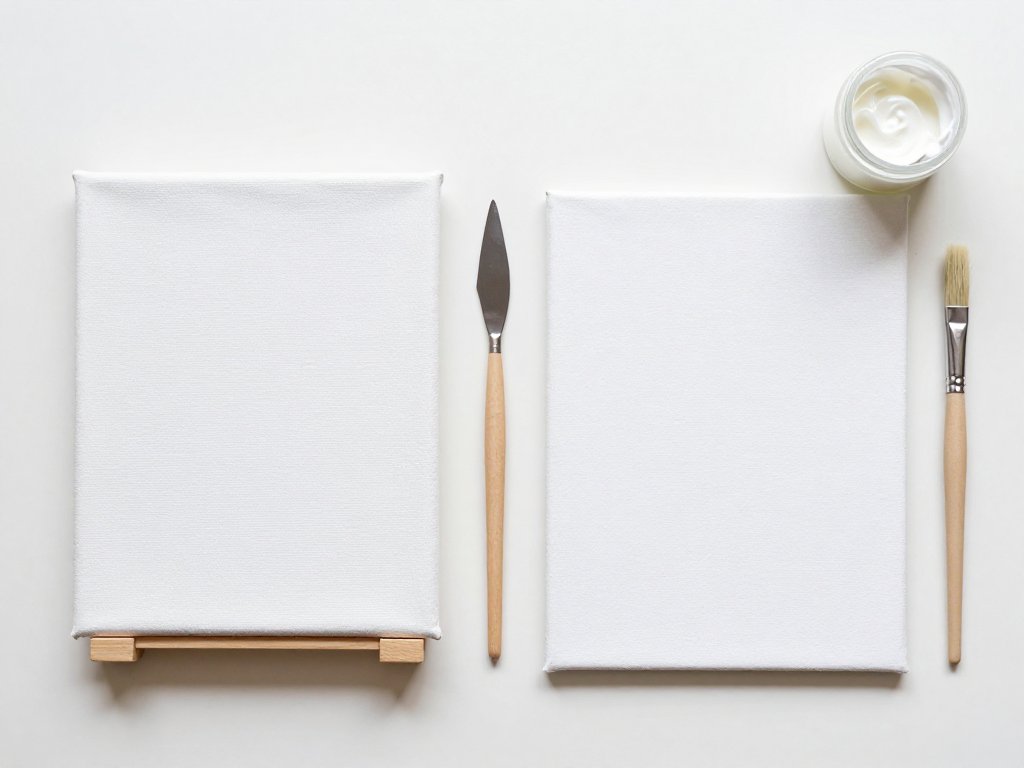
If you are unsure, buy one of each in the same size and paint the same subject twice. The surface that stops distracting you is the one to buy in bulk, and that test costs far less than a wasted series. That test is cheap education.
That stack of canvases taught me a lesson I could have learned for the price of one panel. The right surface is not the cheapest; it is the one you do not fight. Buy for the way you actually paint, not the way you hope to.