Introduction
I bought eleven skeins of clearance yarn for a sweater once. The label said worsted, the pattern said worsted, so I figured I had done my homework. I had not.
Four months later I had a sweater that fit my brother-in-law and stopped one full sleeve short. The yarn cost me $38. The lesson cost me a winter of knitting and a colorway I could never buy again.
That sweater is why I built a system. It is not a clever system. It is four measurements and three multiplications, and it has not failed me since.
This is that system, laid out the way I wish someone had laid it out for me on the afternoon I walked out of that store with eleven bags of "worsted."
The Label Is Not the Whole Story
Start with what the label actually promises. Yarn is sorted into numbered weight categories by the Craft Yarn Council, and almost every band prints that number beside a little skein icon.
Those numbers are the shared language of yarn substitution, so learn them once and they serve you for years:
- 0 — Lace: thread-fine, 8 or more stitches per inch. Shawls, doilies, held-double work.
- 1 — Super fine / fingering: socks and lightweight garments. Roughly 7 to 8 stitches per inch.
- 2 — Fine / sport: baby garments and lighter sweaters. About 6 stitches per inch.
- 3 — Light / DK: the workhorse middle ground. Usually 5.5 stitches per inch.
- 4 — Medium / worsted: the most common sweater weight in North America. About 5 stitches per inch.
- 5 — Bulky: fast, thick, cozy. Roughly 3.5 to 4 stitches per inch.
- 6 — Super bulky: blankets and statement hats. About 2 to 3 stitches per inch.
Here is the trap that got me. Those categories are ranges, not fixed points. Two yarns can both sit in category 4 and still knit two whole stitches apart per four inches.
That sounds harmless in a sentence. Hold the thought, because we are about to watch it turn into inches across a real chest measurement.
So how do you check a yarn that has no label at all? You measure wraps per inch, usually shortened to WPI, and it costs you nothing but a ruler and five minutes.
Measuring Wraps Per Inch at Home
- Hold a ruler upright and let about six inches of yarn hang free.
- Wrap the yarn around the ruler, snug but never stretched, each wrap touching the one before it.
- Wrap until you have covered exactly one inch of the ruler's markings.
- Count the wraps that fall inside that inch, counting the first wrap as one.
- Repeat twice more and average the counts, because tension genuinely varies between mornings.
Roughly: 8 to 10 wraps reads as light worsted, 11 to 13 is worsted, 14 to 16 is sport, 17 to 20 is fingering, and 21 or more is lace. Below 8 and you are in bulky territory.
Sharp-eyed readers will notice something already. A fuzzy single-ply and a tight four-ply can measure the same WPI and still behave completely differently, because wraps measure diameter, not behaviour. We will come back to that.
The Gauge Math That Saves a Sweater
Gauge is simply how many stitches and rows you get inside a measured square. Ball bands print it as something like "20 stitches and 26 rows = 4 inches (10 cm)."
That number is not a suggestion. It is the currency the whole pattern was written in. Change the currency and every stitch count in the pattern stops meaning what the designer intended.
Here is the one formula worth memorising. New stitch count = (pattern gauge ÷ your gauge) × pattern stitch count.
Stitch gauge controls width. Row gauge controls length. Width is the thing that decides whether a garment fits a human body, which is why stitch gauge matters far more.
Row gauge is the forgiving one. If your rows run long, you simply work fewer of them until the piece measures right. You cannot fudge width that way.
A Worked Example With Real Numbers
Say the pattern wants 20 stitches per 4 inches and tells you to cast on 200 stitches. That is 200 ÷ (20/4), which gives a finished chest of 40 inches.
Now suppose your substitute yarn gauges at 22 stitches per 4 inches on the same needles in the same hands. That is two extra stitches per four inches.
Knit the pattern exactly as written and you get 200 ÷ (22/4), which is 36.4 inches. You have just made a sweater three and a half inches narrower than the schematic promised.
Run it the other direction. A substitute at 18 stitches per 4 inches gives 200 ÷ (18/4), or 44.4 inches — a sweater four inches wider, which is a size and a half in most pattern ranges.
Both of those disasters came from a yarn that was, technically and legally, labelled worsted.
To fix it honestly, convert the pattern to your gauge. If the schematic wants a 40-inch chest and you knit 22 stitches per 4 inches, your cast-on becomes (20 ÷ 22) × 200, which is 182 stitches.
That single adjustment rescued my second sweater. What it did not rescue was the sleeve, because I ran out of yarn — which is the next problem entirely.
When You Can Just Change Needle Size
Sometimes you can skip the arithmetic completely. If your substitute gauges slightly tighter than the pattern calls for, go up one needle size and measure again. Too loose, go down one.
This works beautifully for scarves, cowls, blankets, dishcloths, and anything where the finished measurement is flexible. Nobody returns a scarf because it came out half an inch narrower.
It is a bad idea for fitted garments, and here is the mechanism. Changing needle size alters stitch gauge and row gauge at different rates, so you may match width and quietly wreck length.
It also changes the fabric itself. Going up two needle sizes to hit a gauge number gives you a looser, drapier, more open cloth, which is not what a dense cabled cardigan wants.
My rule after years of getting this wrong: adjust needles for accessories, adjust the pattern math for garments. And never do both at once, or you will never know which change caused the problem.
Yardage and Meterage Math
Now the part that left me one sleeve short. Skein count is a terrible way to compare yarns, because skeins arrive in wildly different sizes from one brand to the next.
One company sells a 50-gram ball holding 110 yards. Another sells a 100-gram skein holding 197 yards. Buy "the same number of skeins" and you can be hundreds of yards apart.
Always compare total yardage or total meterage instead. The conversion is simple: yards × 0.9144 = meters, and meters × 1.0936 = yards.
If a label only lists grams, look the yarn up on the manufacturer's site or a yarn database. Yardage per gram swings too widely between fibers to guess at it.
How Much Buffer to Add
Once you know the pattern's stated total yardage, add a buffer before you buy anything:
- 10% for plain stockinette or garter garments. Covers small gauge drift and a body knit slightly longer than planned.
- 15% for cables and heavy texture. Cabled stitches pull yarn sideways and consume more of it than flat knitting.
- 20 to 25% for stranded colourwork. Carried floats on the wrong side are real yarn that never shows on the front.
Cables are yarn-hungry because a cable is a folded column of stitches. Swapping two stitches over two others uses more length than knitting them straight, and the fabric pulls in narrower, so you knit more of them.
Textured patterns like bobbles, nupps, and popcorn eat yarn for the same reason. Every bobble is a small cluster of extra stitches stuffed into a single space.
Tie this to money and it stops feeling abstract. At $12 a skein, a 15% buffer on a 1,200-yard sweater is one extra skein. One extra skein is cheaper than hunting down a matching dye lot later.
Fiber Blends and Behaviour
Weight and yardage get you the right size. Fiber gets you the right object. A cotton sweater and a wool sweater at identical gauge are still two very different garments.
Wool to acrylic. Acrylic does not bloom the way wool does, so lace and cables look flatter. It also has no blocking memory, meaning you cannot steam a shape into it.
Cotton to wool. Cotton is heavier, has almost no stretch, and grows with wear. A cotton sweater that fits at cast-off can hang past your hips by spring.
Superwash versus non-superwash wool. Superwash is treated so it will not felt, which makes it machine-washable. The trade is that it stretches more and knits slicker.
Acrylic for cotton. Usually fine for blankets and bags, but a poor swap for anything that must hold its shape against gravity, like a dishcloth or summer top.
Bamboo and silk blends. These bring drape and shine. Lovely for shawls and lightweight tops, hopeless for structured jackets because they hang rather than hold.
For a beginner, the safest swaps stay within one fiber family and one weight category. Wool for wool, acrylic for acrylic, cotton for cotton. Change one variable, not two.
If you must cross fibers, go from a heavier memory fiber toward a lighter one, not the reverse. Replacing wool with cotton in a fitted garment rarely ends well.
Substitution Traps
Dye lot. Every band is stamped with a dye lot number, and two lots of the same colorway can differ visibly side by side. Buy everything for a project in one order when you can.
If you are one skein short, alternate skeins every two rows across the entire body. That blends the difference instead of leaving a hard stripe at the sleeve.
Ply and structure. A fluffy single-ply and a tight four-ply can measure the same wraps per inch and knit into completely different fabrics. Single-ply is soft and pilly. Tight ply is crisp.
Twist. Higher twist gives you sharp stitch definition, which is why cables and lace look best in firmly twisted wool. A soft, low-twist yarn blurs those same cables into mush.
Lace and cables. Both read as texture, and texture is fragile. If a substitute is fuzzier or less twisted than the original yarn, your beautiful pattern is the thing that vanishes.
None of these are reasons to avoid yarn substitution. They are reasons to swatch, which is exactly the step I skipped on that clearance sweater.
Test It Before You Commit
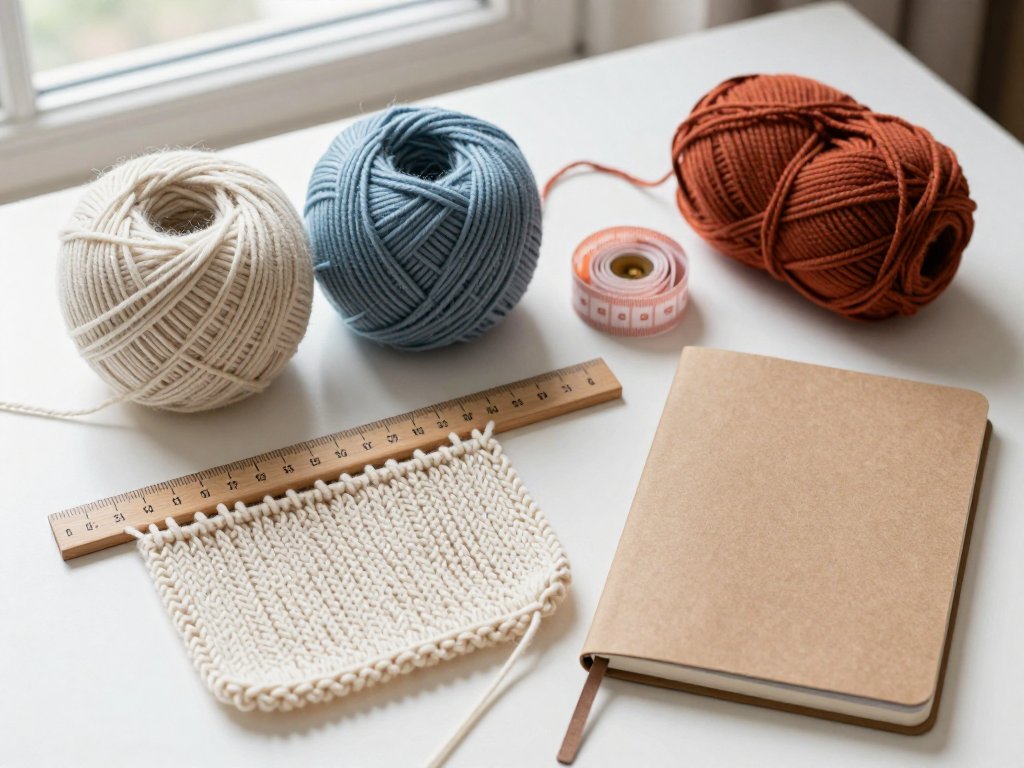
The gauge swatch is the cheapest insurance in knitting. One evening of work protects a month of knitting and the full cost of the yarn.
- Knit a swatch at least 6 inches square in the pattern stitch, not just stockinette.
- Cast off loosely and let the swatch rest for an hour.
- Wash it exactly the way you plan to wash the finished piece.
- Lay it flat and let it dry completely, because gauge changes most while wet.
- Measure three separate spots at least an inch in from the edges, then average them.
- Compare against the pattern gauge and decide: needles, math, or a different yarn.
Washing matters more than beginners expect. Wool relaxes and blooms, cotton grows, acrylic barely moves at all. A swatch measured dry tells you almost nothing about the sweater you will wear.
The cross-reference fits naturally here — if you want to see how much swatching changes a small fitted project, Sock Knitting for Beginners walks through the whole process step by step.
Stash Busting and Budget Substitutions
Half of yarn substitution is not shopping at all. Your stash already holds yarns with real gauges, and the labels are usually still tucked in the bin.
Measure wraps per inch on anything unlabelled, then swatch it. A mystery ball that hits gauge is worth more to you than a perfect match you still have to buy.
Holding Two Strands to Fake a Heavier Weight
Two strands of the same weight behave roughly like one weight category heavier. Fingering held double lands close to worsted, though not exactly, so always swatch before committing.
For a physical estimate, doubling halves the effective stitch count. If your fingering knits at 28 stitches per 4 inches, two strands held together land near 14, which is the light-worsted neighbourhood.
That is how I emptied three orphan balls of sock yarn into a very serviceable hat, at a cost of zero dollars and one evening of swatching.
Before you start anything from stash, estimate honestly. Total pattern yardage plus your buffer has to be smaller than what you own, or you will be hunting a discontinued colorway at midnight.
Substituting When You Sell or Gift
If money changes hands, the stakes change with it. Consistent gauge across a batch matters far more than any single measurement on any single item.
For batch production, buy all the yarn at once from one dye lot, and work every piece on the same set of needles. One swatch defines the gauge for the whole run.
Quote materials from the pattern's stated yardage plus your buffer, not from what you happened to use this time. Price from a lucky partial skein and you will lose money on the next order.
And never promise a color you cannot rebuy. If a customer falls for a limited colorway, say so honestly and photograph the finished piece before it leaves your hands.
Gifting works the same way, minus the invoice. A gift with a spare skein tucked into the bag is a gift that can be repaired later, and that is worth more than the skein cost.
Conclusion
That clearance sweater is still in my closet. I finished the second sleeve from a different dye lot, and there is a visible band around the cuff if you go looking for it.
I keep it because it works. Not because it fits, but because every time I reach past it, I remember to measure before I buy.
Yarn substitution is not risky. Substitution without information is risky. Weight category, gauge, yardage, fiber — check those four things and you have done more homework than I did that day.
So measure wraps per inch on the yarn sitting in your stash tonight. Swatch for one evening, wash it, measure it, and write the numbers in a notebook. Next time the clearance bin calls your name, you will know whether to answer.