Introduction
There was a tin in my grandmother's pantry that I was not allowed to touch. It sat on the shelf above the flour bin, unlabelled and dusty, and inside it was a fine grey powder she called milk paint.
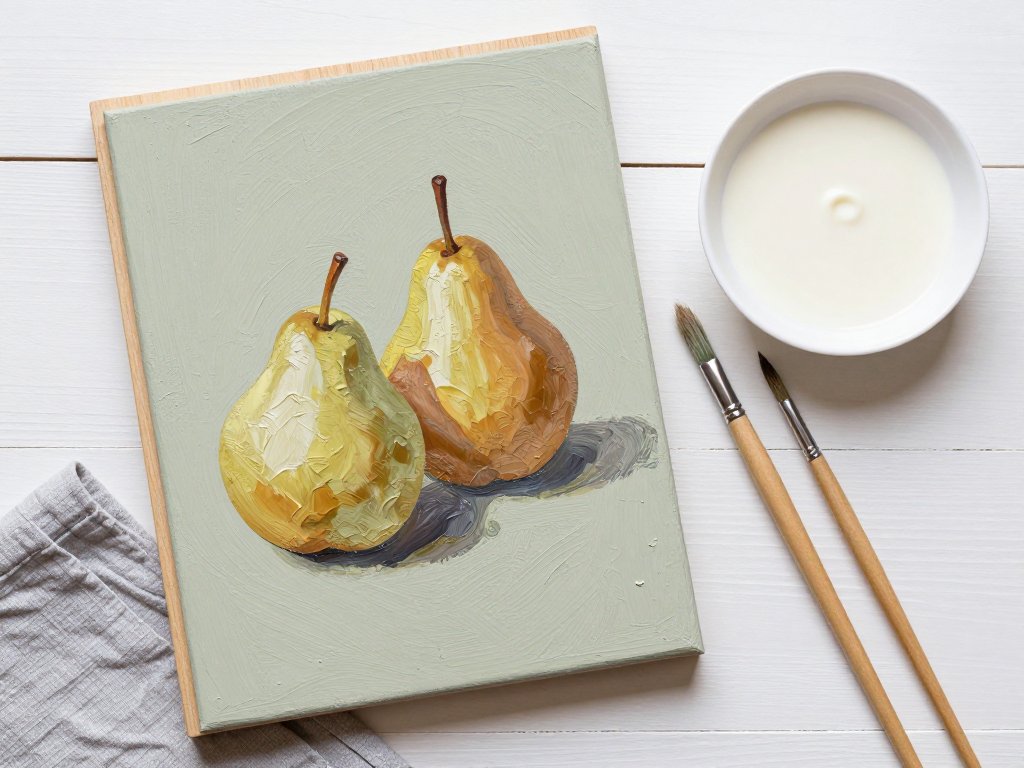
She used it on small things. A wooden breadboard. The back of a kitchen chair. A little panel, not much bigger than a postcard, with three pears on it, which hung by the door to the garden for as long as I can remember.
I thought she was being poetic. Milk, I reasoned, was for tea and porridge. It was not for painting, and it certainly was not for making a surface look like soft chalk.
She was not being poetic. She was being accurate. Casein, the protein in milk, has bound pigment for centuries, and it is still one of the calmest, most forgiving materials a beginner can pick up.
This is a guide to using it. What it is, how the chemistry works in a kitchen saucepan, how it differs from the milk paint sold for furniture, what to buy, how to mix it, and a first small still life of your own.
There is nothing fast about it. That is rather the point.
What Casein Paint Actually Is
Casein paint is pigment held together by a binder made from milk protein. No oil, no acrylic resin, no gum arabic. Just casein, a little alkali to keep it fluid, water, and colour.
The protein is the whole trick. Casein is a long-chain molecule that, once dry, locks together into a hard, lean film. It grips a porous surface and stays put.
Artist casein comes in two forms. Tubes of ready-made paint, which behave much like a thick, fast-drying gouache, and powder that you mix yourself with water.
Both are real paint. The difference is convenience. Tubes cost more and save you the mixing; powder costs less, keeps for years, and gives you control over consistency.
When people say casein, they usually mean the artist material: a pigmented, creamy paint with enough binder to build a proper film. Hold that thought, because it matters in a moment.
The finish is the giveaway. Casein dries to a soft, chalky matte, the kind of surface that swallows light rather than bouncing it back at you. There is nothing glossy about it until you varnish.
The Chemistry, in Kitchen Language
You can make the binder yourself in a saucepan, and understanding how is the fastest way to understand the paint.
Start with milk. Leave it out overnight, or warm it gently and stir in a spoonful of vinegar or lemon juice. The milk separates into white curds and a thin yellowish liquid: whey.
The curds are the casein. The whey is mostly water, sugar, and the whey proteins you do not want. Strain the curds through muslin and you have a soft, rubbery mass.
Now wash it. Rinse the curd in clean water two or three times, squeezing gently between rinses. This removes lactose and leftover acid, which would otherwise make the finished paint sour or brittle.
What you have now is clean, acid-curdled casein. It will not dissolve in water on its own. The protein has curled up and gone stubborn.
So you slake it. Add a small amount of an alkali — borax, a little ammonia, or slaked lime — and the curd loosens, softens, and turns into a smooth, gluey liquid.
That liquid is the binder. Grind pigment into it on a glass slab with a palette knife or a muller and you have paint. Commercial casein does this in a factory, but the principle is identical.
The choice of alkali matters. Borax gives a smooth, workable paint with a generous open time. Lime gives a harder, more water-resistant film but can be gritty and quick-setting.
A Short History
Casein is old. Egyptian and Roman craftsmen used milk-based binders, and medieval painters knew casein as a sturdy alternative to egg and hide glue.
For most of its history it was a workhorse material rather than a glamorous one. It sized panels, glued wood, primed walls, and bound pigment for quick, practical decoration.
Its modern revival came with the muralists. In the 1920s and 1930s, painters working on large public walls needed something that dried fast, stayed matte, and did not glare under gallery lights.
Casein gave them that. It could be laid thinly over huge areas, it dried within minutes, and it held up outdoors far better than most water-based paints of its day.
It also appealed to the purse. Casein was cheap, water-based, and made from a material every household already had. Through the Depression years it became a serious artist's medium in America.
Conservators like it for quieter reasons. A cured casein film is lean — almost no oil to yellow, wrinkle, or darken over time — and it stays relatively flat and stable for decades.
It also responds well to careful cleaning and does not bloom the way some resin films do. When a casein panel is damaged, the repair is usually straightforward and local.
That is why you still find casein in conservation studios, on murals that are nearly a century old, and in the hands of painters who want a matte surface that will not shift on them.
Casein, Milk Paint, and the Obvious Question
This is the part that confuses almost everyone, so let us be very clear about it.
Walk into a hardware or furniture-finishing shop and you will find bags labelled milk paint. That is a different animal. It is usually a powder, mixed with water, and sold for painting dressers and cupboards.
Decorative milk paint is thin. It carries less binder, often with chalk, clay, or lime added as filler, and it is designed to soak into bare, porous wood and dry to a dusty, faded finish.
It is lovely on a chair. It is a poor artist's paint. The film is weak, it can flake off a sealed panel, and it lacks the body to hold a brush mark or layer cleanly.
Artist casein is a pigmented paint with a strong film. The binder-to-pigment ratio is higher, the colour load is heavier, and it is made to be brushed, layered, and worked over.
If it comes in a tube beside the oils and the gouache, it is artist casein. If it comes in a bag with instructions about sanding between coats, it is furniture paint. Simple as that.
And what of egg tempera? Both are lean, water-based, matte, and old, but casein is more flexible, more water-resistant once cured, and asks nothing of you in the way of yolk handling.
That is the only comparison you need here. The two are cousins, not twins, and you can happily learn one without ever touching the other.
Supplies for Your First Panel
You do not need much, and most of it is probably already in the house. Here is the honest list.
- Casein paint. Either tubes of ready-made artist casein or a jar of casein powder. Tubes are kinder for a first attempt.
- Distilled water. A gallon costs less than a coffee and solves half the problems beginners blame on themselves.
- A rigid panel. Sealed hardboard, birch plywood, or a gessoed panel, six by eight inches or so. Casein wants a support that will not flex.
- Brushes. Two or three soft synthetics for smooth passages, and one or two hog bristle filberts if you want visible brush marks.
- A palette with wells. A ceramic dish, an enamel butcher's tray, or a muffin tin. Wells keep mixed colours from running into each other.
- A spray bottle. For misting the palette. Casein skins over quickly in dry indoor air.
- A palette knife, a jar, and a rag. For mixing, rinsing, and wiping between passages.
Two notes on the panel. Casein is a brittle film, so stretched canvas is the wrong choice; the weave flexes and the paint cracks along it.
And seal your panel properly. Raw hardboard drinks water and swells. A coat of shellac or acrylic gesso gives the paint something stable to sit on.
Mixing: Ratios, Consistency, and Water
If you are using tubes, you are mostly thinning. If you are using powder, you are making paint, and the ratio is where beginners get into trouble.
Start with one part casein powder to one and a half parts distilled water, by volume. Stir into a paste, then add water a few drops at a time until it loosens.
Let it sit for ten or fifteen minutes. Casein powder needs time to hydrate, and a mix that looks lumpy at first often smooths out on its own.
Stir again, and add pigment if your powder is uncoloured. A little pigment goes a long way; add it in pinches, not spoonfuls, and keep a note of what you used.
Now the consistency test. Lift a brush and let the paint fall back into the well. It should ribbon like heavy cream and settle in a soft mound that slowly flattens.
That is your working cream. For a glaze or a thin wash, add water until it runs off the brush like thin milk, coating the bristles but not clinging to them.
Cream to thin milk. Those two consistencies will carry you through almost the whole painting, and you will learn to feel them within an hour.
Mix only what you can use in one sitting. Casein is a milk product; a wet puddle left overnight grows a skin, then a smell, then a small science experiment.
If you must keep a mix, cover it and refrigerate it, and use it within two or three days. Anything older goes down the sink.
Use distilled water, not tap. Hard water carries calcium and magnesium that interfere with the binder, and the paint turns gritty, streaky, or simply refuses to smooth out.
The same problem shows up in the rinse jar. If your brushes feel stiff and squeaky after washing, your tap water is likely the culprit.
How Casein Behaves on the Brush
Casein has a personality, and it is a fairly opinionated one. Knowing its habits before you start saves a lot of quiet swearing.
First, it dries fast. Genuinely fast — a thin layer can be touch-dry in two or three minutes, and a fatter one in ten. You will not be blending wet-into-wet for long.
Second, it dries matte and chalky. The surface drinks light. That is beautiful for soft, quiet pictures and frustrating if you were hoping for depth and glow straight from the tube.
Third, it lifts. Go over a half-dry passage with a loaded brush and you will pull the layer underneath back up into your new colour. That is not a flaw; it is how the medium works.
The answer is patience. Let a layer dry fully, then lay the next one down in a single confident pass rather than scrubbing at it.
Fourth, it rewards thin layers. Casein is lean and slightly brittle, and thick impasto will crack as it cures. Build in washes and thin creams instead of mounds.
Fifth, it changes colour as it dries. Every casein painter learns this the hard way: the wet paint looks richer and darker, and it lightens by roughly a shade as the water leaves.
So paint your darks a little darker and your colours a little stronger than seems right. The drying will meet you halfway.
And once cured — usually a few days — casein becomes largely water-resistant. That is a gift at the end and a nuisance in the middle, because a dried passage will not rewet the way gouache does.
A First Project: Three Pears on a Small Panel
Here is a first painting that will teach you nearly everything the medium does. Three pears, a small panel, one afternoon and one evening.
Choose pears with some shape to them — one upright, one tipped on its side, one set slightly behind. Sit them on a plain cloth near a window, and turn off the overhead light.
Set your panel at a slight angle rather than flat. Casein settles and pools on a level surface, and a tilt lets you see the sheen that tells you a layer is still wet.
- Tone the ground. Mix yellow ochre with a touch of raw umber and thin it to thin milk. Brush it over the whole panel and let it dry. This warm middle tone kills the glare of white and gives every later colour something to sit against.
- Block in the shapes. With burnt sienna at cream consistency, draw the three pears as simple ovals plus a suggestion of cloth fold. Keep your arm loose and your brush almost dry.
- Establish the darks. Mix burnt umber with a little viridian for the shadowed sides and the cast shadows. Lay these in thinly, once, and leave them alone. Do not fuss.
- Mix your greens. Yellow ochre plus a touch of viridian gives a soft sage; add white for the lit side. Keep two or three separate puddles rather than one average green.
- Lay the mid-tones. Fill the pears with your sage mixtures, following the form. One pass, thin paint, no scrubbing. Let it dry before you go anywhere near it again.
- Refine the shadows. Glaze a thin wash of the umber mixture into the core shadows and under each pear. This is where the fruit starts to sit on the table instead of floating above it.
- Dry-brush the highlights. Load a hog brush with a pale ochre-white, wipe most of it off on the rag, and drag it lightly across the lit shoulder of each pear. The dry bristles catch the texture of the panel.
- Add the stems and the cloth. A few quick dark strokes for stems, a grey wash for the cloth, and then stop. Resist the urge to keep going.
The whole painting should take two or three hours of actual work, split across a couple of sittings so the layers can dry in between.
If it looks chalky and flat when you finish, good. That is exactly what unvarnished casein looks like, and the next section fixes it.
Finishing: Bringing the Colour Up
Casein out of the tube dries to a matte so flat it can look dusty. The colours are all there, but the surface scatters light and mutes them.
A topcoat does two things. It brings the colour up, sometimes dramatically, and it protects a film that is tougher than it looks but not invincible.
You have two good options: a thin varnish, or wax. Both are applied sparingly, and both are easy to overdo.
For varnish, use a matte or satin artist's varnish; an acrylic varnish works well over fully cured casein. Wait at least a week, and longer over thicker passages.
Apply it with a soft flat brush in one thin coat, working from the top down and keeping a wet edge. Do not go back over a half-set coat; it will drag and cloud.
One coat is often enough for a matte look. A second, applied once the first is touch-dry, deepens the colour slightly and evens out any patchiness.
For wax, use a soft beeswax or a cold wax medium. Rub on the thinnest possible film with a lint-free cloth, wait ten minutes, then buff with a clean cloth.
Wax gives a soft sheen rather than a shine, and it suits casein's quiet temperament. It is also more forgiving than varnish if you are nervous about the whole idea.
Either way, thin. A heavy coat of anything will pool, yellow, or crack, and you will have undone an afternoon's work in about ninety seconds.
When Things Go Wrong
Most casein problems come from four things: too much water, too little patience, the wrong support, or a brush left dirty. Here is how each one shows up.
Chalky streaks across a passage. Usually too much water and not enough binder. The pigment separates and dries dusty. Add a touch more paint or medium to the mix and lay it once, without scrubbing.
Paint lifting when you overbrush. You are working a layer that is neither properly wet nor properly dry. Stop, let it cure, then lay the next passage in one pass with a soft brush.
Cracking along a canvas weave. The support is flexing under a brittle film. Casein belongs on rigid panels. Move to board, or accept the crackle as a look rather than an accident.
A brush ruined by dried casein. Casein sets hard inside the ferrule and resists plain water once cured. Rinse often while painting, wash with soap at the end, and never stand a brush bristle-down in the jar.
Colours dulling as they dry. This is normal, not a mistake. Casein lightens as the water leaves. Paint a shade stronger than you want, and let the varnish bring the depth back at the end.
Paint that smells sour in the palette. You mixed too much and kept it too long. Discard it, wash the wells properly, and mix smaller amounts for the next session.
A gummy, uneven film. Often hard water, sometimes an overloaded brush. Switch to distilled water and thin the paint rather than pushing it around the panel.
A Quiet Closing
My grandmother's tin is long gone. I looked for it after she died and found only the panel with the three pears, still hanging by the door, still faintly chalky under a coat of wax she must have applied decades ago.
The paint has not yellowed. It has not cracked. It looks almost exactly as it did when I was small enough to be told not to touch it.
I mix my own casein now from powder, in a chipped ceramic dish, at the same kitchen table where I used to watch her. It is a slow way to spend an afternoon.
That is what I want to leave you with. Casein will not flatter you, and it will not hurry. It asks for thin layers, dry time, and a light hand.
In exchange it gives you a surface like soft chalk and colour that settles down and stays. Find a small panel, three pears, and an hour when nobody needs you.
Paint thinly. Wait. Let the milk do what it has been doing for centuries.