Introduction
There is a moment every knitter remembers: the first time they hold a ball of truly chunky yarn.
It feels less like string and more like a cloud you could wrap around your shoulders.
The needles are thick as pencils, the stitches are big enough to count at a glance, and a scarf that would take weeks in fingering weight suddenly grows an inch in a single row.
That is the quiet magic of chunky yarn knitting. It trades tiny, patient stitches for bold, generous ones, and it rewards you with a finished project in days instead of months.
If you are a busy mom who has always wanted to knit but worried you could never finish anything, this is the place to start.
You will learn what makes yarn "chunky," how to choose the right one, and how to knit your first scarf — all without complicated patterns or a drawer full of specialty tools.
By the end of this guide, you will have everything you need to cast on tonight and wear your finished scarf by the weekend. Let's begin.
The Long History of Big Yarn
Before we pick up needles, it is worth knowing that thick yarn is nothing new. For centuries, knitters in cold, windswept places chose bulky yarns out of pure necessity.
In the fishing villages of the Aran Islands and along the coasts of Scotland and Ireland, women knitted dense, textured sweaters from heavy wool to protect their men from Atlantic gales.
Those famous Aran patterns — cables, diamonds, honeycomb — were worked in yarn far thicker than the fine wools favored by Victorian fashion.
The Gansey sweaters of Yorkshire and Norfolk tell a similar story. Fishermen's wives knitted hard-wearing jumpers in tightly spun worsted wool, often in thick gauges that could stand up to salt water and hard work. These were working garments, knitted fast because they were needed fast.
In the twentieth century, chunky yarn became a style choice rather than a survival tool. Designers in the 1960s and 1970s embraced bulky knits for their sculptural, modern look, and chunky turtlenecks became a fashion staple.
Then came the early 2010s, when arm knitting — knitting with your forearms instead of needles — went viral online. Suddenly, oversized blankets and cowls made from jumbo yarn were everywhere, and a new generation discovered that bigger yarn means faster results.
Today's chunky knitting is the cheerful heir to all of these traditions. It carries the warmth of the Aran Isles and the modern love of instant gratification, all wrapped up in one gloriously thick strand of wool.
What Counts as Chunky Yarn?
Yarn comes in a standardized range of weights, and "chunky" sits at the thick end of the scale. The Craft Yarn Council divides yarn into seven numbered categories, from 0 (lace weight) to 7 (jumbo).
Chunky yarn usually refers to category 5 (bulky) and category 6 (super bulky). Category 7, jumbo, is the enormous yarn used for arm knitting and statement blankets.
Here is a quick guide to the weights you will meet:
- Bulky (category 5): Knits up at roughly 12 to 15 stitches per 4 inches on 5.5 to 8 mm needles. This is the classic "chunky" — substantial but still easy to work.
- Super bulky (category 6): About 8 to 11 stitches per 4 inches on 8 to 12.75 mm needles. Big, soft, and very fast.
- Jumbo (category 7): Six stitches or fewer per 4 inches, worked on needles 12.75 mm and up, or knitted on your arms. Dramatic, cuddly, and almost comically quick.
Every ball of yarn sold in a craft store carries a label with its weight category, recommended needle size, and gauge. That little rectangle of information is your best friend — it tells you exactly what you are buying before you spend a penny.
For your first chunky project, a super bulky yarn in category 6 is a wonderful choice. It is thick enough to knit up quickly, but not so enormous that it feels awkward in your hands.
Choosing the Right Yarn
Walking down the yarn aisle, you will notice that not all chunky yarns are created equal. The fiber makes a big difference in how your finished project feels, wears, and costs.
Wool. Wool is the traditional choice, and for good reason. It is warm, springy, and forgiving — if you make a mistake, wool stitches are easy to pull out and re-knit.
A superwash wool, which has been treated so it will not felt, is even easier to care for.
Expect to pay more for wool, but it will last for years.
Acrylic. Acrylic chunky yarn is budget-friendly, widely available, and machine washable — a real blessing with kids in the house. Modern acrylics are remarkably soft and come in every color imaginable. The main trade-off is that they can pill over time and do not breathe as well as wool.
Blends. Wool-acrylic blends give you the best of both worlds: wool's warmth and spring at a more affordable price. Many of the softest, coziest chunky yarns on the market are blends, and they are an excellent place for a beginner to start.
Roving and unspun yarn. You will also see chunky "roving" yarns that look like soft, unspun wool.
They are gorgeous and pillow-soft, but they have a catch: because the fibers are not twisted tightly, they can pill, shed, and even pull apart with wear.
Roving is lovely for decorative throws that will not be handled roughly, but for a scarf you will actually wear, choose a spun yarn instead.
As for price, a ball of chunky acrylic runs about five to eight dollars, while a premium wool skein might cost fifteen or more. A scarf typically needs two to four balls, so a first project is very affordable — often under twenty dollars total.
Tools of the Trade
The beautiful secret of chunky knitting is how little you need. Here is the complete beginner kit:
- Knitting needles. For super bulky yarn, look for needles in the 9 to 12 mm range. Circular needles are a great choice even for flat projects — they are easier on your hands and keep long work from slipping off the ends. Your yarn label will recommend a size; trust it.
- Stitch markers. Small plastic rings that slip onto your needle to mark the start of a round or a pattern repeat. They cost a couple of dollars and save you from counting mistakes.
- A tapestry needle. A large-eyed, blunt-tipped needle for weaving in ends when your project is finished.
- Scissors. Any pair will do.
That is genuinely it. No blocking mats, no row counters, no fancy gadgets required for your first project.
One more option worth knowing about: you can knit chunky yarn with no needles at all. Arm knitting uses your forearms as needles, and it is surprisingly easy to learn. For a first project, though, real needles give you more control and a neater finish, so we will start there.
Your First Project: The Chunky Garter Scarf
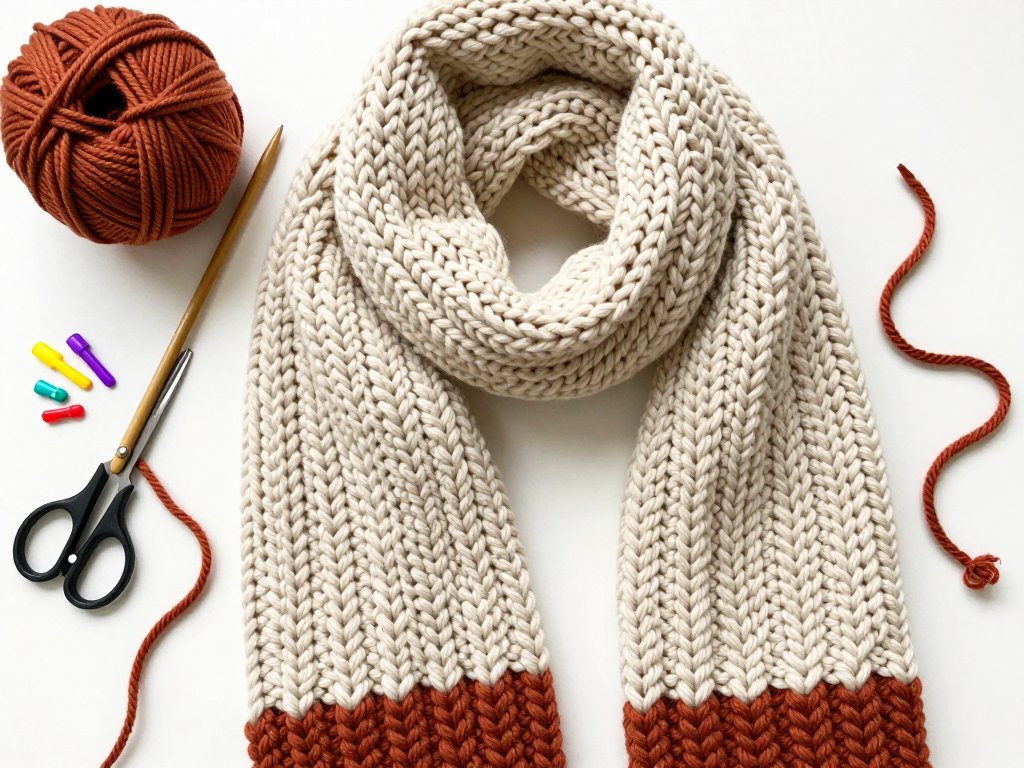
Our first project is a simple garter stitch scarf. Garter stitch is the most basic knitting pattern in the world — you simply knit every stitch, every row.
No purling, no shaping, no counting beyond a simple repeat. It looks lovely in chunky yarn, with those rippled, squishy ridges that make bulky knits so appealing.
Step 1: Cast on. Make a slip knot on one needle, leaving a tail about six inches long.
Then cast on 14 stitches using the long-tail method — it creates a stretchy, neat edge that suits a scarf.
Fourteen stitches in super bulky yarn will give you a scarf about eight to ten inches wide, perfect for wrapping twice around your neck.
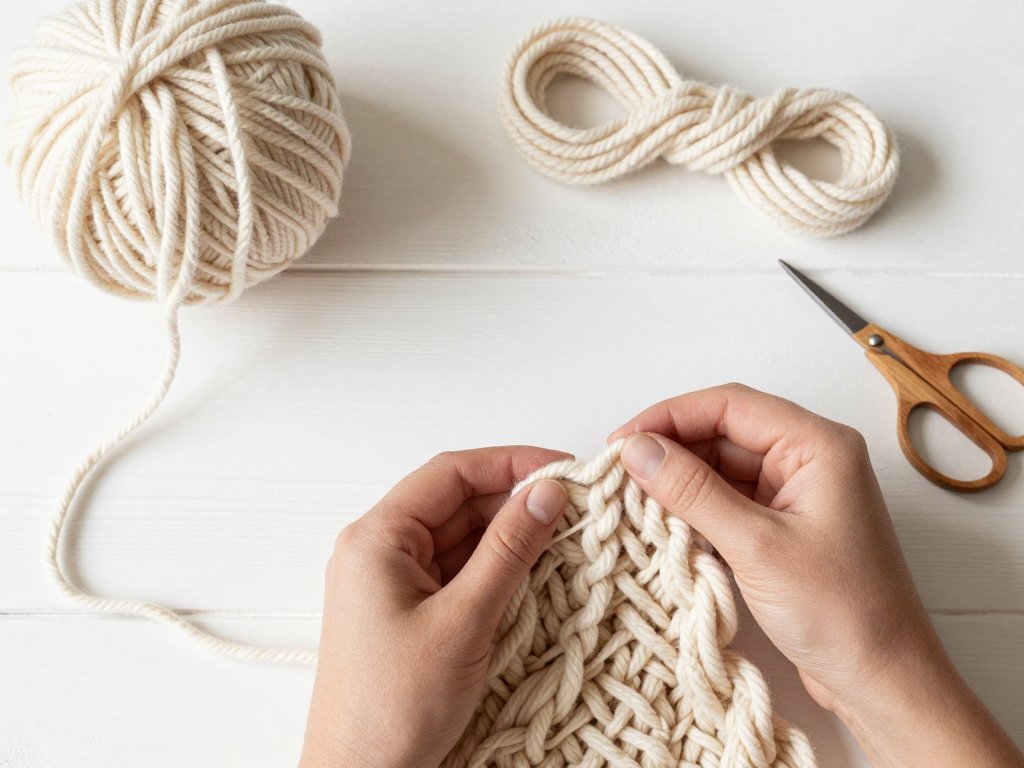
Step 2: Knit every row. Hold the needle with the cast-on stitches in your left hand and the empty needle in your right.
Insert the right needle into the first stitch from front to back, wrap the yarn around the tip counterclockwise, and pull the new loop through.
Slip the old stitch off the left needle. Repeat across the row, then swap hands and knit the next row the same way.
Step 3: Keep going. Knit until the scarf measures about 60 inches, or as long as you like. This is the beauty of garter stitch — you can stop anytime and the edge will still look intentional.
Step 4: Bind off. Knit the first two stitches. Then, using your left needle, lift the first stitch over the second and off the needle.
Knit one more stitch and repeat, always lifting the older stitch over the newer one, until one stitch remains.
Cut your yarn, leaving a six-inch tail, and pull it through the last loop.
Step 5: Finish. Thread the tapestry needle with the tails and weave them through the edge stitches on the wrong side. Snip the excess. Congratulations — you have a scarf!
A note on tension: beginners tend to knit too tightly. Big yarn is forgiving, but if your scarf starts to curl or narrow, relax your grip and let the yarn flow through your fingers. Your stitches should glide on the needles, not fight them.
Five More Fast Projects
Once the scarf is off your needles, the possibilities multiply. Chunky yarn is ideal for any project you want to finish quickly. Here are five favorites:
1. A cozy cowl. Cast on 20 to 24 stitches, knit in garter stitch until the piece wraps comfortably around your neck, then bind off and seam the two short edges together. A cowl is like a scarf that cannot fall off — perfect for chasing toddlers around the playground.
2. A lap blanket. Cast on 60 to 80 stitches and knit until the blanket is as long as you want. Garter stitch laps up beautifully, and a chunky throw can be finished in a couple of weeks of evening knitting.
3. Fingerless mitts. Knit a simple rectangle wide enough to wrap around your hand, leaving a thumb hole by working two short rows with the yarn wrapped around the gap. Seam the side, and you have instant hand warmers for morning school runs.
4. A chunky pillow cover. Knit two large squares in stockinette or garter stitch, seam three sides, insert a pillow form, and seam the fourth. This is one of the quickest ways to refresh a living room — one evening per square.
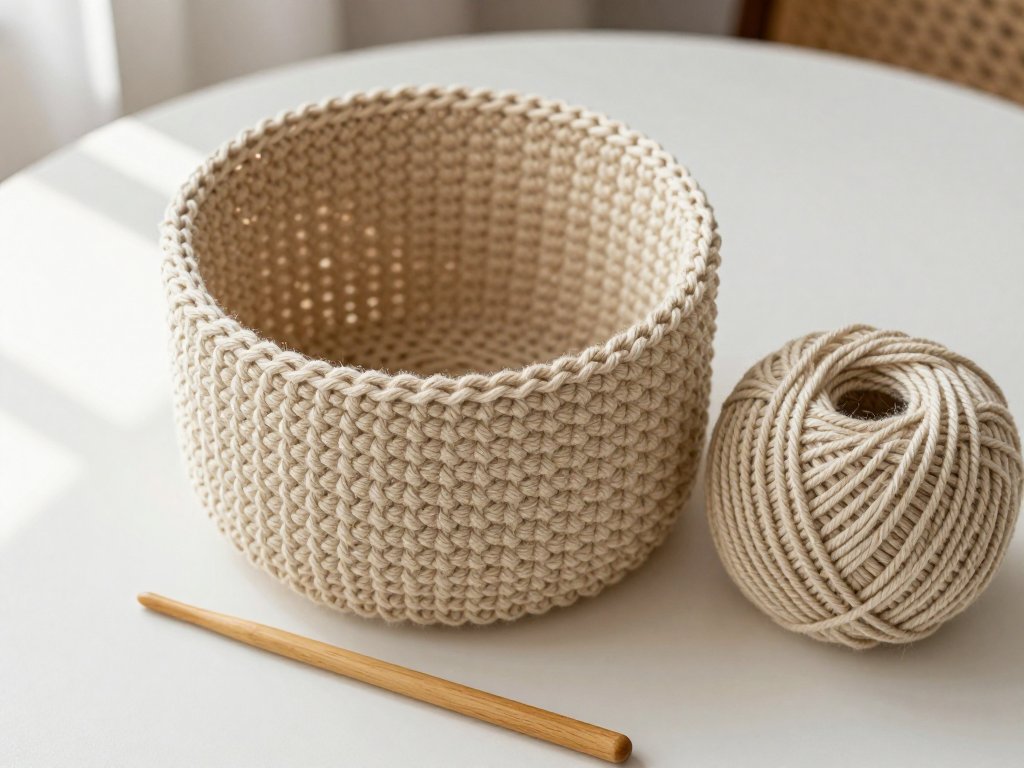
5. A knit basket. Super bulky yarn knitted very tightly (or felted wool) creates a sturdy, squishy basket that holds yarn, toys, or mail. It is a wonderful first "home decor" knit.
Each of these projects uses the same basic stitches you already know. The pattern changes, but the skills carry over — which is exactly how knitters build confidence, one fast win at a time.
Gauge: Why It Matters with Big Yarn
Every yarn label prints a gauge: the number of stitches and rows per four inches, knitted on a recommended needle. Most beginners ignore it, and most beginners regret it.
Here is why gauge matters. If you knit looser than the pattern assumes, your scarf comes out wider and uses more yarn than planned.
If you knit tighter, it comes out narrow and possibly too stiff. With chunky yarn, small differences in gauge create large differences in the finished size, because each stitch is so big.
The fix is easy. Knit a small swatch — about 20 stitches wide and 20 rows tall — in the pattern you plan to use.
Measure how many stitches fall within four inches. If you have more than the label says, try a larger needle; if fewer, try a smaller one.
Five minutes of swatching saves you from an entire project of disappointment.
Gauge also helps you estimate yardage. If your swatch uses about 15 yards of yarn, you can calculate how much a scarf will need before you buy.
When in doubt, buy one extra ball. Leftover chunky yarn makes excellent coasters, trivets, or a mini scarf for a doll — nothing goes to waste.
Common Beginner Mistakes (and How to Avoid Them)
Every knitter makes mistakes, and chunky knitting is wonderfully forgiving of most of them. Still, a little foresight goes a long way.
Knitting too tightly. The most common beginner error. If your stitches feel difficult to slide, you are gripping too hard. Loosen up, and if your hands cramp, put the work down for ten minutes.
Splitting the yarn. Chunky yarns are often made of several plies twisted together, and an impatient needle tip can slip between them. Insert your needle cleanly through the whole stitch, and slow down a little.
Dropped stitches. A stitch that slips off the needle unravels a neat ladder down the row. If you catch it quickly, you can scoop it back up with a crochet hook — or simply unravel back to the mistake and re-knit. With garter stitch, frogging (unraveling) is painless.
Buying yarn without a plan. A single ball of chunky yarn is a good start, but make sure you have enough for the whole project. Dye lots vary between batches, and trying to match a color later rarely works. Buy all your yarn at once.
Ignoring the label. Washing instructions matter. Some wools felt if you machine wash them; some acrylics can melt in a hot dryer. Check the care symbols before you wash, not after.
Caring for Chunky Knits
Your finished chunky scarf deserves a little care to stay beautiful for years.
Blocking. When you finish a project, wet-block it to even out the stitches and set the shape.
Soak the piece in cool water with a drop of gentle soap, squeeze (never wring) out the excess, lay it flat on a towel, and gently pat it into shape.
Let it dry completely. You will be amazed at how professional the edges look afterward.
Washing. Hand wash in cool water with a wool-safe detergent, or follow the care label.
Always dry flat — hanging a wet chunky knit stretches it out of shape under its own weight.
That rule matters for dry knits too: heavy sweaters should be folded, not hung on hangers, or the shoulders will stretch.
Storing. Keep chunky knits folded in a drawer or on a shelf, and add a cedar block or lavender sachet to keep moths away. If you store them for the summer, make sure they are clean — moths are drawn to food spills and body oils.
With this simple routine, a chunky knit stays soft, shapely, and ready to wear every autumn for a decade or more.
Conclusion
Chunky yarn knitting is one of the warmest welcomes the craft world offers. It asks for only two skills — casting on and knitting — and gives back a finished project in a weekend, the kind of visible progress that keeps new knitters motivated.
You are following a thread that stretches back to the fishing villages of the Aran Isles, where thick wool meant warmth and survival. Today it means something gentler: an evening of quiet stitches, a handmade gift, a scarf that smells faintly of wool and home.
Start with the garter stitch scarf. When it is finished, wrap it around your neck, feel the weight of it, and know that you made that.
Then pick your next project — a cowl for a friend, a blanket for the couch, a basket for the toy room — because now you know the secret: with big yarn, every project is a quick one.
Happy knitting, and may your evenings be warm and your stitches stay loose.