Introduction
Fourteen candles. That was the plan the December I decided handmade gifts would save me money. I melted a ten-pound slab of soy wax on a Tuesday, poured fourteen jars in one sitting, and handed them out eight days later.
Every single one smelled like warm nothing. Not spruce. Not cranberry. Warm, faintly waxy air. My sister lit hers on Christmas Eve and asked, politely, what scent it was supposed to be.
The fragrance oil was in there. I had measured it. It just hadn't bound to the wax yet, because soy needs time after pouring before it smells like what you put in it. I gave away fourteen jars of potential and called it a gift.
That mistake cost me about $40 in materials and a little pride. The fix costs nothing but calendar space, which is why I now plan holiday candles backward from the gift exchange instead of forward from a free evening.
Here's the reframe that stuck: a candle is a gift only when three things are true. The scent has cured. The color reads festive instead of craft-fair. And the whole batch is finished before gift week starts, not during it.
Miss any one of those and you've spent money to hand someone a jar they'll keep out of politeness. If you've never poured a candle at all, start with candle making basics first.
This article assumes you can melt wax and set a wick. What it covers is turning that skill into twenty gifts that don't embarrass you.
Why Holiday Candles Fail as Gifts
Almost every failed gift candle fails for one of three reasons. None of them are about talent. All of them are about order of operations.
1. Poured too late to cure
This is the big one, and it's mine. Fragrance oil needs days to fully incorporate into soy wax, and a candle poured on December 17 for a December 20 exchange will smell thin and sweet-ish at best.
People pour late because the holiday crunch hits and candle making looks like a one-evening job. It is a one-evening job. The cure is the part nobody budgets for.
2. One generic scent for everybody
A single "holiday spice" blend for your mother-in-law, your kid's teacher, and your office gift exchange is the candle equivalent of a fruitcake. It's safe, it's forgettable, and half the recipients don't actually like clove.
Three blends cost you the same in materials as one. They cost you a little more attention, which is the actual gift.
3. Containers bought before the scent was chosen
I've done this too. Twelve amber jars on sale in October, then a scent palette that wanted clear glass and deep red wax. Amber glass turned my cranberry red into muddy brown.
Choose the palette first, then the vessel, then the dye. Buying in the other order is how a sale turns into a $30 mistake.
There's a fourth, quieter failure: the batch gets rushed at the end, the labels go on crooked, and you deliver something that looks like a prototype. Packaging is covered below because it's the cheapest part to get right.
Build a Scent Palette, Not a Scent List
A scent list is five bottles you liked in a store. A palette is three blends with a job each, chosen so the set looks intentional when someone opens a box of them.
Every blend in a holiday palette follows the same shape: one resin or wood base, one fruit or citrus top, one spice accent. The base carries the weight and does the holiday work. The top makes the candle recognizable from across the room. The spice is seasoning, not an ingredient.
That shape is why my early attempts smelled like a candle aisle. I was stacking three top notes and wondering why nothing had depth.
Blend 1: Fir Needle, Sweet Orange, Clove
Six parts fir needle, three parts sweet orange, half a part clove. In a one-ounce batch that's 0.63 oz fir, 0.32 oz orange, and 0.05 oz clove — about a quarter teaspoon.
This is the tree-lot blend. Fir is the resin base, orange keeps it from smelling like cleaning product, and the clove reads as warmth rather than spice rack. It's the safest of the three and the one people ask for by name.
Blend 2: Cranberry, Cedarwood, Cinnamon Leaf
Five parts cranberry, three parts cedarwood, half a part cinnamon leaf. In one ounce: 0.59 oz cranberry, 0.35 oz cedarwood, 0.06 oz cinnamon leaf.
Cranberry alone is thin and a little artificial. Cedarwood gives it a dry, woody floor so it smells like a fruit, not a lollipop. Cinnamon leaf is sharper and greener than cinnamon bark, which is why it works here in such a small amount.
Blend 3: Vanilla, Smoked Birch, Bergamot
Five parts vanilla, three parts smoked birch, two parts bergamot. In one ounce: 0.5 oz vanilla, 0.3 oz smoked birch, 0.2 oz bergamot.
This is the cozy one, and it's the blend that sells in a small-batch shop. Smoked birch keeps the vanilla from going dessert-sweet, and bergamot lifts the top so it doesn't smell like a bakery.
One warning on vanilla: it discolors wax over time, drifting toward tan or amber. Plan the color around that instead of fighting it — more on that below.
And the spice rule, because this is where batches die. Clove, cinnamon leaf, and anise are dominated by eugenol, which is loud and lingers. One drop too many and all twenty candles smell like the same red hots, no matter what else is in the blend.
Measure spice in fractions of a part, never in parts. If you're eyeballing "a few drops," you're not making a palette, you're making one scent in three jars.
Color That Reads Festive Without Looking Like Candy
Use dye chips, not liquid dye. Liquid color is mostly solvent, it can streak in soy, and it's almost impossible to dose by less than a full drop. Chips dissolve cleanly at melt temperature and let you work in fractions.
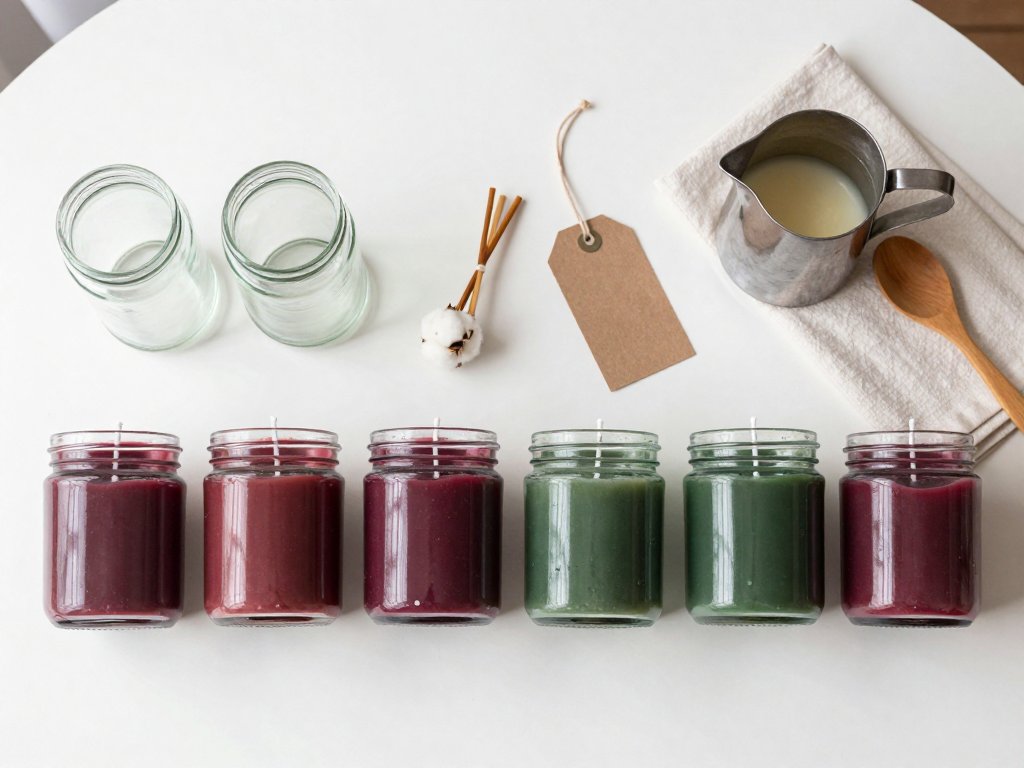
One to two chips per pound of wax gives a pale tint — think blush, sage, cream. Four to five chips gives a saturated jewel tone. Two chips is usually the sweet spot for gift candles, because most people want a candle that looks like a candle.
Shave or grate the chip before it goes in. A whole chip can sit at the bottom of the pitcher and leave you with a streaky first pour and a pale second one.
Match color temperature to scent family. Deep red for the cranberry blend. Forest green for fir. Amber or soft ochre for the vanilla and smoked birch. Those three read as December without a single snowflake sticker.
Skip true red and grass green. They're the two shades that tip a candle from festive into candy, and they're the two most people reach for first.
Then do a one-candle test pour. Color deepens as wax sets and continues shifting over the first day. A tint that looks slightly too pale in the pitcher is usually right in the jar, and a tint that looks perfect in the pitcher is usually too dark.
A test pour costs seven ounces of wax and twenty minutes. It saves you from pouring twenty candles in a color you can't give away.
Batch Math: Wax by Weight, Fragrance by Percentage
Here's the part I got wrong for two years, and it's the reason my first batches came up short. Wax is measured by weight, never by melted volume.
Seven fluid ounces of melted soy is not seven ounces of wax. Melted wax takes up more space than solid wax, so a measuring cup will always overstate how much you have. Put the pitcher on a scale and weigh the wax.
An 8 oz jar holds about 7 oz of wax by weight, filled to roughly half an inch below the rim. That headspace matters: it keeps wax off your counter and gives the wick room to stand.
So a ten-pound slab — 160 ounces — divided by 7 gives 22.8. Call it 22 jars, because some wax stays in the pitcher. Plan for 20 gifts and keep two as test burns.
Fragrance goes in at 6% of wax weight. That works out to one ounce of fragrance oil per pound of wax, which is the easiest number in this whole article to remember and the only one you really need at the melting pot.
Now the full chain for 22 jars. Twenty-two jars times 7 oz is 154 oz of wax. Multiply by 0.06 and you need 9.24 oz of fragrance oil.
Divide that by your bottle size. Nine point two four ounces is ten one-ounce bottles, or three four-ounce bottles. Buying three 4 oz bottles instead of ten 1 oz bottles usually saves $8 to $12 and leaves you less packaging to throw away.
Before you order anything, run your numbers through the Candle Wax Calculator. It takes jar size and count and gives you wax and fragrance in ounces, which beats my napkin math when you're buying a slab size you haven't used before.
One more useful conversion: 20 candles at 7 oz is 140 oz of wax, or 8.75 pounds, and 8.4 oz of fragrance. That's the number you write on the shopping list.
The Cure Timeline, Built Backward from Gift Day
Work backward from the date you hand things over, not forward from the night you're free. That single change is what separates a gift from a jar of wax.
Soy needs a minimum of four to five days for the fragrance to bind. Two weeks is what it takes to smell like the blend you designed instead of a suggestion of it. I plan on fourteen days and treat five as an emergency floor.
A December 20 gift exchange means the last pour is December 6 at the absolute latest — fourteen days, no slack. If you want a properly cured scent plus a buffer week for labeling, a test burn, and a resupply run, December 1 is your pour date.
If you're pouring December 15, you're inside the emergency floor. If you're pouring December 18, put the wax away and buy something. There's no technique that fixes six days of cure time.
A six-week plan for a 20-candle batch
- Week 1 (Nov 8–14): Choose the palette and order wax, fragrance, wicks, and jars in one shipment. Shipping is the hidden cost that eats a handmade gift's savings.
- Week 2 (Nov 15–21): Pour three test candles, one per blend, one chip dose each. Burn them for two hours after a five-day rest and write down what you actually smell.
- Week 3 (Nov 22–28): Lock the blends and the dye dose. Wash and dry all 22 jars. Set up a pouring station with a scale, a thermometer, and a level surface.
- Week 4 (Nov 29–Dec 5): Pour batch one, ten candles in two blends. Write the pour date on each jar bottom in pencil the moment it sets.
- Week 5 (Dec 6–12): Pour batch two, ten candles in the third blend and your bestseller. Rotate the first batch to the back of the shelf and leave it alone.
- Week 6 (Dec 13–19): Test burn one candle from each blend. Trim wicks, add tags, tie twine, and box everything. Gift week starts December 20 with nothing left to do.
Pour in two batches instead of one marathon evening. Twenty jars in a single session means the last six go into wax that's cooled past the point of a clean top, and those are the ones that crack or sink.
If your gift day isn't December 20, shift the whole plan rather than compressing it. Check the jar count against the candle wax calculator before the second pour so you're not short four jars with a week to go.
Containers That Survive Gifting
A gift candle gets carried in a bag, left in a car, and set on a table by someone who doesn't know it's handmade. The vessel has to survive all three.
Heat-safe tempered glass is the default. Plain tins with lids are cheaper, lighter to ship, and nearly indestructible. Straight-sided jars give you an even melt pool and a clean label surface.
Skip vintage glass, because you can't verify how it was tempered and old glass fails unpredictably. Skip cut bottles, which carry stress fractures from the cutting. Skip ceramics not made for heat, and skip anything with a narrow neck that traps heat and starves the flame.
Lids are worth the extra dollar for gifts. They keep dust out of the wax and keep the scent in during a week in a tote bag.
Centering the wick without buying a tool
Lay two chopsticks across the rim of the jar and pinch the wick between them. It holds straight while the wax sets and lifts off clean.
No chopsticks? Lay a pencil across the mouth of the jar and tape the wick to the middle of the pencil. The tape does the centering, the pencil does the holding.
Check from directly above before the wax skins over. A wick that's two millimeters off center looks like a mistake by the third burn, and it's the easiest fix in the whole process.
Packaging and Labeling on a Budget
Kraft hang tags, cotton twine, and a fine-tip pen will carry everything a gift candle needs. A hundred tags runs about $8 and a spool of twine about $3 — enough for several seasons of gifting.
Front of the tag: the scent and the pour date. "Fir, Orange + Clove — poured Nov 29." That one line tells the recipient the candle is fresh, intentional, and made by a person.
Back of the tag: two short burn notes. Trim the wick to a quarter inch. Burn long enough for the wax to melt to the edge.
The bottom of the jar carries the safety line: burn within sight, keep away from children and pets, keep away from drafts and anything flammable.
A warning label is expected on any candle you give away, even to family. The hang tag is the cheapest way to carry it, and a plain sticker on the base works just as well.
Don't buy a label printer for twenty candles. Twine and a tag read as handmade; a glossy printed label reads as a product sample.
What a Gift Candle Actually Costs
Here's the per-candle math for a 7 oz candle in an 8 oz straight-sided jar. Soy wax from a $22 ten-pound slab comes to about $2.20 a pound, so seven ounces is roughly $0.96.
Fragrance at 6% is 0.42 oz. At a mid-priced $0.50 an ounce, that's about $0.21. A wick is $0.12. A jar with a lid is $1.40. A tag and a length of twine, $0.12.
Total: about $2.81 a candle, and $3 if you round up for electricity and paper towels. A set of three lands under $9.
A store-bought single candle in the same size runs $18 to $28. Swap the glass jar for a tin and your cost drops to about $2.20 a candle, which puts a set of three under $7.
Time is the other number. Twenty candles is about ninety minutes of active work once the wax is melting, plus twenty minutes of labeling. Call it two hours for roughly $60 worth of gifts.
Gift-Day Problems and How to Fix Them
Four things go wrong between your table and someone else's hands. All four are predictable, which means all four are preventable.
Wax cracked after a cold car ride
A jar that goes from a warm house to a freezing trunk contracts, and the wax pulls away from the glass or cracks across the top. Hairline cracks at the edge are cosmetic; the candle still burns normally.
Box them for transport, don't leave them in the car overnight, and let them come back to room temperature slowly instead of putting them straight on a radiator.
Scent faded in a warm closet
Fragrance migrates out of wax faster in heat. A candle stored at 85°F for a month smells noticeably flatter than one kept cool and dark, even at a proper 6% load.
Keep the lid on, store them in the coolest closet in the house, and gift close to the date you poured. If a candle has been sitting since October, it's not ruined, just quieter.
Labels lifting at the edges
Adhesive doesn't stick well to cold, dusty, or slightly waxy glass, and condensation in a gift bag finishes the job. Clean the jar with rubbing alcohol and press the label for a full thirty seconds.
Or skip the label entirely and use a hang tag. That's the version I've stopped arguing with.
Wick drowning on the first burn
Usually the candle was poured too cool, so the top set unevenly and buried part of the wick under a waxy ridge. The recipient lights it, the flame barely holds, and they assume you made a bad candle.
Trim to a quarter inch and burn three to four hours to let a full melt pool form. If it still struggles, the wick is a size small for that jar and the next batch needs a step up.
Test burn one candle from every blend. Those are the two extras out of twenty-two, and they're your only real quality control before the box gets taped shut.
Conclusion
Three numbers carry this entire process: 6% fragrance, 7 oz of wax per 8 oz jar, and 14 days of cure. Everything else is preference.
If you're planning your first holiday batch, start with ten candles and one blend. Order the wax and jars together, pour by the second week of December at the latest, and leave the tray alone for two weeks.
Then run the whole thing through the candle wax calculator so you're buying one slab and three bottles instead of guessing twice.
Nobody remembers the jar. They remember lighting something that smelled like December and asking where you got it. That's the whole return on a $3 candle and a calendar you actually planned around.