Introduction
Halloween is coming, and the costume panic is real. The store-bought options are expensive, the good ones sell out, and who has time to sew? The answer is simpler than you think: you do not need a sewing machine — or any sewing skills — to make a wonderful costume.
With fabric glue, scissors, and a few basics from your closet, you can put together adorable outfits in a single evening. Many of these costumes cost under ten dollars, and most use things you already own.
In this guide, you will find eight easy no-sew costume ideas, a complete supply list, and all the little tricks that make homemade costumes look polished instead of thrown together. Let us get started.
Why No-Sew Costumes Work for Busy Families
No-sew costumes are the perfect answer to the October scramble. They come together fast, they are gentle on the budget, and they are easy to adjust when a child changes their mind at the last minute.
Because nothing is sewn, nothing is permanent. You can glue, wear, and then carefully pull apart — the clothes go back in the closet and the felt goes in the craft bin for next year.
These costumes are also wonderfully comfortable. Kids can move, run, and collect candy without stiff fabric or scratchy tags. That means happier children and a smoother evening for everyone.
And there is a special joy in making something yourself. When your child puts on a costume you built together, they are wearing a little piece of your care.
Homemade costumes also start conversations. When someone asks where you bought it, you get to say, "We made it!" That little moment of pride is part of the fun.
The No-Sew Toolkit: What You Actually Need
Here is the complete list of supplies you will use all season. You probably have most of it already.
- Fabric glue. Look for washable fabric glue or a strong craft glue that dries flexible. This is your sewing machine.
- Scissors. A good pair of fabric scissors makes clean cuts. Keep a separate pair for paper.
- Felt sheets. Felt is the star of no-sew costumes. It cuts easily, glues well, and comes in every color. Stock up on black, white, orange, and green.
- Safety pins. These hold pieces in place while the glue dries, and they are invisible inside a costume.
- Basic clothing. Plain t-shirts, leggings, hoodies, and sweatpants in solid colors form the base of nearly every costume.
- Cardboard. A clean shipping box becomes wings, signs, and robot parts.
- Hot glue gun. Optional but handy. It dries fast and holds felt beautifully. Use it with adult supervision only.
- Iron-on hem tape. This bonds fabric without sewing and is wonderful for fixing hems on thrifted base clothes. A single roll lasts for years.
That is the whole toolkit. With these items, you can make every costume in this guide — and invent plenty of your own.
The Golden Rules of No-Sew Costumes
Three simple rules will make every costume you build look better.
Rule one: start with the right base. A solid-color outfit in the costume's main color does half the work. A gray hoodie and sweatpants become a robot, a mouse, or a storm cloud — the base clothes set the stage.
Rule two: add one big, clear detail. The best costumes read from across the street. One large element — wings, a hood, a sign — matters more than ten tiny details nobody can see.
Rule three: fit matters. Glue pieces while your child wears the base clothes. That way everything lands in the right place, and nothing hangs off oddly.
Keep these rules in mind, and even your simplest costume will look intentional and charming.
Get the kids involved in the making. Even a two-year-old can help glue a felt patch or pick the colors. When children help build their costume, they wear it with extra pride.
Eight Easy Costumes You Can Make in an Evening
Here are eight crowd-pleasing costumes, each doable in an evening with the supplies above.
1. Classic Ghost
The ghost is the ultimate budget costume — and with a few upgrades, it can be genuinely adorable instead of just a sheet.
- You need: a white flat sheet, scissors, fabric glue, black felt.
- Make it: cut a hole in the center for the head and trim the bottom so it clears the floor. Cut two small arm holes. Glue two black felt oval eyes and a small mouth onto the front.
For extra charm, cut the eyes extra large — big, soft eyes make the ghost friendly rather than spooky. Wear white clothes underneath so nothing shows through.
2. Mummy
The mummy is fast, funny, and endlessly adjustable. You will wrap your child in soft fabric strips — no glue needed for the wrapping itself.
- You need: an old white or cream sheet cut into strips, a white long-sleeve shirt and pants, safety pins.
- Make it: wrap the strips loosely around the body, arms, and legs, tucking ends in or pinning them. Leave the face clear, and add a little dark gray felt patch on the cheek if you like.
The trick is loose wrapping. Tight strips look like bandages and get uncomfortable; loose ones read as mummy at a glance and let your child move freely.
3. Little Black Cat
A black cat costume is simple, classic, and works for every age from baby to grown-up.
- You need: black clothes, black felt, a headband, fabric glue.
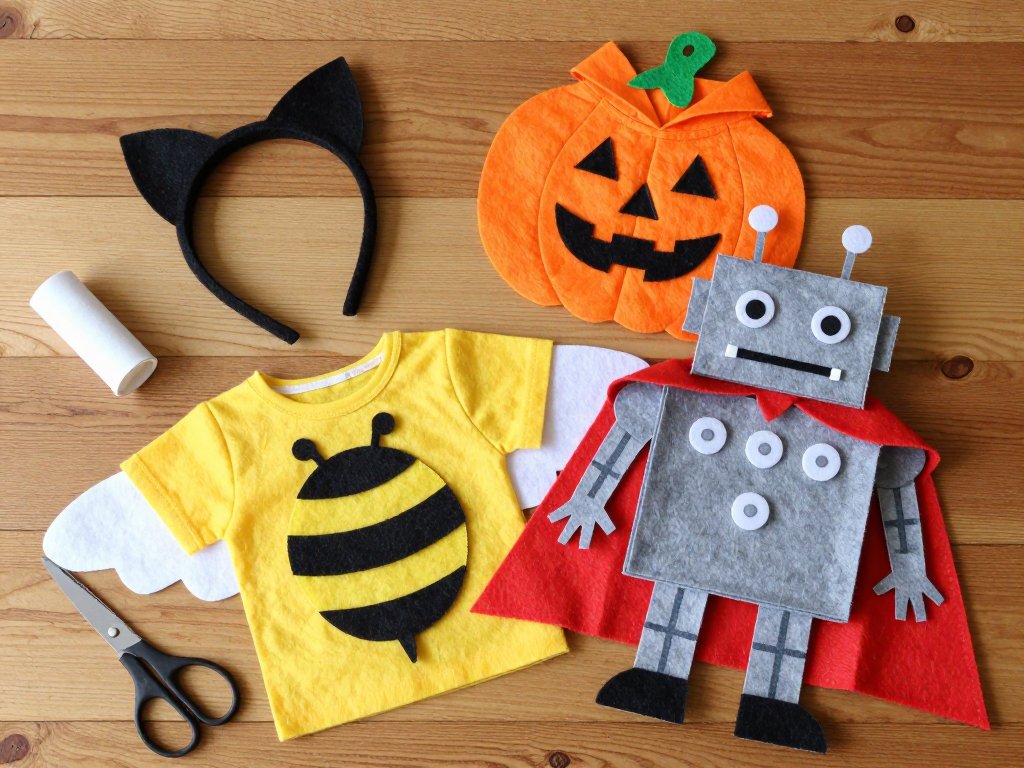
- Make it: cut two pointed ears from felt and glue them to the headband. Cut a long tail from felt — or better, from an old pair of black tights — and pin it to the back of the pants. Add a pink felt nose and whiskers drawn with face paint.
The ears make the costume. Make them tall and slightly rounded at the base, and they will stay visible even from behind.
4. Pumpkin
The pumpkin is a Halloween icon, and this version uses an orange sweatshirt you may already own.
- You need: an orange hoodie or sweatshirt, orange or brown pants, black felt, fabric glue.
- Make it: cut a pumpkin face — triangle eyes and a jagged smile — from black felt and glue it to the front of the hoodie. Add a small green felt leaf at the collar and a brown stem shape on the hood.
Pull the hood up and your child becomes the whole pumpkin, stem and all. It is cozy enough for chilly evenings, which is a major win.
5. Busy Bee
Bees are perennial favorites, and the costume is mostly stripes you already have.
- You need: a yellow shirt or hoodie, black pants or leggings, black felt, white felt, a headband, fabric glue.
- Make it: glue black felt stripes across the shirt. Cut two oval wings from white felt — or white poster board — and glue or pin them to the back. Add simple black antennae to the headband with small felt balls on top.
Make the wings extra large for maximum cuteness. They will flutter as your child runs, which is exactly the effect you want.
6. Superhero
Every kid wants to be a superhero, and this costume takes about twenty minutes.
- You need: a colored t-shirt, matching pants, felt in a contrasting color, fabric glue or safety pins.
- Make it: cut a simple cape shape from felt — a rectangle with the top corners rounded. Attach it at the shoulders with safety pins or glue. Cut a superhero emblem, like a lightning bolt or a star, and glue it to the chest.
A fabric cape is softer and safer than a plastic one. Add a paper cuff on each wrist with the same emblem for a finished look.
7. Robot
Cardboard boxes are the secret weapon of no-sew costumes. This robot is sturdy, fun to decorate, and guaranteed to be unique.
- You need: a large cardboard box, silver or gray paint or paper, scissors, tape, markers.
- Make it: cut arm holes in the sides of the box and a head hole in the top. Cover the box with silver paper or paint it gray. Draw buttons, dials, and a control panel with markers, and add foil-covered cardboard antennae to the top.
Keep the box a little loose so your child can move. Add blinking LED stickers if you want extra robot flair.
8. Scarecrow
The scarecrow is warm, whimsical, and perfect for fall weather. It is also one of the easiest costumes to pull together.
- You need: a flannel shirt, overalls or brown pants, a straw hat, raffia or yellow yarn, fabric glue.
- Make it: glue tufts of raffia to the collar, cuffs, and hat brim. If you do not have a straw hat, glue raffia around the edge of any old hat. Add a red felt patch on the shirt for a folksy touch.
You can even skip the face paint — just a little blush on the cheeks makes the look complete. This costume reads "scarecrow" from across the street.
Costume Ideas for Toddlers and Babies
Little ones have their own costume needs. Babies cannot wear masks or heavy headpieces, and toddlers need freedom to move. Here is how to adapt the ideas above.
For babies, focus on the base outfit and skip anything on the head. A onesie with glued-on felt spots becomes a ladybug. A brown onesie with a felt belly and ears pinned to a hood becomes a bear.
For toddlers, choose costumes with no pieces to lose. The pumpkin, bee, and cat all work beautifully — just keep the ears and wings securely glued and skip anything that could become a choking hazard.
And remember: the best toddler costume is one they can sit, crawl, and nap in. Comfort wins every time.
Take a photo in the afternoon light once the costume is ready. Your child gets to see the magic before the big night, and you get a sweet keepsake of the whole process.
Family and Group Costume Themes
Costumes are even more fun when the whole family joins in. Coordinating themes make group photos unforgettable, and no-sew methods keep the workload light.
A rainbow family is simple and cheerful. Each person wears a different solid color and a matching felt accessory. Kids love choosing their color and spotting the whole rainbow together.
Classic pairs work beautifully too. A cat with a pumpkin, a bee with a flower, or a ghost with a monster all pair well with the costumes above. Mix and match the ideas in this guide to build your own theme.
Neighborhood groups can coordinate as a box of crayons or a garden of flowers. Simple bases plus one big felt detail keep everyone recognizable — and the photos will be amazing.
Finishing Touches That Make Costumes Look Great
Small details turn a good costume into a great one. Here are the finishing touches that make the biggest difference.
Face paint over masks. Masks are uncomfortable and hard to see out of. A painted nose, whiskers, or cheeks completes the costume while keeping faces visible and happy.
One matching accessory. A trick-or-treat bucket painted to match, or a simple prop like a cardboard sign, pulls the whole look together.
Layer for the weather. Halloween nights get cold. Build costumes over long sleeves and leggings, and keep the base clothes warm. Nobody enjoys a shivering superhero.
Keep a repair kit handy. Pack a few safety pins, a small bottle of glue, and extra felt in your candy bag. A quick fix on the sidewalk keeps the costume going strong all night.
Test everything before the big night. Have your child wear the costume for ten minutes the day before. You will spot loose pieces, uncomfortable spots, and fit issues while there is still time to fix them.
Conclusion
Making a no-sew costume is about so much more than saving money — although you will save plenty. It is about the joy of creating together, the pride in wearing something handmade, and the fun of solving a problem with your own two hands.
Pick one costume from this list and give it a try this week. Gather your supplies in the evening, put on some music, and make a little magic.
Your child will wear it with pride, and you will have a memory that lasts far longer than any store-bought costume. Happy Halloween, and happy making.