Introduction
There is something deeply satisfying about making a paper chain garland. Maybe it is the rhythmic snip of scissors through patterned paper, or the way each loop links into the next like a quiet meditation.
Perhaps it is the memory of sitting at a classroom table in December, construction paper scraps littering the floor, your tongue poking out in concentration as you glued one more strip into a circle.
Whatever the reason, paper chains have been a beloved craft for generations — and they are having a real moment right now.
In an era of expensive party decorations and single-use plastic banners, the humble paper chain offers something rare: it is beautiful, biodegradable, budget-friendly, and deeply personal all at once.
I have made paper chains for birthday parties, baby showers, Christmas mornings, Fourth of July barbecues, and quiet Tuesday afternoons when the kids needed something to do that did not involve a screen.
And here is the truth: they never get old. Every time I cut into a fresh stack of paper, I feel that same flutter of anticipation I felt in first grade.
In this guide, I will walk you through everything you need to know to make your own paper chain garlands.
You will learn which papers work best, how to size your chains for different spaces, and creative variations that take this classic craft to a whole new level.
By the end, you will have a festive, handmade decoration that cost pennies to make and looks like it belongs in a boutique party shop.
What You Will Need
One of the best things about paper chains is how short the supply list is. You probably already own most of these items.
Essential Supplies
- Paper. You can use construction paper, scrapbooking paper, wrapping paper, cardstock, or even pages from old magazines. For beginners, standard construction paper (12 by 9 inches) is the easiest to work with — it cuts cleanly, folds easily, and comes in every color imaginable.
- Scissors. A sharp pair of scissors makes a real difference. Dull blades will leave ragged edges that tear when you glue the loops. For younger children, blunt-tipped safety scissors work fine.
- Glue stick or tape. Glue sticks are cleaner and less messy than liquid glue, but both work. Double-sided tape is also an excellent option, especially for larger chains where you need a strong hold.
- A ruler or measuring guide. You do not strictly need one, but a ruler helps you cut uniform strips, which makes the finished chain look more professional.
Nice-to-Have Extras
- Paper trimmer. If you plan to make multiple chains or work with large quantities, a guillotine-style paper trimmer saves time and gives perfectly straight edges.
- Hole punch and string. For hanging the finished garland without damaging your walls.
- Embellishments. Stickers, stamps, washi tape, or glitter glue for decorating the individual links before assembly.
- A bone folder or the back of a spoon. Useful for creasing fold lines if you are making folded links.
Step-by-Step Instructions
Now for the fun part. Here is exactly how to make a classic paper chain garland from start to finish. I have broken this down into clear steps so you can follow along easily, even if you are crafting with little helpers.
Step 1: Prepare Your Strips
Cut your paper into strips. The standard size for a classic chain link is about 1 inch wide by 6 inches long. This produces a chain that is substantial enough to see from across the room but delicate enough to drape gracefully.
If you are using 9 by 12 inch construction paper, you can cut six strips from a single sheet — three along the short side and three along the long side.
Eight and a half by eleven inch printer paper yields five to six strips depending on how you cut it.
Wrapping paper can give you dozens of strips from a single roll.
For variety, mix two or three coordinating colors or patterns. A chain made from three alternating colors looks intentional and polished, even if you are using basic construction paper.
Pro tip: Stack several sheets of paper on top of each other and cut them all at once.
This saves time and ensures every strip is exactly the same width. Just make sure the stack is no more than four or five sheets thick, or the top sheet will shift as you cut.
Step 2: Form the First Link
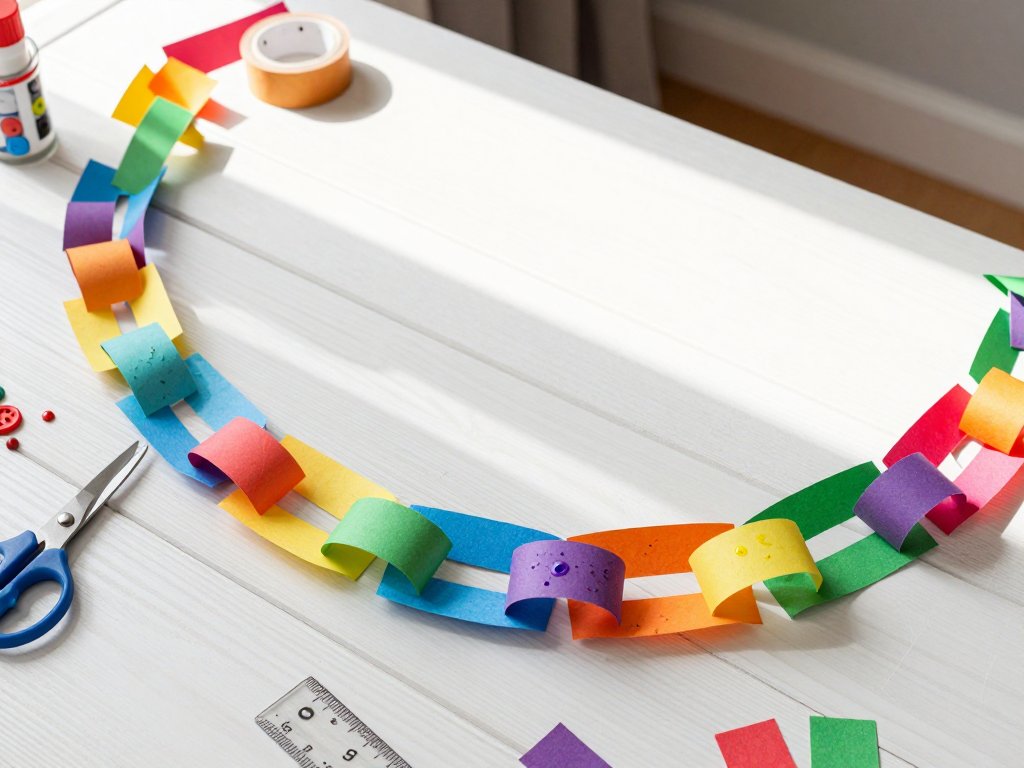
Take one strip of paper and bring the two short ends together to form a circle. Overlap the ends by about half an inch. Apply glue or a piece of tape to the overlapped area and press firmly until it holds.
Hold the link closed for about ten seconds to make sure the glue sets. Construction paper is porous, so glue sticks bond quickly. If you are using glossy or coated paper, you may need to hold it a little longer or use a stronger adhesive.
Step 3: Link the Next Strip
Thread your next strip of paper through the first link before closing it. This is the step that trips up most beginners, so pay close attention.
Take a fresh strip and slide it through the completed loop so that it rests inside the circle.
Then bring the ends of the new strip together and glue or tape them just as you did with the first link.
The new strip should sit comfortably inside the previous link without being squished. If the loop is too tight, use wider strips next time. If it is too loose and the chain looks floppy, shorten your strips by half an inch and try again.
Repeat this process for every link in your chain. Each new strip goes through the previous loop before being closed. This linking action is what creates the distinctive daisy-chain pattern that makes paper chains so recognizable.
Step 4: Build Your Chain to Length
Continue adding links one at a time until your chain reaches the desired length. For a standard doorway arch, you will need about 40 to 50 links, which takes roughly fifteen to twenty minutes of steady work. A six-foot mantel or shelf display needs around 60 to 70 links.
If you are making the chain with children, let each person take turns adding links.
This turns the project into a collaborative activity and keeps little hands busy. You can also prepare all the strips ahead of time and let the kids focus on the assembly step, which is the most satisfying part anyway.
Check your progress every ten links or so by holding the chain up and letting it drape naturally.
This helps you see if the colors are balanced and whether the chain is hanging the way you want it to.
You can adjust the color order as you go by setting aside certain strips and introducing them later.
Step 5: Finish and Hang
Once your chain is long enough, close the final link and let everything dry for a few minutes. If you used glue stick, the bond is almost instant. If you used liquid glue or glossy paper, give it five to ten minutes to set properly.
To hang your garland, you have several options:
- Adhesive hooks. Removable command hooks work beautifully and do not damage walls. Place one at each end of the area you want to decorate and drape the chain between them.
- Pushpins or thumbtacks. Invisible on most surfaces, these are the quickest option for a temporary display. Just pin the end links to the wall at your desired height.
- Tape. Use painter's tape for delicate walls or washi tape for a decorative touch that doubles as a fastener.
- String or ribbon. Thread a length of string or thin ribbon through the top link of each end, then tie it to curtain rods, hooks, or furniture. This works especially well for photo backdrops and party arches.
For a draped look, attach the ends slightly higher than the center point so the chain hangs in a gentle swag. For a straight-across look, attach the ends at the same height and pull the chain taut without stretching it.
Paper Selection Guide
The type of paper you choose has a bigger impact on the finished look than you might expect. Here is a quick guide to help you pick the right paper for your project:
- Construction paper. The classic choice. It is inexpensive, comes in dozens of colors, and has a soft, matte finish that takes glue well. Best for general-purpose party decorating and kids' crafts. Expect a matte, slightly textured finish that feels warm and handmade.
- Cardstock. Thicker and more durable than construction paper. Cardstock chains hold their shape beautifully and can be reused multiple times if stored carefully. Best for permanent or semi-permanent decorations. Expect a crisp, sturdy chain with clean lines.
- Scrapbooking paper. Available in thousands of patterns and prints. Scrapbooking paper is acid-free and fade-resistant, so your garland will look good for years. Best for themed parties and special occasions. Expect intricate designs, metallics, and coordinated collections.
- Wrapping paper. An excellent way to use up leftover wrapping paper. The thin material makes for delicate, lightweight chains that drape especially well. Best for holiday decorating and gift-wrapping-themed parties. Expect shiny or metallic finishes depending on the paper.
- Magazine pages. A free and eco-friendly option. Glossy magazine pages create shiny, colorful links with unexpected text and image fragments. Best for eclectic, artsy displays. Expect a glossy finish with fragments of images and text showing through.
- Scrap paper. Kid's artwork, old flyers, school projects, and other paper destined for the recycling bin can be transformed into beautiful garlands. Best for casual, everyday decorating and teaching kids about reusing materials. Expect a charmingly mismatched, eclectic look.
Sizing Your Chain
Getting the scale right makes all the difference between a chain that looks like a children's craft project and one that looks like intentional decor. Here are the most common sizes and when to use each one:
- Mini chains (half-inch by three-inch strips). These tiny links are perfect for decorating gifts, wrapping around candles or vases, and adding to wreaths. A single sheet of paper yields about 60 mini strips. These make delicate accent pieces that add a handmade touch without overwhelming the item.
- Standard chains (one-inch by six-inch strips). The all-purpose size. Use for party garlands, mantel decor, photo backdrops, and general decorating. One sheet of construction paper yields 6 strips. This is the size most people picture when they think of paper chains, and it works beautifully in almost every setting.
- Jumbo chains (two-inch by ten-inch strips). Large, dramatic links that make a statement. Best for outdoor parties, large wall displays, and event backdrops. One sheet yields 3 to 4 strips. These chains are bold enough to fill a large empty wall and read clearly from across a room.
Creative Variations to Try
Once you have mastered the basic technique, here are some creative twists that will make your garlands truly unique.
Patterned and Printed Chains
Use scrapbooking paper with themed prints — polka dots for a birthday, pine trees for Christmas, hearts for Valentine's Day. Mix one patterned link with two solid-color links for a balanced look. The patterned links become accents that draw the eye, while the solid links provide visual breathing room.
You can also stamp or stencil designs onto plain construction paper before cutting your strips. Let the paint dry completely before assembling the chain. This adds a custom, handmade feel that store-bought decorations simply cannot replicate.
Graduated Color Chains
Arrange your strips so the colors transition gradually from light to dark or from one hue to the next. For example, you might start with pale pink, move through blush and rose, and finish with deep burgundy. This creates an ombre effect that looks sophisticated and custom-designed.
To plan a graduated chain, lay out all your strips on a table in the order you plan to assemble them.
Step back and look at the progression before you start gluing. Adjust any strips that break the visual flow.
A well-planned gradient takes a few extra minutes to set up but elevates the finished piece dramatically.
Photo and Memory Chains
Print small photos and glue them onto cardstock strips before cutting. Use these as special links mixed into a regular paper chain. This works beautifully for birthday countdowns, anniversary celebrations, and milestone events like graduations or retirements.
For a baby shower, include photos of the parents-to-be at each month of pregnancy. For a retirement party, include photos from each decade of the person's career. These chains become keepsakes that guests will linger over and that honorees will want to save.
Confetti-Filled Chains
Before closing each link, drop a few small confetti pieces, glitter stars, or tiny sequins inside the loop.
When the chain is hung, the bits inside catch the light and move gently with air currents.
This works especially well for New Year's Eve parties, birthday celebrations, and any event where a little sparkle is welcome.
Use lightweight confetti that will not weigh down the paper strips. Metallic mylar confetti in star or circle shapes is perfect. Avoid heavy sequins or beads that could cause the links to sag or tear.
Nature-Inspired Chains
Press dried leaves, small flowers, or fern fronds between two strips of paper before gluing the link closed. The natural elements peek through the paper, creating an earthy, organic garland that is beautiful for fall celebrations, garden parties, and Thanksgiving.
Make sure the botanicals are completely dry before encasing them in paper, or they may mold over time. Press them in a book for a week before using them in your craft. Thin, flat specimens work best — think single fern leaves, pansy petals, or maple leaves.
Troubleshooting Common Problems
Even experienced crafters run into issues sometimes. Here are the most common problems and how to fix them.
- My links keep coming apart. You are probably not pressing firmly enough or long enough. For glue sticks, hold the overlap for at least ten seconds. For liquid glue, give it a full thirty seconds. If the paper is glossy or coated, switch to double-sided tape or a hot glue gun for a stronger bond.
- My chain looks uneven. Your strips may not be exactly the same width. Measure them carefully before cutting. If you have already assembled the chain and notice unevenness, try adjusting the amount of overlap on each link. More overlap makes a link smaller; less overlap makes it larger. Consistent overlap is the key to a uniform chain.
- The chain is too floppy. Use shorter or wider strips for a sturdier chain. Standard one-inch by six-inch strips produce a moderately sturdy chain. For something more rigid, try one and a half inches by five inches. You can also switch to cardstock, which holds its shape much better than construction paper.
- My chain keeps twisting. Make sure each new strip is threaded straight through the previous link. If you insert it at an angle, the chain will gradually twist. Hold the chain flat on a table as you work and check the alignment every few links. Untwist any twisted links immediately before they set.
- I am running out of a color before the chain is finished. This happens to everyone. The best fix is to make it part of the design. Switch to a complementary color for the remaining length and call it a faded gradient. No one will know it was not intentional.
Ideas for Every Occasion
Paper chains are endlessly versatile. Here are just a few ways to use them throughout the year.
Birthday parties. Create a rainbow chain in the birthday person's favorite colors. Drape it across the cake table, along the staircase railing, or above the gift table. Add a mini chain to the top of the birthday crown or party hat for an extra special touch.
Holiday decorating. Red and green for Christmas, orange and black for Halloween, pink and red for Valentine's Day. Metallic gold and silver chains look elegant for New Year's Eve. For a cozy winter look, use cream, burgundy, and forest green in matte cardstock.
Baby showers. Pastel pink, blue, yellow, or mint green chains create a soft, celebratory atmosphere. Use them to frame the dessert table, decorate the gift-opening area, or create a photo backdrop for the guest of honor.
Classroom and homeschool projects. Use paper chains to teach patterns, counting, and color recognition. Create a countdown chain for an upcoming event and tear off one link each day. This is a wonderful visual way to help young children understand the passage of time.
Weddings and anniversaries. Elegant paper chains in white, ivory, and blush make beautiful, budget-friendly wedding decor. For an anniversary celebration, use the couple's wedding colors or create a chain with photos from their years together.
Everyday cheer. Sometimes the best reason to make a paper chain is no reason at all. Hang one across your kitchen window, along a bookshelf, or over a child's bed just because. It will make you smile every time you walk by, and that is reason enough.
Crafting with Kids
Paper chains are one of the best crafts to do with children. Here is how to make the experience enjoyable for everyone.
Set up a dedicated crafting station with a tablecloth or newspaper to catch scraps. Pre-cut the strips for younger children and let them focus on the gluing and linking. Older children can cut their own strips with a paper trimmer under supervision.
Turn the assembly into a game by timing how fast each person can add five links, or challenge everyone to create a pattern using specific color sequences.
Play music in the background and make it a party. The goal is not a perfect chain — it is the time spent together making something with your hands.
Celebrate every finished chain by hanging it up immediately. Children love seeing their work displayed, and the instant gratification of a completed project is motivating. Keep the chain up for as long as they want, even if it does not match your decor. Their pride is worth the temporary clash.
Storing and Reusing Your Chains
Paper chains can be reused if you store them properly. Gently unwind the chain and lay it flat in a storage box or album. If the links are glued well, they will hold their shape year after year.
Keep your chains in a cool, dry place away from direct sunlight, which can fade the paper over time.
If a chain gets crushed or bent, you can usually reshape it by gently pulling the links back into position.
For chains made from cardstock, store them hanging if possible — they will keep their shape much better than folded chains.
Label your storage box with the occasion and year so you can find the right chain quickly next time. With proper care, a well-made paper chain can last for years and become a treasured part of your holiday decorations.
Final Thoughts
Paper chains are proof that the simplest crafts are often the most rewarding. With nothing more than paper, scissors, and glue, you can create something that brings joy to a room and a smile to everyone who sees it.
There is no expensive equipment to buy, no complicated techniques to learn, and no wrong way to do it.
Whether you are making a birthday garland for your child, decorating for a holiday gathering, or just looking for a quiet afternoon project, a paper chain is always a good idea.
The rhythm of cutting, linking, and building is meditative. The finished product is genuinely beautiful.
And the whole process costs less than a fancy coffee.
So pick your colors, cut your strips, and start linking. Your next celebration deserves a handmade touch, and you already have everything you need to give it one.