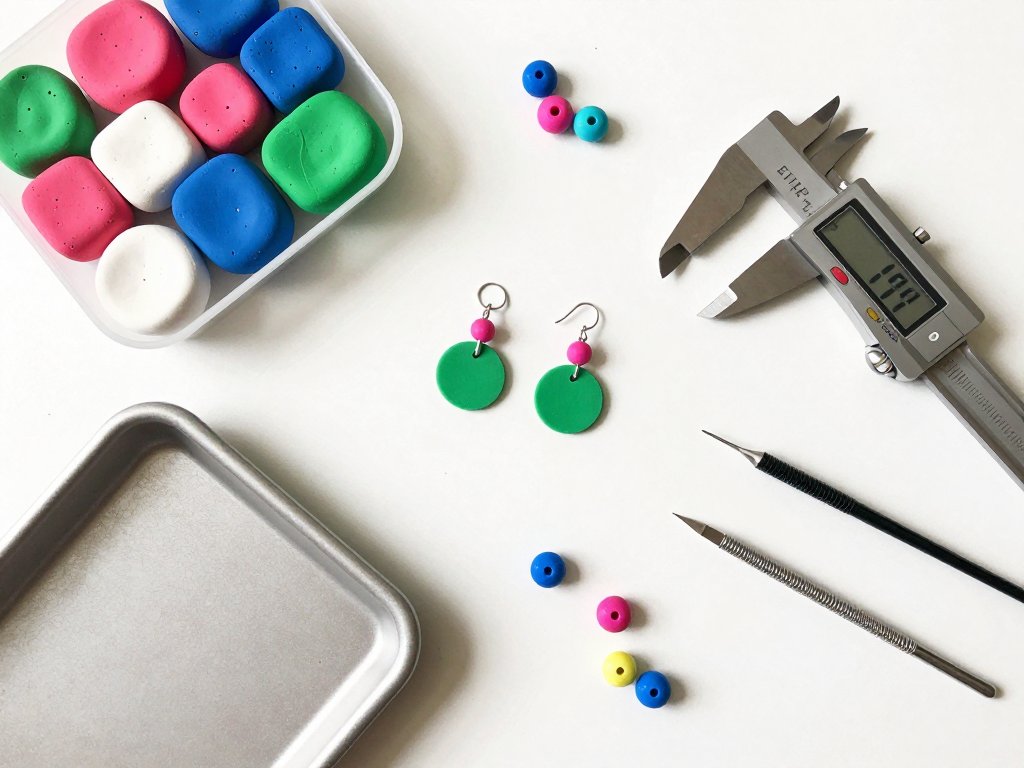
I bought a block of turquoise polymer clay for a pair of earrings I had sketched. The earrings were small — inch-and-a-half teardrops. I figured one block would be plenty. I conditioned the clay, rolled it, cut my shapes, baked them, and still had three-quarters of the block left. That turquoise sat in my scrap bin for six months. By the time I had another project that called for it, the color had shifted. I tossed it.
That was the day I stopped buying clay by instinct. The Polymer Clay Calculator came from exactly that kind of waste — a $3 block here, a $5 block there. It adds up fast when you're building inventory for a craft fair or prototyping a new figurine line.
Why Polymer Clay Is Expensive Enough to Care About
A 2-ounce block of quality clay like Premo or Fimo runs $3 to $5. That does not sound like much until you realize a pair of earrings might use half an ounce — roughly $1.25 in clay. That is fine. But buying eight colors at $4 each and only using a third of each block means you have spent $32 to get $10 worth of usable material. The rest is hardening in your scrap drawer.
For miniaturists and sculptors, the numbers are worse. A 4-inch figurine can eat two or three whole blocks. At $5 each, that is $15 in raw material for one piece. Prototype three versions and you have spent $45 on a single character. Calculate ahead and you buy exactly what you need, in the colors you need.
The Math Behind the Calculator
The calculator handles three shapes because almost every polymer clay project breaks down into one or a combination: rectangular, cylindrical, and spherical.
Rectangular — pendants, cabochons, tiles, cane slices. Length × width × height. A 1.5" × 1" × 0.25" pendant blank is 0.375 cubic inches. At a density of roughly 0.075 ounces per cubic inch, that is 0.028 ounces — a tiny amount. Most people guess high, not low, because they have no visual reference. The calculator gives you a real number.
Cylindrical — round beads, tube beads, canes, rattail pendants. π × radius² × height. A bead 0.5 inches wide and 0.5 inches tall has about 0.098 cubic inches — roughly 0.007 ounces. Twenty matching beads for a necklace is 0.14 ounces total. One 2-ounce block covers all twenty with plenty left over. Without the math, you would buy four or five blocks in one color and never use them.
Spherical — beads, balls, doll heads, eyes. (4/3) × π × radius³. A 2-inch sphere is about 4.19 cubic inches — 0.31 ounces. A 2-ounce block gives you roughly six of them. That is useful when you are planning a batch order.
The density — 0.075 ounces per cubic inch — is worth remembering because it helps you visualize. That is roughly the density of a hard cheese like parmesan. A one-inch cube of polymer clay weighs about the same as a one-inch cube of aged gouda. Cheese cube math has saved me more times than I can count.
The 15% Buffer — Spills, Test Bakes, and Mistakes
The calculator adds 15% to your total automatically. That is the difference between finishing a project and hunting through your scrap bin for enough conditioned clay to complete one more bead.
Here is where that extra goes: you will bake test pieces to check color shift under heat. You will lose clay to your work surface and pasta machine rollers. And most importantly — once polymer clay is conditioned and mixed, you cannot separate it back into its original colors. Make a gradient cane that does not come out right, and that clay is a muddy blend you cannot un-mix. You can use it for core material, but it will never be that clean turquoise again. Fifteen percent extra in your original color means you can start over without buying another block.
When You Need This Calculator
Earrings and pendants. A pair of 2-inch teardrop pendants needs roughly twice the volume of one. Enter one pendant, multiply by two, add the buffer. You will know exactly how many pairs one block yields.
Bead sets. Twelve matching round beads at 0.4 inches diameter is about 1.8 grams total. Twenty-four beads for earrings is about 3.7 grams. The calculator scales linearly so you can batch with confidence. No guessing how many packages of Fimo to buy.
Miniature food and figurines. Miniaturists in 1:12 and 1:6 scale build in layers — foil armature, bulk clay core, thin skin layer. Each layer has volume. If your figurine has a cylindrical body, spherical head, and rectangular feet, the calculator adds all the shapes together. One total number for the whole piece means one order, not three emergency refills.
Sculptors prototyping. Run your armature dimensions plus expected clay thickness through the calculator. You get a baseline material cost per iteration. When you know each prototype costs $4.50 in raw clay, you make that prototype count.
Measuring in Real Life
The calculator is only as accurate as your measurements. Use calipers for beads and small components — a 0.5mm error on a 6mm bead is an 8% volume error, and on twenty beads that compounds. Cheap digital calipers are $15 and will pay for themselves on your first serious project.
Weigh finished pieces before baking. A kitchen scale accurate to 0.1 grams costs $10. Weighing confirms your estimate and trains your eye. After a few pieces, you will develop intuition for what 0.1 ounces of conditioned clay looks like in your hand. Until then, trust the Polymer Clay Calculator.
How to Use the Polymer Clay Calculator Like a Pro
This calculator has four inputs, and each one changes your result. Here is exactly what to do — and what not to do — for each field.
- Object Type — Pick the shape that best matches your project. Rectangular is for pendants, cabochons, tiles, and cane slices. Cylindrical is for round beads, tube beads, and rattail pendants. Spherical is for beads, balls, doll heads, and eyes. Most complex pieces are combinations of these three — you can calculate each part separately and add them up.
- Dimensions — Enter the finished dimensions of your object in inches. For rectangular pieces: length, width, and height. For cylindrical: diameter and height (the calculator divides by 2 for radius automatically). For spherical: diameter. Use calipers for small beads — a 0.5mm measurement error on a 6mm bead is an 8% volume error, and on a set of 20 beads that compounds.
- Calculate — The calculator returns clay weight in both ounces and grams. Standard polymer clay blocks are 2 ounces (56 grams). If the calculator says 1.2 ounces for a pendant, you need one block — with the 15% buffer you will have plenty left for test bakes. If it says 3.4 ounces for a figurine, buy two blocks (4 ounces total).
Pro tip for color blending: Polymer clay colors cannot be unmixed once conditioned together. If you need 0.3 ounces of a custom blend that you created by mixing three colors, calculate 0.1 ounces per color, then add 15% to each component. That way you have enough blend for the project plus a tiny backup if the first bake cracks or discolors.
Open the Polymer Clay Calculator in a new tab and walk through these steps with your project. After two or three uses you will be able to estimate your material needs before you even type the numbers — but you will still type them anyway because the precision is worth it.
From One Maker to Another
I co-created the Polymer Clay Calculator because I got tired of throwing away half-used blocks that had gone stiff or discolored. Polymer clay is a precision material — it bakes at specific temperatures, takes detailed impressions, sands to a glassy finish. It deserves precision in the planning phase too.
Whether you are making earrings for a Saturday market, sculpting a miniature dragon for a collector, or prototyping a new bead line for Etsy, every gram of clay you buy should end up in a finished piece. Enter your dimensions, pick your shapes, and let the Polymer Clay Calculator tell you exactly how much to buy. Your wallet — and your scrap bin — will thank you.
— Mason Reed