Introduction
I still remember the first sumi-e painting I ever saw. It hung in my grandmother's hallway — a single bamboo stalk rising from soft gray mist, painted with what looked like a few effortless strokes.
I was a child then, and I was certain the artist must have been magic.
No one could paint something that alive with just a brush and ink.
Years later, I learned the truth, and it changed how I think about art forever.
Sumi-e is not about magic. It is about practice, patience, and learning to let go.
The painter does not try to copy every leaf and branch; they try to capture the spirit of the bamboo — its strength, its grace, its quiet sway in the wind.
And the wonderful secret is that beginners can start today, with nothing more than ink, a brush, and paper.
If you have ever been drawn to the calm, flowing lines of Japanese ink painting, this guide is for you. We will cover the tools, the brush basics, and your very first painting — all in a way that feels like a deep breath, not a chore.
What Is Sumi-e? A Brief History
Sumi-e means, quite simply, "ink picture." It is the Japanese art of painting with black ink on paper or silk, using brushes and a technique that has been refined over centuries.
The art form arrived in Japan from China, where ink painting had flourished since the Tang dynasty.
Buddhist monks carried the practice across the sea, and Japanese artists made it their own.
Over time, sumi-e became closely connected to Zen philosophy — a meditation in brushstrokes, a way of seeing clearly.
What makes sumi-e so distinctive is what it leaves out. There is no color, no shading with paint, no endless detail.
The artist works with black ink in many intensities, from pale misty gray to rich, deep black.
Every stroke must count because ink cannot be erased. That constraint sounds intimidating, but it is actually liberating — it forces you to be present, to commit, and to trust yourself.
The subjects are often drawn from nature: bamboo, orchids, plum blossoms, chrysanthemums, mountains, birds, and fish.
These are not just pretty pictures. In traditional sumi-e, they carry meaning — strength, resilience, renewal, and the beauty of impermanence.
When you paint a bamboo stalk, you are joining a conversation that artists have been having for a thousand years.
The Four Treasures: What You Need
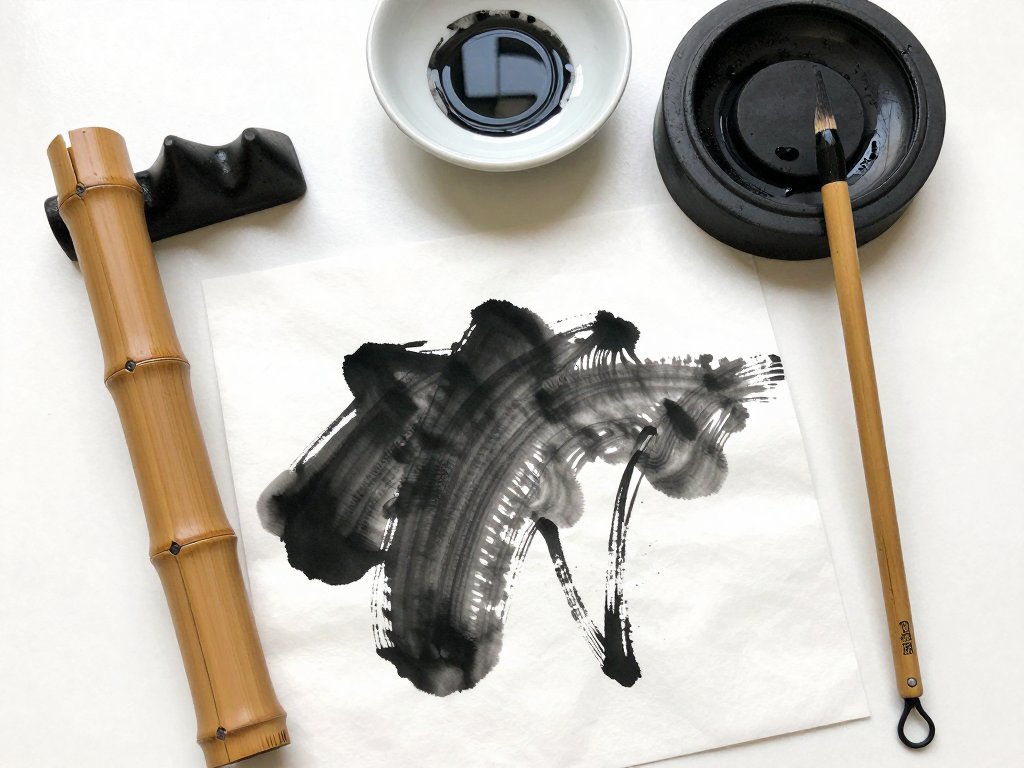
In East Asian tradition, the tools of ink painting are called the Four Treasures. They are simple, and most of them will last you for years:
- Ink. Traditional sumi-e uses ink sticks, which are rubbed against an inkstone with water to create fresh ink. It is a lovely, meditative ritual. For beginners, liquid ink (sumi ink in a bottle) is perfectly acceptable — many contemporary artists use it every day.
- Brush. A sumi-e brush has a soft, tapered tip that holds water and ink beautifully. Bamboo-handled brushes are traditional and lightweight. You do not need many — one good brush will carry you through your first months.
- Paper. Sumi-e paper, called washi, is soft and absorbent. It lets the ink bloom and feather in ways that are part of the art. For practice, many beginners use washi practice paper, which is affordable and kind to beginners.
- Inkstone. A smooth stone slab used to grind the ink stick and hold the mixed ink. If you use liquid ink, a small ceramic dish or palette works as a stand-in.
That is the whole kit. You can begin with a student set — brush, ink, paper, and a simple dish — for less than the cost of a dinner out. It is one of the most affordable art forms I know.
Choosing Your First Brush
The brush is your partner in sumi-e, and choosing your first one deserves a little thought. Here is what to look for:
Size. Start with a medium brush — one that holds a good amount of ink but still allows fine control. A brush with a hair length of about three to four centimeters is a comfortable middle ground. Too small, and your strokes feel timid; too large, and control feels impossible.
Hair type. Sumi-e brushes come in a few varieties. White goat hair is soft and holds a lot of water, perfect for washes and soft effects. Horse or deer hair is springier and gives more control for detailed work. Many beginners love a mixed-hair brush that balances both qualities.
Shape. The brush tip should come to a fine point when wet. This is the "needle tip" that allows you to paint everything from a broad leaf to a delicate stem with the same brush.
Here is a piece of advice I wish someone had given me: do not buy the cheapest brush you can find.
A mid-priced brush from an art supply store performs dramatically better and will last for years with care.
Wash it gently after each session, reshape the tip with your fingers, and let it dry lying flat or hanging tip-down.
Preparing Your Ink and Paper
Before you paint, take a moment to prepare. This ritual is part of the practice — it settles the mind.
If you use an ink stick: place a few drops of water on the inkstone, hold the stick upright, and rub it in slow circles.
You will see the water turn into ink. Keep grinding until you reach the darkness you want — about two minutes of gentle rubbing gives a good working ink.
The rhythm is calming, almost like prayer.
If you use liquid ink: pour a small amount into a shallow dish. Add a few drops of water if you want softer grays. You can create different intensities of ink in separate areas of the dish — dark for bold strokes, lighter for washes.
Prepare your paper. Lay your paper on a flat, clean surface. Some artists use a felt mat under the paper to give it a little cushion; a clean towel works in a pinch. Keep a small container of clean water and a cloth nearby for rinsing and blotting your brush.
Sit comfortably with your paper in front of you. Take three slow breaths. Then pick up your brush.
Holding the Brush: Grip and Posture
The way you hold the brush shapes every stroke you make. In sumi-e, the brush is held differently than a pencil — more upright, more relaxed.
The grip. Hold the brush near the top of the handle, loosely, between your thumb and first two fingers.
Imagine holding a small bird: firm enough that it cannot fly away, gentle enough that you could not hurt it.
The brush should feel like an extension of your arm, not a tool you are gripping.
The angle. Keep the brush fairly vertical — perpendicular to the paper or tilted only slightly. This upright position lets the tip do the work and gives you the full range of stroke widths.
The movement. Sumi-e strokes come from the whole arm, not the wrist and fingers. Your wrist stays relatively still; your arm glides. Paint as if you are writing in the air, letting the movement flow through you.
The breath. Here is the part that makes sumi-e feel like meditation: breathe out slowly as you make each stroke. The exhalation steadies your hand and keeps the movement unhurried. When you hold your breath, your strokes become tight; when you breathe, they become alive.
Practice the grip for a few minutes without touching paper — just holding the brush, breathing, moving your arm through imaginary strokes. This small warm-up makes a surprising difference when you start painting.
The Four Gentlemen: Basic Brushstrokes
Traditional sumi-e students learn by painting the Four Gentlemen — four plants that represent the seasons and the virtues of a noble person:
- The orchid — spring, elegance, and refinement. Its graceful grass-like leaves teach the soft, sweeping stroke.
- The bamboo — summer, strength, and integrity. Straight stalks and angular leaves teach the confident, direct stroke.
- The chrysanthemum — autumn, vitality, and perseverance. Petals and complex blossoms teach control and layering.
- The plum blossom — winter, hope, and renewal. Gnarled branches and delicate flowers teach contrast between bold and fine strokes.
You do not need to master all four to begin. Bamboo is the classic starting point because its structure is simple and forgiving — straight lines, angular leaves, and plenty of negative space. When you can paint a bamboo stalk that feels alive, you have learned the heart of sumi-e.
As you practice each plant, remember the deeper lesson of the Four Gentlemen: the subjects are not just botanical studies. They are qualities to cultivate in yourself — flexibility like the orchid, integrity like the bamboo, endurance like the chrysanthemum, and hope like the plum.
Your First Painting: Bamboo Stalks
Let us paint. Set up your paper, prepare your ink, and take those three slow breaths. We are going to paint a simple bamboo stalk.
Step 1: Load the brush. Dip your brush in the dark ink, then gently squeeze the tip against the edge of your dish to remove excess. The brush should be full but not dripping.
Step 2: Paint the stalk. Starting about a third of the way up the paper, draw a vertical line downward in one steady motion.
Let the brush press a little in the middle and lighten at the end — the stalk should be slightly thicker at the base and taper as it rises.
If it wobbles, that is fine. Bamboo wobbles in the wind.
Step 3: Add the joints. With the tip of your brush, paint two or three short horizontal lines across the stalk at intervals. These are the bamboo's joints — the knuckles that give it structure. Keep them loose and slightly curved, not stiff.
Step 4: Paint the leaves. Switch to a lighter ink. With quick, flicking strokes, paint a few leaves — each one a short, pointed oval, made by pressing the brush down and lifting as you sweep.
Leaves grow from the joints in small clusters. Three leaves, five leaves — no need to count too carefully.
Step 5: Stop. This is the hardest step of all. When the bamboo looks alive, put the brush down. Sumi-e artists learn to stop before the painting is "finished" — leaving space for the viewer's imagination is part of the art.
There it is: your first sumi-e painting. It will not look like a photograph, and that is precisely the point. It looks like bamboo the way bamboo feels — and that is what sumi-e has always been about.
Learning from Mistakes
Here is the honest truth about sumi-e: you will make mistakes, and they will be visible. Ink does not erase. A stroke that goes too far, a leaf that lands in the wrong place — they stay, like footprints in wet sand.
This is the gift hidden inside the challenge. Because you cannot erase, you learn to accept.
You learn that a "mistake" often becomes the most interesting part of the painting. The branch that wobbles gives the tree character.
The ink that pools becomes the mist. Some of my favorite paintings began as happy accidents — a too-wet brush, a startled hand, an unexpected bloom of gray.
When a stroke goes wrong, do not crumple the paper. Paint around it. Make it part of the scene.
This is not a trick; it is the philosophy of sumi-e made visible. Perfection is not the goal.
Presence is. And presence means accepting whatever appears on the paper — including the parts you did not plan.
Keep every painting, even the ones you dislike. Number them and date them. In a month, you will look back and see progress you could not feel day to day. That stack of paper is your diary in ink.
Building a Daily Practice
Sumi-e rewards consistency over intensity. Ten minutes a day will teach you more than three hours once a month. Here is how to build a practice that fits into a busy life:
- Keep your tools ready. A small tray with brush, ink, and paper — ready to go — removes every barrier to starting. If setup takes two minutes, you will do it daily. If it takes twenty, you will not.
- Set a tiny goal. One stalk of bamboo. Five leaves. One orchid petal. A goal so small it feels almost silly — because then you will always do it, and often you will continue past it.
- Paint the same subject for a week. Repetition is how sumi-e is traditionally learned. The first bamboo is stiff; the seventh has life in it. Watching that transformation is deeply satisfying.
- Paint before the day begins. Many sumi-e artists practice in the morning, before the mind fills with errands. A few quiet strokes with your coffee is a beautiful way to start the day.
- Do not judge. This is practice, not performance. Some days the brush will dance; some days it will stumble. Both are part of the path.
If you miss a day — or a week — do not give up. The ink will still be there, the brush will still be soft, and the paper will welcome you back. That is the beauty of a practice: it waits for you.
Conclusion
When I look at the sumi-e painting in my grandmother's hallway now, I see something different than I did as a child.
I still see the magic — but I understand it now. That bamboo stalk was painted by a person who practiced, breathed, and let go.
They made mistakes and painted around them. They stopped before the painting was finished and trusted the empty space.
That is the invitation sumi-e offers you: not to become a perfect painter, but to become present. To pick up a brush, breathe out, and make a stroke that is completely yours. The ink does not lie, and neither do you.
Set up your Four Treasures tonight. Grind your ink or pour it gently. Take three breaths. Paint one stalk of bamboo. And when you are done, know that you have joined a conversation a thousand years old — one brushstroke at a time.