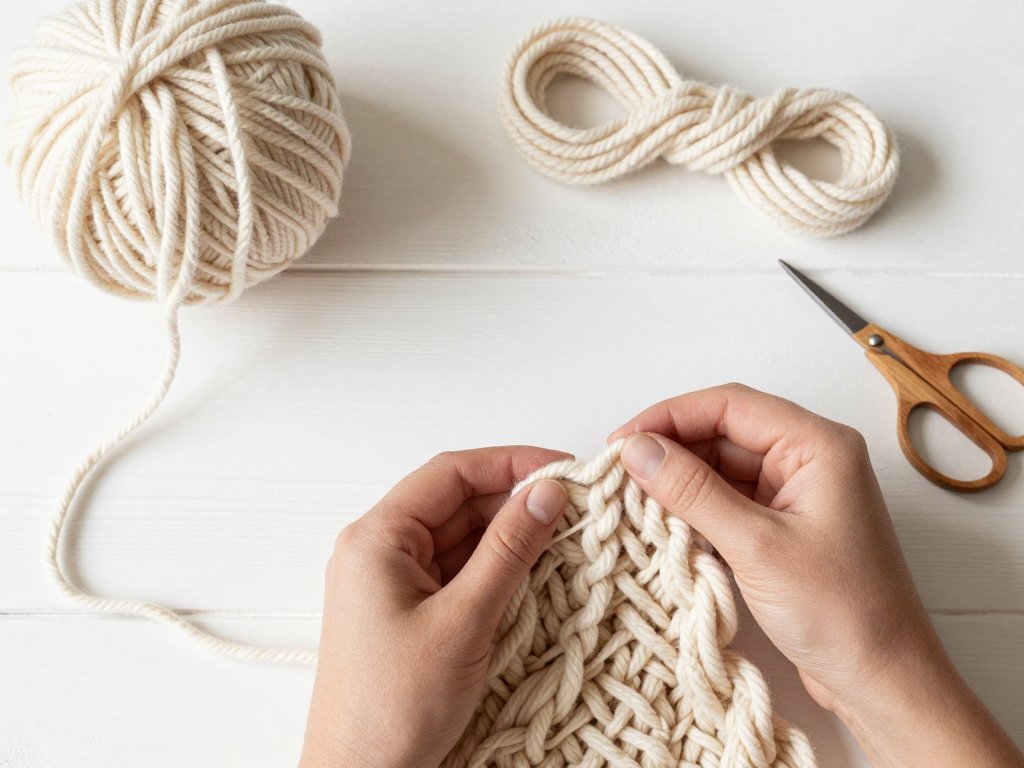
It's 11pm on a Sunday. You're on the home stretch of a sweater you've been knitting for three weeks. One sleeve done, second sleeve almost there — and you pull the last loop through to find about eighteen inches of yarn dangling from your working needle. The skein is a ghost. The second sleeve is half-finished. Every yarn shop within fifty miles closed five hours ago.
If you've been knitting or crocheting longer than about two projects, this has happened to you. It's not a moral failing. It's a math problem — specifically a volume-estimation problem, and humans are famously bad at those. We're great at picking colors, terrible at predicting cubic yardage.
This is where the Yarn Yardage Calculator comes in. I want to walk you through how to use it, when to use it, and why the numbers work. The goal isn't just to finish your project — it's to finish it without panic-ordering a single skein at 1.8x markup on overnight shipping.
The Three Things That Multiply Against You
Every project lives at the intersection of dimensions, yarn weight, and stitch style. Change any one, and your yardage estimate changes more than you'd expect.
Dimensions. Width × length gives you surface area. A baby blanket at 36" × 36" is 1,296 square inches. A throw at 50" × 60" is 3,000 square inches — more than double the area, more than double the yarn. Easy to underestimate when you're just "making it a little bigger."
Yarn weight. This is where the biggest swings happen. A lace-weight scarf might eat 1,200 yards; bulky yarn covers the same ground in 300. The calculator has seven weight options — Lace, Fingering, Sport, DK, Worsted, Bulky, Super Bulky — and each one shifts the yardage-per-square-inch significantly. A DK-to-Worsted swap on a sweater can add or subtract 400 yards. Run the numbers before you buy.
Stitch style. This one surprises people the most. Stockinette knit uses less yarn per square inch than garter stitch because those flat V's pull tighter. Garter stitch's ridges stack up and consume more. Single crochet is dense and greedy. Double crochet covers more ground with less. The difference between stockinette and single crochet on the same blanket can be hundreds of yards. The calculator handles all four: Stockinette Knit, Garter Stitch, Single Crochet, and Double Crochet.
All three compound each other. Small changes in two categories can mean a big yardage swing. Your gut doesn't do compound multiplication at 11pm on a Sunday — let the calculator handle it.
Your Gauge Swatch Is Not Optional
I know. Nobody likes making gauge swatches. You want to dive into the real project. The swatch feels like homework. But the Yardage Calculator is only as accurate as the numbers you feed it. If you tell it your project is 20 inches wide but your actual gauge runs 5.5 stitches per inch instead of 5, your real width is about 22 inches. That extra 10% cascades into extra area, extra yardage — and you're back to the 11pm situation.
Here's what I actually do: knit a 6" × 6" swatch in the stitch pattern I'll use, wet-block it the same way I'll block the finished piece, then measure stitch and row gauge over a 4" section in the middle. Plug that into the calculator alongside my project dimensions. It takes an evening. It saves me from buying either too little yarn (disaster) or too much (annoying, expensive, and now I have a partial skein that exactly one future project will match). The calculator removes the math guesswork; the swatch removes the gauge guesswork. Together they're a safety net.
The 10% Buffer: Blocking Stretch + Oops Rows
You'll notice the Yardage Calculator automatically adds a 10% buffer. That's not arbitrary padding. It covers two things that happen on every single project.
Blocking stretch. When you block a finished piece — especially lace, but really any natural fiber — it relaxes and expands, consuming more yarn than the unblocked swatch suggested. If you've ever blocked a scarf and watched it grow three inches, you've seen it happen. The 10% covers that.
Oops rows. You will frog rows. You will tink back stitches. You will rip out four inches of a sleeve that's too long. Every time yarn gets undone and re-knit, it loses a tiny bit of integrity. If you're a newer maker, your oops factor is probably higher than 10%. Consider this your baseline — add more if you know you're a frogger.
The 10% isn't the yarn store trying to upsell you. It's the difference between "just barely enough" and "enough." I've never finished a project and regretted having a partial skein left over. I've definitely regretted not having it.
When Should You Use This Calculator?
1. You're modifying a pattern. Lengthening a sweater body? Adding sleeves to a vest? Widening a blanket by eight inches? The pattern's original yardage no longer applies. The writer calculated for their dimensions, their gauge, their yarn. As soon as you change any of those, their number is wrong. Run the calculator.
2. You're designing your own project. No pattern means no baseline at all. You've got a vision, a hook or needles, and a pile of yarn you're hoping is enough. Put in your dimensions, yarn weight, and stitch style, and get a real number before you cast on. It beats knitting a third of a blanket and realizing you're a full sweater's worth of yarn short.
3. You're using stash yarn. This is my personal favorite. You've got four skeins of a discontinued colorway from three years ago. Can you make a sweater? A shawl? A hat and mitts? Plug the yardage per skein into the calculator and try different project dimensions until something fits. It turns "mystery stash" into "Saturday afternoon project." Budget-conscious makers, this one's for you.
How to Use the Yarn Yardage Calculator Like a Pro
This calculator asks for three inputs, and each one changes your yardage estimate. Here is exactly how to measure and what to enter for each field.
- Width and Length — Enter your finished project dimensions in inches, not the raw fabric size before blocking. If your pattern says "after blocking, measures 36 by 48 inches," use 36 and 48. If you are modifying a pattern — adding length to a scarf, widening a shawl — enter your modified dimensions. The calculator only knows what you tell it.
- Yarn Weight — Pick the weight that matches your yarn from the dropdown: Lace, Fingering, Sport, DK, Worsted, Bulky, or Super Bulky. Each weight has a standard yardage range baked into the calculator. If your specific brand falls outside the range (indie-dyed yarns vary), check the label for actual yardage and compare it to the calculator's estimate. When in doubt, bump up one weight category — more yarn is cheaper than a dye-lot scramble.
- Stitch Style — This is the variable most people get wrong. Stockinette Knit uses the least yarn per square inch. Garter Stitch uses roughly 30% more because of the ridge structure. Single Crochet is dense and greedy. Double Crochet covers ground faster with less yarn. If you are combining stitches, pick the dominant one. For colorwork or cables, add a safety margin by selecting the next heavier stitch style.
- Calculate — The button returns total yardage and the number of skeins needed in your chosen weight. Always buy the next whole skein up. If the calculator says 4.2 skeins, buy 5. Partial skein math is a trap — leftover yarn becomes a hat or a swatch. Running out means a dye-lot mismatch that forces you to buy a whole new set.
Pro tip for pattern hacking: Run the original pattern dimensions through the calculator first to see its estimate, then run your modified dimensions. The difference tells you exactly how many extra skeins you need — no guessing, no "buy one extra just in case." This is how I started buying exactly what I needed instead of stockpiling partial skeins.
Open the Yarn Yardage Calculator and run your numbers. After two or three projects you will start to develop intuition for yardage — but you will keep using the calculator anyway because the precision saves you money.
When "Buy 5 Skeins" Is a Trap
Pattern labels aren't wrong, but they always generalize. That "buy 5 skeins" note is based on some project at some gauge with some ease. It is not your project at your gauge with your modifications. If you're between sizes, if your tension runs tight, if you're adding length — take "5 skeins" as a starting point, not scripture.
Run the calculator. Compare the result to the recommendation. If they agree, great. If they don't, trust the one using your specific numbers. The calculator doesn't know your brand or care about your color. It just does compound multiplication correctly, every time.
And if it tells you to buy six skeins instead of five? That's still cheaper than paying overnight shipping on a single skein because you ran out at 11pm on a Sunday.
Grab your swatch, measure your gauge, punch in the numbers at the Yarn Yardage Calculator, and buy with confidence. Your future self — the one with a finished project and no yarn stress — will thank you.