Introduction
For sixty-six years, the Ann Arbor Art Fair has marked a highlight of the summer art season.
What began in 1960 as a modest gathering of 132 artists — ninety-nine of them local — along the streets near the University of Michigan campus has grown into one of the largest juried outdoor art fairs in the United States.
Today, nearly half a million visitors walk more than thirty city blocks over four days every July, browsing the work of nearly one thousand artists spread across three distinct fairs: the Ann Arbor Street Art Fair, the Original (the oldest); the State Street District Art Fair; and the Guild's Ann Arbor Summer Art Fair.
If you have visited before, you know the feeling: the late-summer sun warming your shoulders as you wander from booth to booth, catching glimpses of oil paintings and pottery and handwoven textiles, pausing to watch a metalsmith hammering at a portable anvil.
Each year brings new artists, new techniques, and new directions. And each year, certain themes rise to the surface — whispers of where the creative world is heading.
As 2026 unfolds, seven distinct trends are emerging across the artists' booths, the fair's emerging artist programs, and the conversations happening in studios from Ann Arbor to Oregon and beyond. These are the trends worth watching when you visit the Art Fair this July 16 through 18.
Let us walk through them together.
1. Mixed Media and Assemblage: Where Fine Art Meets Found Objects
The line between fine art and craft has never been thinner at the Ann Arbor Art Fair. This year, mixed media artists are turning up in force, bringing work that layers painting with collage, embedded textiles, found objects, and reclaimed materials into single, richly textured compositions.
This is not a new impulse — artists have incorporated non-traditional materials since the early twentieth century, from Picasso's 1912 Still Life with Chair Caning to the American assemblage movement of the 1950s and 60s.
But at the 2026 fair, the trend feels different. Where earlier generations used collage as a formal experiment, today's mixed media artists are making work that tells layered stories: a vintage map pressed into acrylic, a child's handwritten note preserved under resin, bits of rusted farm equipment woven into a commentary on rural life.
Erin Hanafin Sweeney, the 2026 commemorative poster artist for the Guild's Summer Art Fair, exemplifies this direction.
A painter and mixed media artist from Geneseo, New York, her work bridges the gap between traditional canvas work and layered, dimensional compositions.
When you visit the Summer Art Fair section, look for booths where the work invites you to lean in close — to discover what is hiding in the layers.
The appeal for art fair visitors is clear. In a time when so much of what we see lives on screens, a mixed media piece offers something the digital world cannot: physical depth, texture you want to touch, and the visible evidence of a human hand at work.
These pieces reward the kind of slow, careful looking that an outdoor art fair is made for.
What to look for: Paintings with embedded fabric or paper elements, sculptural wall pieces that combine wood and metal, works that incorporate letterpress or handwritten text.
2. The Textile Art Renaissance: Weaving, Punch Needle, and Slow Stitching
Walk through any of the three fairs this July, and you will notice something that would have surprised a 1960s visitor: textiles are everywhere, and they are being presented as fine art.
Textile art has undergone a remarkable resurgence over the past five years. What began with the tufting trend — which has amassed over 4.7 billion views on TikTok — has matured into a broader movement encompassing hand-weaving, punch needle embroidery, rug hooking, and the meditative practice known as slow stitching.
Craft Industry Alliance's 2026 Retail Product Trend Report identifies woven textiles, lace, sheer fabrics, and mixed-fiber creations as some of the strongest growth categories in the handmade market this year.
At the Ann Arbor Art Fair, you will find textile artists who work on floor looms, producing yardage that takes weeks to complete.
You will find punch needle artists creating dense, textured wall hangings in muted earth tones and jewel tones alike.
And you will find quilters whose work has transcended the traditional bed cover to become narrative art pieces — story quilts that document family histories, local landscapes, or social commentary in fabric and thread.
The State Street District Art Fair, which runs along State Street and its surrounding areas, has historically been a strong home for textile and fiber artists.
The 2026 Emerging Artist Program at State Street offers reduced booth fees for artists with three or fewer prior fairs — a pathway that may introduce fresh fiber artists to the fair for the first time.
What makes textile art so compelling at a fine art fair? It asks for a different kind of engagement.
You feel the weave under your fingertips. You see the warp and weft. You understand, instinctively, the hours of handwork that went into a single piece.
In a market where consumers increasingly value "Buy Less, Buy Better," a handwoven scarf or a tapestry wall hanging carries the weight of visible craftsmanship.
What to look for: Handwoven scarves and shawls in washed linen, punch needle wall art with nature motifs, narrative quilts, and tufted rugs in organic, earth-inspired color palettes.
3. Functional Ceramics and Practical Pottery
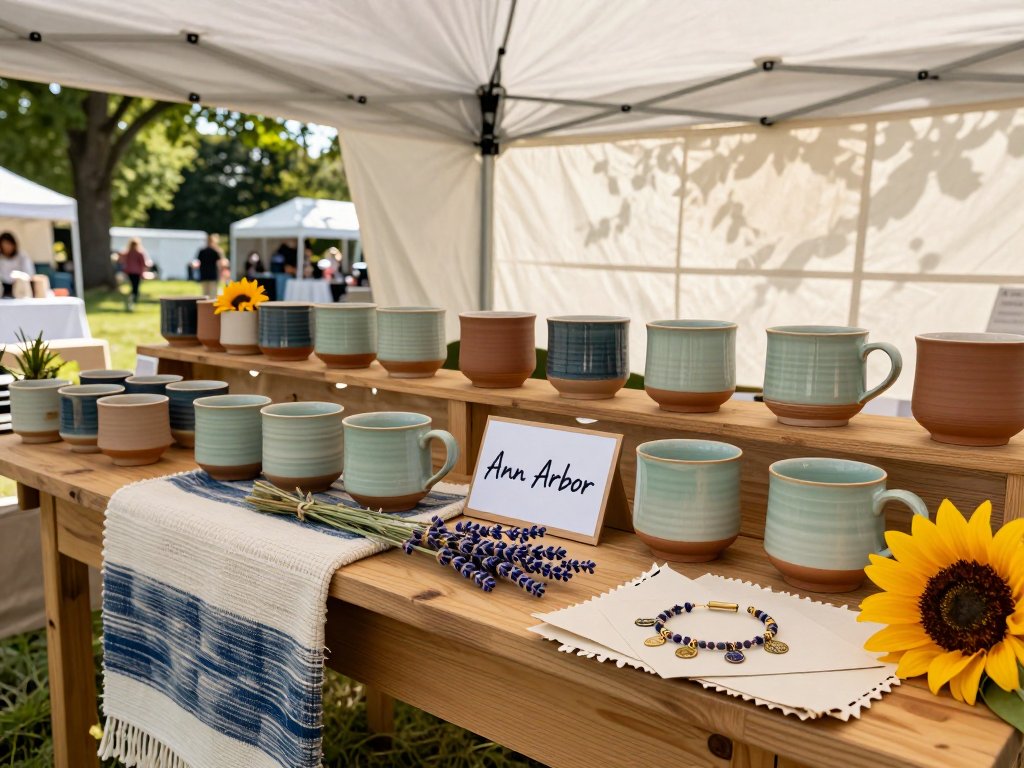
Ceramics have always been a beloved category at the Ann Arbor Art Fair, but the 2026 edition reveals a notable shift: potters are leaning into function with renewed purpose. The trend is not toward decorative sculptural pieces alone — it is toward pottery you can use, every single day.
Demand for functional pottery workshops has surged 80% in the past year, according to industry data.
Potters are responding by producing work that balances beauty with utility: mugs whose handles fit your hand perfectly, bowls whose glaze reveals something new with each angle of light, serving dishes designed to move from oven to table.
The ollas — traditional unglazed clay irrigation pots buried in gardens — have seen a surprising revival among home gardeners, and several Michigan potters are bringing them to the fair this year.
This trend connects to broader consumer values in 2026. People want objects that earn their place in the home.
A handmade mug costs more than a factory-produced one, but it offers something the mass-produced piece cannot: the slight irregularity of the potter's touch, the way glaze pools differently on each piece, and the knowledge that a human being shaped it on a wheel in a studio not so different from your own home.
The Ann Arbor Art Fair's long tradition of featuring ceramic artists gives fair-goers a rare opportunity to meet potters in person, discuss glazing techniques, and hold dozens of pieces before choosing one.
The South University area — now managed by the Guild's Summer Art Fair since 2020 — has become a particularly strong destination for ceramic artists, and the Guild's Emerging Artist Program (which selected twelve artists for shared 10-by-20-foot tents on South University this year) includes several promising young potters.
What to look for: Wheel-thrown mugs and bowls with earth-toned glazes, hand-built serving dishes with visible texture, ollas for garden irrigation, and minimalist porcelain pieces with soft cream and celadon finishes.
4. Charm Bars and Interactive Jewelry
Jewelry artists at the 2026 Ann Arbor Art Fair are bringing something new to their booths this year: the charm bar experience.
Charm jewelry has exploded in popularity over the past eighteen months. What started in New York City with Brooklyn Charm — now four locations and counting — has spread across the country as a DIY jewelry experience.
Customers select individual charms, beads, and spacers and assemble them onto a bar or chain to create a personalized piece.
Craft Industry Alliance's April 2026 report on "The Rise of the Charm Bar" notes that the charm bar creates a low-barrier entry point for jewelry buyers: the average charm purchase runs between $20 and $30, making it accessible while creating a personal connection between maker and buyer.
At the fair, you will see this trend manifest in several ways. Some jewelers are bringing actual charm bars — trays of loose charms that visitors can mix and match on the spot.
Others are creating pre-assembled charm necklaces that tell specific stories: a bird charm paired with a leaf and a tiny book charm, for example, evoking a walk in the woods with a good read.
Mixed-metal designs are especially popular in 2026, with silver-forward pieces accented in warm brass or copper tones.
Brooches are also making a strong comeback, worn not just on lapels but on bags, scarves, and even the straps of summer sandals.
The kinetic, interactive quality of modern jewelry — pieces that move, dangle, or reveal hidden details — speaks to the same desire for personal connection that drives the broader "Buy Less, Buy Better" movement.
For a jewelry artist at the fair, the charm bar model creates something special: a conversation.
The visitor talks about what they love, what matters to them, what symbols resonate. The artist helps assemble those symbols into a wearable piece.
That interaction — that shared act of creation — is exactly the kind of human connection that art fair visitors are seeking in 2026.
What to look for: Charm bar stations in jewelry booths, mixed-metal necklaces and bracelets, brooches designed for bag and scarf wear, lockets and pieces with hidden compartments or moving elements.
5. Handmade Paper and the Written Word
The art of papermaking is experiencing a renaissance, and the 2026 Ann Arbor Art Fair will be a wonderful place to see it firsthand.
Chicago Pulp, which opened its doors in September 2025, is one of several new studios across the Midwest dedicated to handmade papermaking.
Offering workshops, pulp sales, and open studio time, it represents a growing appetite for a craft that combines tactile pleasure with environmental mindfulness.
At the fair, look for paper artists who transform cotton fiber, abaca, and lokta into sheets with visible texture, embedded flower petals, and deckled edges that no machine can replicate.
This trend extends beyond papermaking into the broader category the Craft Industry Alliance calls "The Written Word." Journals, writing sets, poetry broadsides, wax seal kits, and text-based art are all gaining traction in 2026.
The desire is for tools and objects that support reflection, creativity, and intentional rituals — a quiet counterpoint to our always-on digital lives.
Several Ann Arbor Art Fair artists specialize in book arts as well: hand-bound journals with exposed stitching, artists' books that unfold like sculpture, and watercolor sketchbooks designed for plein air painting.
The practice of keeping a visual journal — mixing quick watercolor sketches with handwritten notes and pressed flowers — has grown significantly among hobbyist artists, and fair visitors often seek out handmade books to begin or continue their own practice.
One of the Ann Arbor Art Fair's most understated pleasures is the paper and book arts section, where the materials themselves — cotton rag paper, linen thread, leather bookcloth — feel like an education in craft history.
This is a revival of methods that connect us to centuries of artistic practice, made new again by artists who respect the tradition even as they push it forward.
What to look for: Handmade paper sheets and stationery, hand-bound journals with exposed stitching, watercolor sketchbooks, wax seal kits, poetry broadsides and text-based art prints.
6. Sustainable Materials and Foraged Craft
Sustainability is not a passing concern in the art world — it is becoming a defining value of the 2026 market. And at the Ann Arbor Art Fair, you will see artists integrating eco-conscious practices into their work in increasingly creative ways.
The "Buy Less, Buy Better" consumer mindset that the Craft Industry Alliance documented in its 2026 trend report shows up clearly at the fair.
Visitors arrive ready to invest in quality pieces that will last, and they are asking questions about materials.
Where does the wood come from? Is the clay locally sourced? Are the dyes natural or synthetic?
Artists who can tell a thoughtful story about their materials are finding that story resonates with buyers.
Foraged materials are appearing in more booths this year. Bark, fallen leaves, seed pods, and naturally shed wool are being incorporated into wall art, jewelry, and home decor.
Botanical dyes — colors coaxed from walnut hulls, marigold petals, and indigo — are showing up in textile and paper work.
Several Michigan artists are working with invasive plant species like spotted knapweed and garlic mustard, transforming ecological problems into beautiful objects while raising awareness about local ecosystems.
The Ann Arbor Art Fair's setting in a city known for its environmental consciousness — Ann Arbor has one of the most robust farmers' market and local-food cultures in the Midwest — makes it a natural home for this kind of work.
Fair visitors are already thoughtful consumers; they respond to artists who share their values.
This trend also connects to the broader nostalgia movement. Vintage and secondhand materials carry history in their fibers. A quilt made from repurposed 1950s tablecloths, a necklace assembled from antique buttons, a journal bound in reclaimed leather — these pieces offer the comfort of something old, made new through craft.
What to look for: Work made with foraged or invasive plant materials, botanical-dyed textiles and paper, upcycled and repurposed material jewelry, artists who describe their material sourcing in their booth signage.
7. The Grandma-Core Aesthetic: Nostalgia, Patchwork, and Whimsy
Perhaps the most delightful trend arriving at the 2026 Ann Arbor Art Fair is what trend forecasters have affectionately named "grandma-core." It is a celebration of the patterns, techniques, and sensibilities that we associate with grandmothers — patchwork, chintz, wallpaper florals, doilies, and the kind of cozy, collected interiors that feel like they have been layered over decades.
Grandma-core is not about replicating the past. It is about taking the visual language of domestic craft — the quilt blocks, the embroidered flowers, the carefully pieced scrap fabrics — and reimagining them for contemporary art and design.
At the fair, you will see it in paintings composed like quilt blocks, in textile work that references grand floral chintz patterns, and in decorative art that mixes stripes, florals, and polka dots in ways that feel both nostalgic and fresh.
Animal motifs are a strong sub-theme within grandma-core. The Craft Industry Alliance report notes that storybook animals — deer, foxes, rabbits, birds, butterflies — are increasingly popular in 2026, rendered in a style that feels more Beatrix Potter than National Geographic.
These motifs appear in everything from painted wooden ornaments to hand-embroidered wall hangings.
In the home decor realm, grandma-core shows up as "collected interiors" — the opposite of the matching-furniture-set aesthetic.
Artists are creating pieces that work together in eclectic groupings: vintage-style brass candlesticks, mismatched ceramic serving bowls, frames that have been layered and grouped on walls.
The Ann Arbor Art Fair, with its sprawling mix of hundreds of artists across dozens of categories, is the perfect place to start or continue a collected interior.
For fair visitors, grandma-core offers something genuinely comforting. After years of sleek minimalism and mid-century uniformity, these warm, pattern-rich, sentimental objects feel like a visual hug. They remind us of the craftspeople — often our grandmothers — who made beauty from whatever materials they had, stitch by patient stitch.
What to look for: Patchwork-inspired paintings and quilts, floral chintz patterns in textile and paper, storybook animal motifs, eclectic vintage-style home decor, anything that makes you think, "My grandmother would have loved this."
Planning Your Visit
The Ann Arbor Art Fair runs Thursday, July 16 through Saturday, July 18, 2026. Hours are 10 AM to 9 PM on Thursday and Friday, and 10 AM to 8 PM on Saturday. Admission is free.
All three fairs — the Ann Arbor Street Art Fair, the Original; the State Street District Art Fair; and the Guild's Ann Arbor Summer Art Fair — operate concurrently across downtown Ann Arbor.
Each fair has its own jury process, its own character, and its own commemorative 2026 poster artist.
Pick up a map at any information booth and plan to spend at least a full day if you want to see it all.
If you are a first-time visitor, here is a gentle suggestion: do not try to see everything.
Let yourself linger at the booths that draw you in. Talk to the artists — they are there because they want to share their work with you.
Ask about their materials, their techniques, their process. That conversation, the one you have standing in the July sunshine while you hold a handmade mug in your hands, is the real reason the Ann Arbor Art Fair has endured for sixty-six years.
Tying It All Together
The seven trends we have explored — mixed media and assemblage, textile art, functional ceramics, charm jewelry, handmade paper, sustainable materials, and the grandma-core aesthetic — are not separate movements. They are different expressions of a single cultural shift: a return to the handmade, the personal, and the meaningful.
In 2026, art fair visitors want objects that carry stories. They want work they can live with, use, and hand down.
They want to know the person behind the piece. And they are willing to invest in quality — not because they have to, but because the alternative, mass-produced objects made by unseen hands, no longer satisfies something essential.
The Ann Arbor Art Fair has been the stage for this kind of exchange since 1960.
It is still the kind of place where an artist sets up a booth on a city street, you stop to look, and a conversation begins.
That is the oldest trend of all — and it never goes out of style.