Introduction
There was a time not so long ago when the words "homemade sweater" conjured an image of something itchy, misshapen, and destined for the back of a closet — a gift from a well-meaning grandmother that one wore only under duress.
Crochet was the province of doilies and doll clothes. Patchwork belonged to quilting bees and pioneer reenactments.
Knitting was something retired women did while watching television, producing lumpy scarves that no one actually wanted to wear.
Look at the runways of Paris, Milan, and New York today, and you will see something remarkable: these very same techniques, once dismissed as domestic busywork, have been elevated to the highest tiers of fashion.
Miu Miu's patchwork denim skirts sell for thousands of dollars and sell out within hours.
Loewe's Jonathan Anderson sends crochet dresses and hand-knitted sweaters down the catwalk to thunderous applause.
Bottega Veneta's Intrecciato leather weaving — a direct descendant of basket-weaving and textile craft — has become one of the most recognizable luxury signatures of the decade.
This is not a passing trend. It is a cultural reckoning. The handmade has become a quiet revolution, and its story is about far more than fashion.
It is about who gets to decide what art is, what we value in an age of mass production, and how a generation raised on screens is rediscovering the profound satisfaction of making something with their own two hands.
The Reclaiming of 'Women's Work' as High Art
To understand why knitting, crochet, and patchwork matter now, we have to understand why they were dismissed in the first place.
The story begins in the 19th century, when the Industrial Revolution split the world of making into two spheres: the professional (male, paid, factory-based) and the domestic (female, unpaid, home-based).
Embroidery, quilting, knitting, and crochet were classified as "accomplishments" — pleasant skills that a gentlewoman might cultivate, but never mistake for serious art.
This hierarchy persisted well into the 20th century. When the feminist art movement of the 1960s and 1970s began challenging the boundaries of what art could be, one of its central acts was to reclaim these dismissed techniques.
Judy Chicago's The Dinner Party (1974–79) used ceramic painting and textile techniques to honor women throughout history — and was met with vicious criticism from the art establishment precisely because it looked like "craft." Miriam Schapiro's "femmages" — collages incorporating fabric, stitching, and quilting patterns — explicitly argued that the decorative arts practiced by women were as worthy of museum walls as any painting by a man.
Fast-forward half a century, and that argument has been decisively won. The Victoria and Albert Museum's "Fashioning Masculinities" exhibition featured knitted and crocheted garments as centerpieces.
The Museum of Modern Art has acquired works by fiber artists like Sheila Hicks and Anni Albers.
The Craftivist Collective has exhibited at the Tate Modern. And in 2022, the Met's "In America: A Lexicon of Fashion" included hand-knitted and crocheted pieces that would have been unthinkable on that stage a generation ago.
What changed? In part, the artists themselves refused to accept second-class status. Fiber artists of the 1960s and 70s — names like Lenore Tawney, Magdalena Abakanowicz, and Olga de Amaral — pushed the technical and conceptual boundaries of textile work until museums could no longer ignore them.
Their enormous woven sculptures, crocheted installations, and stitched canvases demanded to be seen as art, not craft.
Today, contemporary artists like Diedrick Bracken, Tschabalala Self, and Shoplifter (Hrafnhildur Arnardóttir) continue this tradition, using yarn, fabric, and thread to create works that are unapologetically ambitious.
But the reclaiming has also happened on the streets and in the living rooms. When millions of women picked up knitting needles during the pandemic, they were not just passing time.
They were participating in a quiet revaluation of the domestic arts — a recognition that the skills our grandmothers possessed were not trivial, but deeply sophisticated.
A crocheted sweater requires geometry, tension math, pattern reading, and three-dimensional thinking. A quilting pattern like the "double wedding ring" involves precision engineering that would challenge a trained architect.
To dismiss these as "women's work" was always a prejudice, never a judgment of their actual complexity.
This historical recontextualization is essential for understanding the current moment. We are not discovering these crafts for the first time. We are rediscovering them — and giving them the respect they have always deserved.
Sustainability and Slow Fashion: The Ethical Stitch
It is no coincidence that the rise of craft in fashion has happened alongside the growing reckoning with fast fashion's environmental toll.
The fashion industry is responsible for an estimated 10% of global carbon emissions and 20% of global wastewater.
Mountains of discarded clothing fill landfills in the Global South. Microplastics from synthetic fabrics have been found in Arctic ice and human placentas.
Against this backdrop, the handmade garment has become something far more significant than a style choice.
It is a philosophical statement. Every hand-knitted sweater is a repudiation of the $5 fast-fashion T-shirt.
Every crocheted bag is a refusal of the disposable consumption cycle. Every patchwork garment — assembled from scraps and remnants — is a small act of resistance against a system built on planned obsolescence.
The visible mending movement, pioneered by figures like Celia Pym and Katrina Rodabaugh, has turned repair into an art form.
Instead of hiding holes and tears, visible menders celebrate them — using contrasting yarns, decorative darning patterns, and elaborate patching to make the repair the most beautiful part of the garment.
A sweater with visibly darned elbows becomes not a damaged item, but a treasured one, its history written in its stitches.
This philosophy, known as "slow fashion," draws inspiration from the slow food movement and applies its logic to clothing. It emphasizes:
- Quality over quantity: One hand-knitted sweater that lasts decades versus ten cheap sweaters that pill, stretch, and fall apart in a season.
- Local production: Garments made from locally sourced wool or cotton, reducing transportation emissions.
- Transparency: Knowing exactly where your yarn came from, who spun it, and who knitted it — a radical proposition in an industry defined by opaque supply chains.
- Emotional durability: The garment you made yourself, or that was made for you by someone who cares, is far less likely to be thrown away.
The numbers bear this out. A 2021 study by the Fashion Revolution movement found that garments made with hand techniques have an average lifespan three to five times longer than mass-produced equivalents.
A hand-knitted sweater might take 40 to 80 hours to produce; its owner is unlikely to discard it after a single season.
By contrast, the average fast-fashion garment is worn just seven times before being thrown away.
Upcycled patchwork has become one of the most visible manifestations of this ethos. Designers like Bode, Emily Adams Bode's eponymous label, build entire collections from antique quilts, vintage textiles, and deadstock fabrics.
Each piece is literally one of a kind — there can be no mass production when you are working with a single 19th-century quilt.
Similarly, labels like Ré, Collina Strada, and Marine Serre have made patchwork and upcycling central to their design language, transforming waste fabric into garments that are more beautiful — and more meaningful — than anything made from new materials.
For the home craftsperson, this translates into a growing enthusiasm for "stash busting" — using up accumulated yarn and fabric scraps rather than buying new.
Ravelry, the online community for knitters and crocheters, hosts thousands of "stash busting" patterns designed specifically to use partial skeins and leftover bits.
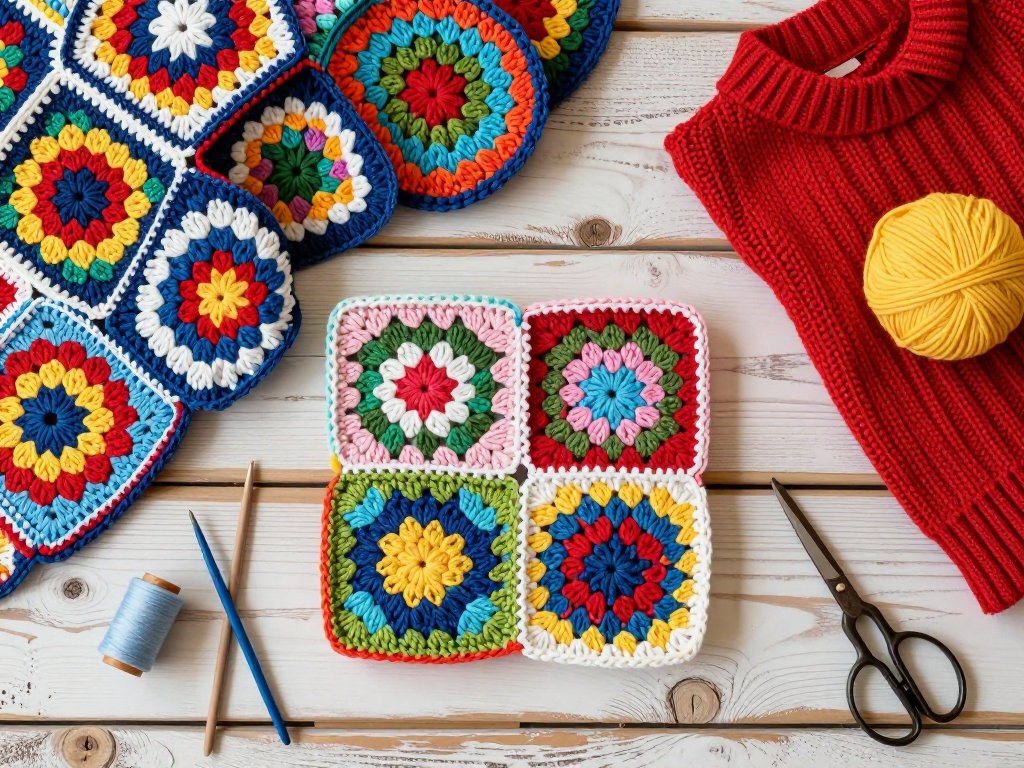
The humble granny square, that most classic of crochet motifs, becomes a sustainable powerhouse when made from scraps: each square uses a tiny amount of yarn, and dozens of them can be combined into blankets, bags, sweaters, and coats that are not only beautiful but made entirely from material that would otherwise have been waste.
Sustainable yarn choices have also expanded dramatically. Small-batch dyers using plant-based, low-impact dyes have proliferated on platforms like Etsy and Instagram.
Wool from heritage breed sheep — whose grazing practices actually benefit ecosystems — has found a passionate audience.
Hemp, linen, and Tencel yarns offer vegan alternatives that biodegrade at the end of their long lives.
The craft industry has responded to this demand with a wave of eco-conscious products that simply did not exist a decade ago.
DIY Culture and TikTok Craftivism: The Democratization of Making
If sustainability provides the moral urgency, social media has provided the fuel. The rise of #knittingtok and #crochettok on TikTok has been nothing short of explosive.
The hashtag #crochet has accumulated over 30 billion views on the platform. #Knitting has another 15 billion.
These are not niche communities — they are among the most active and engaged corners of the entire platform.
What is remarkable about this digital craft renaissance is how it has upended traditional learning pathways.
In the past, learning to knit or crochet typically required a teacher — a grandmother, a friend, a class at a local yarn shop.
Today, a 14-year-old in Jakarta can learn to crochet a granny square from a 60-second TikTok posted by a teenager in Texas, and then adapt it into a sweater using a YouTube tutorial from a designer in Finland.
The knowledge transfer is instantaneous, global, and free.
This democratization has produced an explosion of creativity. Traditional patterns are being reinterpreted, remixed, and reimagined in real time.
The "cardigan of the week" phenomenon — in which a new sweater design goes viral and thousands of people make their own versions simultaneously — has become a recurring feature of the platform.
Designers like Ann Manser, who posts free patterns on TikTok under the handle @annmanser, have built audiences of hundreds of thousands simply by sharing clear, accessible instructions.
The line between designer and maker has blurred to the point of near invisibility.
But TikTok craft culture is not only about aesthetics. It has also become a powerful vehicle for what scholars call "craftivism" — the intersection of craft and activism.
The most famous example remains the Pussyhat Project, launched in the lead-up to the 2017 Women's March.
The project called for knitters and crocheters to create pink hats to be worn at marches worldwide, and the response was staggering.
Over 2.5 million hats were made, turning a knitted object into one of the most recognizable symbols of political protest in modern history.
Yarn bombing — the practice of covering public objects (statues, lampposts, bus shelters, entire buildings) in knitted or crocheted fabric — has become a global phenomenon.
Pioneered by artists like Magda Sayeg and the Houston-based Knit the World collective, yarn bombing transforms urban spaces into unexpected galleries of textile art.
A bronze statue wrapped in a crocheted scarf and hat is impossible to ignore; it forces passersby to reconsider their relationship with both public space and the handmade.
The practice has been used to draw attention to issues ranging from homelessness to climate change to the erosion of public funding for the arts.
Craftivism projects have multiplied in recent years. The Temperate House project at the Kew Royal Botanic Gardens invited crocheters worldwide to create "endangered plant" installations to draw attention to botanical extinction.
The Social Justice Sewing Academy uses quilt-making to amplify marginalized voices and document social justice movements.
Knitters without Borders, organized through Ravelry, has raised over a million dollars for Doctors Without Borders through craft-related fundraising events.
The intersection of craft and activism has become so established that it now has its own scholarship, its own conferences, and its own dedicated museums.
What makes craftivism so effective is its inherent contradiction. Knitting and crochet read as gentle, domestic, non-threatening — the very qualities that led to their historic dismissal.
When these techniques are used to make political statements, they disarm the viewer. A knitted banner reading "Climate Justice Now" is harder to dismiss than a screen-printed one; its handmade quality signals care, conviction, and the investment of real time.
It says: this matters enough that someone spent dozens of hours making it.
The DIY culture surrounding these practices has also created new economic models. Independent pattern designers on platforms like Ravelry, Etsy, and Payhip can earn a full-time living selling digital patterns.
Small-batch dyers and spinners have built thriving businesses supplying the home craft market. The "maker" economy — estimated at over $10 billion globally — runs on the passion of people who make things for the joy of making, even as some have turned that passion into a livelihood.
It is a cottage industry in the truest sense: work done at home, by hand, with love.
High-Low Fusion: From Granny Squares to Couture Runways
The most visible proof of craft's cultural ascendance is the way high fashion has embraced it.
The relationship between luxury fashion and handcraft is not new — haute couture has always relied on extraordinary handwork — but what has changed is the type of handwork being celebrated.
It is no longer just the invisible, impossibly fine embroidery of a Parisian atelier. It is the visible, imperfect, proudly handmade aesthetic of the domestic crafter.
Miu Miu's patchwork collections may be the single most influential example. In 2022, Miuccia Prada sent patchwork denim miniskirts and jackets down the runway that looked as though they had been assembled from thrift-store remnants — mismatched washes, visible seams, raw edges, and all.
The collection sold out immediately. Copycat versions flooded fast-fashion websites within weeks. The message was unmistakable: the aesthetic of the homemade, the improvised, the pieced-together had become the most desirable look in fashion.
Loewe's creative director Jonathan Anderson has been perhaps the most consistent champion of craft techniques in luxury fashion.
His collections for Loewe have featured crocheted dresses that resemble handmade doilies writ large, intarsia-knitted sweaters with photorealistic imagery, and patchwork leather goods that celebrate the beauty of piecing.
Anderson has spoken openly about his fascination with traditional craft techniques and his desire to bring them into the realm of high fashion without polishing away their handmade character.
His Fall/Winter 2023 collection featured dresses made from hand-crocheted raffia that took over 500 hours each to produce — a labor investment that would be impossible to justify in any commercial system not built on the cachet of the handmade.
Bottega Veneta, under both Daniel Lee and now Matthieu Blazy, has built its identity around a technique — Intrecciato leather weaving — that is itself a form of craft.
The woven leather bags, shoes, and accessories evoke basket-weaving, a textile technique thousands of years old.
The brand's celebration of handwork has resonated powerfully with consumers weary of logo-covered mass production.
In a world of identical designer bags, a woven leather piece reads as unique, as made, as real.
The influence flows both ways. Luxury designers look to folk traditions and home crafts for inspiration; at the same time, home crafters are creating pieces that rival what appears on runways.
The Instagram and TikTok feeds of independent crochet artists like Aya Kakeda (who designs for fashion labels under the handle @chocokabocha) and the collaborative work of the Lune Collective show garment-making that is every bit as sophisticated as what Loewe or Miu Miu produce.
The difference is only one of price and brand — not of skill or creativity.
Exhibitions have been crucial in cementing this fusion. The "Fashion and Textile" exhibitions at museums worldwide have devoted increasing space to handcraft techniques.
The Louvre's 2023 "Fashion and Textile: The Art of Handwork" exhibition placed couture garments alongside traditional folk textiles, arguing for a continuous lineage of craft excellence.
The Museum at FIT's "Fabric of Fashion" explored how designers from Schiaparelli to McQueen have incorporated handcraft techniques.
Each exhibition reinforces the same message: there is no meaningful distinction between "art" textiles and "craft" textiles.
There is only good work and less good work.
The granny square — that humble crochet motif, beloved of grandmothers and beginners alike — exemplifies this high-low fusion better than any single object.
It began as a practical way to use up yarn scraps, each small square worked in the round and then joined to others.
For decades, it was the very definition of craft kitsch: the granny square afghan, the granny square vest, the granny square everything.
And then, in the 2020s, the granny square was reborn. TikTok crocheters began making granny square sweaters, bags, and bikinis in bold, modern color combinations.
High-fashion brands followed. Suddenly, the granny square was on the cover of Vogue, on the runways of Copenhagen Fashion Week, and on the backs of celebrities like Harry Styles and Bella Hadid.
What had been the ultimate symbol of domestic craft had become an avatar of contemporary cool.
This transformation did not happen by accident. It was driven by a generation of young makers who refused to accept the hierarchy that said a hand-crocheted garment was less worthy than a machine-made one.
They saw the beauty in the irregular stitch, the charm in the slightly uneven edge, the profound skill involved in creating fabric from a single strand of yarn and a hook.
In embracing the granny square, they were not being ironic or nostalgic — they were making a genuine aesthetic claim about what is beautiful and worthy of celebration.
Conclusion: The Future of Making
What we are witnessing is nothing less than a revaluation of the handmade. After centuries of being dismissed as women's work, domestic pastime, or quaint hobby, knitting, crochet, patchwork, and their related crafts have claimed their place in the world of serious art and serious fashion.
The journey has taken them from the parlor to the protest march, from the quilting bee to the museum gallery, from the grandmother's rocking chair to the runways of Paris.
This is not to say that the work is done. The craft community continues to grapple with issues of cultural appropriation, as traditional techniques from non-Western cultures are sometimes adopted without acknowledgment or respect.
The labor of the handmade is still undervalued — a hand-knitted sweater may sell for hundreds of dollars, but the maker's hourly wage is often below minimum.
And the environmental benefits of handmade clothing are only meaningful if we actually wear and care for these garments, rather than treating them as disposable novelties.
But the direction is clear. The boundaries between art and craft, between high fashion and homemade, between the professional and the amateur, have become porous to the point of irrelevance.
What matters now is not whether a piece was made by hand or by machine, not whether it was produced in a Paris atelier or a suburban living room, but whether it was made with skill, intention, and care.
Those qualities transcend categories. They are what make something worth keeping, worth wearing, and worth passing on.
For the home crafter, this moment offers something precious: permission. Permission to take your craft seriously, even if you learned it from a YouTube video.
Permission to call what you make art, even if it started as a granny square.
Permission to spend hours on something that could be bought in a store for a fraction of the time — because the time itself is the point.
The act of making is not just about producing a garment. It is about reclaiming a piece of our humanity in an age of machines.
The stitch you are working on right now — whether it is a knit stitch, a single crochet, a running stitch, or a patchwork seam — connects you to a lineage of makers stretching back centuries.
The women (and they were mostly women) who sat by firelight piecing quilts, who knitted socks for soldiers, who crocheted lace to adorn their homes against the drabness of poverty, who embroidered their names into fabric to leave a trace of their existence — they did not think of what they were doing as art.
But they were making art nonetheless, and they were making meaning. We, their descendants in stitch, are finally ready to see it.