Introduction
There is a special kind of magic in giving jewelry you made yourself. The recipient sees the hours of care in every wrapped coil and every perfectly placed bead — and you get the quiet thrill of watching someone fall in love with something your hands created.
But handmade gifts carry one worry that store-bought presents never do: the cost of supplies.
Good jewelry materials can add up fast, and nobody wants to spend more making a gift than they would spend buying one.
Here is the good news: beautiful handmade jewelry does not require a big budget. With a little planning, you can create gifts that look professionally made for under fifty dollars in supplies — and often far less.
The secret is choosing projects with short supply lists, buying materials in quantities that make sense for the project, and letting simple techniques do the heavy lifting.
This guide walks through seven jewelry gifts you can make at home, with honest budget breakdowns for each one. Whether you are shopping for a birthday, a holiday, or a just-because moment, there is a project here that fits your budget and your skill level.
Why Handmade Jewelry Makes the Best Gift
Handmade jewelry occupies a sweet spot that few other gifts can match. It is personal — you chose the colors, the stones, the style with a specific person in mind.
It is practical — jewelry gets worn, often daily, so your gift becomes part of someone's everyday life.
And it is deeply thoughtful in a way that a gift card simply cannot replicate.
There is also a lovely economy to it. A twenty-dollar beaded bracelet made with gemstone chips and sterling silver findings can look every bit as refined as a boutique piece at three times the price.
The materials are honest, the craftsmanship is real, and the story behind the gift — "I made this for you" — is priceless.
For the maker, jewelry is one of the most forgiving crafts to start. The tools are small and inexpensive, the projects are quick, and mistakes are easy to undo. A beginner can produce a genuinely beautiful piece in a single evening, which makes it perfect for gift-making season.
Budgeting Your Jewelry Supplies
Before you buy anything, plan your budget around the whole project — not just the beads. A common beginner mistake is buying a little of everything and ending up with a drawer full of orphaned supplies. Instead, pick a project, list its exact materials, and buy only what you need.
Here is what a reasonable starter supply kit costs in general terms. A spool of craft wire runs about five to eight dollars and will make many projects.
A small assortment of beads — glass, wood, or gemstone chips — costs anywhere from five to fifteen dollars depending on the material and where you shop.
Findings like ear wires, jump rings, and clasps are sold in small packs for two to five dollars each.
Pliers, the one real tool investment, cost about ten to fifteen dollars for a decent set that will last for years.
The key to staying under fifty dollars per gift is matching the project to the recipient's taste, not the price tag.
Simple designs with high-quality materials read as elegant; busy designs with cheap materials read as crafty.
Spend your money on the centerpiece — a beautiful focal bead, a strand of genuine stones — and let simple wire or cord carry the rest.
Gemstone Chip Beaded Bracelets
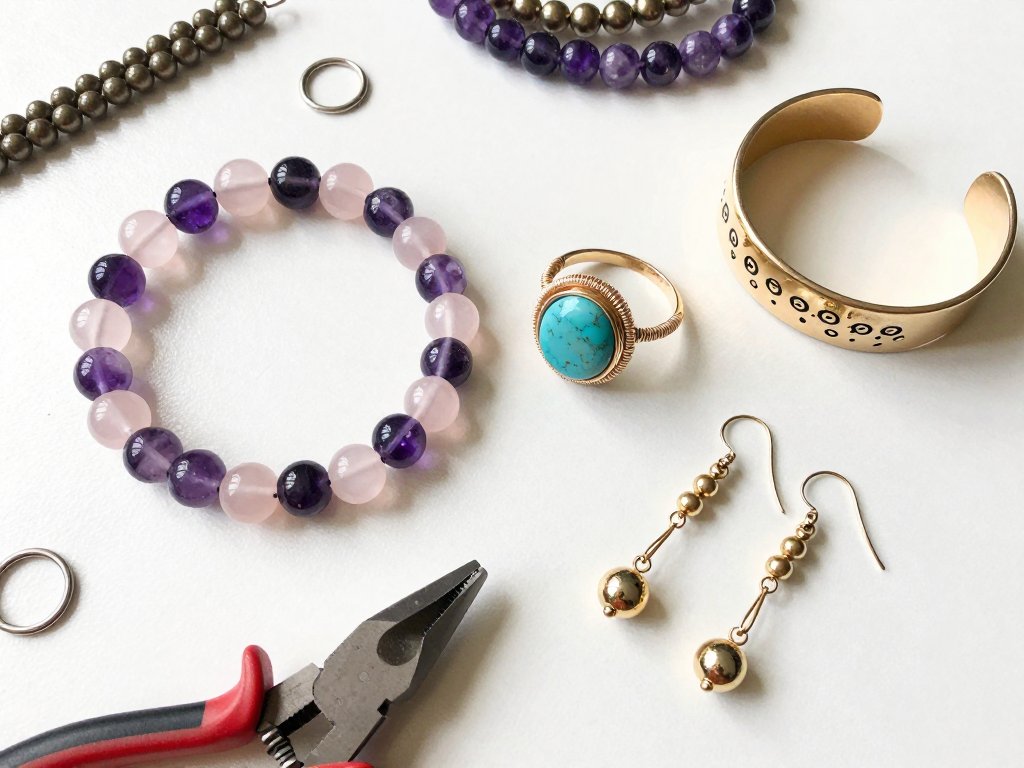
This is the project that converts skeptics. A strand of genuine gemstone chips — amethyst, rose quartz, turquoise, or howlite — costs about eight to twelve dollars and makes several bracelets.
Add a small pack of elastic cord and a few silver or gold spacer beads, and you have a gift that looks boutique-bought.
To make one, cut a piece of elastic cord about twelve inches long, fold it in half, and thread your beads onto the doubled cord in a pattern you like.
When the bracelet reaches the desired length, tie a secure square knot, add a tiny drop of jewelry glue to the knot, and trim the ends close.
The doubled cord keeps the bracelet from stretching out over time.
Budget: roughly ten to fifteen dollars in supplies for two or three bracelets. These are wonderful for making matching sets — a bracelet for a friend and a mini version for her daughter, or a whole family set in coordinating stones.
Wire-Wrapped Stone Rings
A single beautiful stone and a few inches of wire become a statement ring that looks like it came from a designer studio. Choose a smooth cabochon or a large faceted bead as the centerpiece, and use 20-gauge craft wire in silver, gold, or copper tones.
Wrap the wire around the stone in a simple cage — two wires crossing over the top, wrapped tightly around the base — and form the band by wrapping the wire tails around a ring mandrel or a marker.
Twist the ends together neatly, trim, and tuck. The whole process takes about twenty minutes once you have the rhythm.
Budget: three to six dollars per ring, depending on the stone. These make fantastic gifts for teens and adults alike, and they are small enough to tuck into a card or stocking. Make a set of three in different stones, and you have a gift with real presence.
Simple Drop Earrings
Earrings are the most economical jewelry gift you can make, because a single pack of findings serves many pairs. Start with a pack of ear wires — about three to five dollars for a dozen pairs' worth of hooks — and pair them with beads you already love.
The simplest design is a head pin threaded with one or two beads, with a wrapped loop at the top connecting it to the ear wire.
A slightly more advanced version uses a small chain: attach a length of chain to the ear wire, add a bead dangle at the bottom with a jump ring, and you have elegant movement that catches the light.
Matching pairs take about fifteen minutes each.
Budget: two to five dollars per pair. Because the cost is so low, you can make several pairs and gift them as a small set — three pairs in coordinating colors makes a thoughtful present that feels generous without straining your wallet.
Memory Wire Bangles
Memory wire is a jeweler's best friend for gift making. It comes pre-coiled in bracelet, ring, and necklace sizes, and it holds its shape without a clasp — the wearer simply slides it on and off. A pack of memory wire costs about five dollars and makes several bangles.
Cut a coil of memory wire with a pair of heavy-duty cutters, then thread beads onto the open end, leaving about an inch of bare wire at each end.
Finish the ends by bending them into small loops with round-nose pliers, so they do not snag clothing.
The result is a bangle that stacks beautifully with other bracelets and never needs a clasp.
Budget: five to eight dollars per bangle. These are perfect for beginners because there is no clasp to attach and no sizing guesswork — the coil does the work. Gift one alone, or make a stack of three in different colors for a bolder present.
Pendant Necklaces With Fabric Cord
A single striking pendant on a simple cord is one of the most elegant gifts you can make, and one of the most affordable.
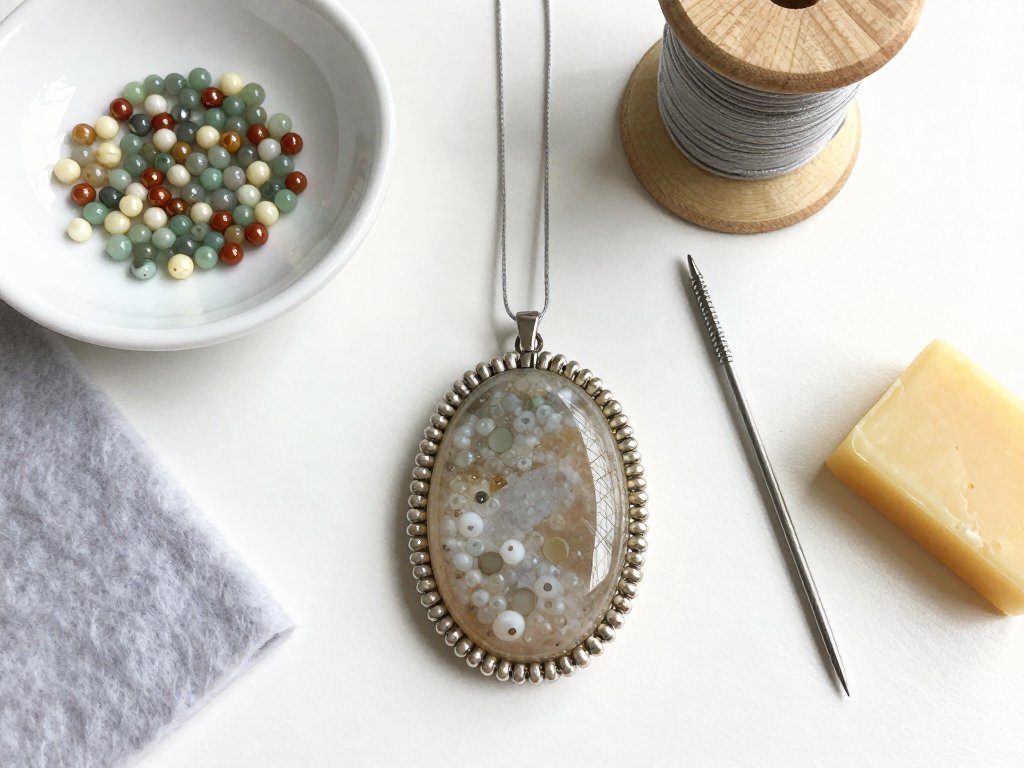
The trick is choosing a pendant with presence — a large faceted bead, a polished stone with a hole, a vintage button, or a piece of sea glass you collected on a beach walk.
Thread the pendant onto a length of waxed cotton cord or leather cord, and finish the ends with a sliding knot closure so the necklace fits any neckline.
Sliding knots sound tricky, but they are just two simple knots mirrored on each side of the cord; a two-minute video tutorial will have you making them confidently.
Trim the ends and add a small bead to each for a finished look.
Budget: five to twelve dollars, depending on the pendant. The beauty of this project is its emotional weight — a pendant with personal meaning, like a stone from a favorite beach or a button from a grandmother's coat, transforms an inexpensive gift into an heirloom.
Charm Bracelets and Keychains
Charm jewelry is endlessly personal, which makes it a wonderful gift for someone you know well. Start with a chain bracelet or a sturdy keychain ring, then add charms that tell the recipient's story — their initials, a tiny heart, a birthstone bead, a miniature of their favorite hobby.
Charms are surprisingly affordable when bought individually, and a small selection lets you build something unique.
Attach each charm with a jump ring, using two pairs of pliers to open and close the rings cleanly.
Arrange the charms with a little breathing room between them so the piece moves well when worn.
Budget: eight to twenty dollars depending on the number and type of charms. For a friend going through a big life moment — a new job, a new baby, a milestone birthday — a charm bracelet built around that moment is a gift they will treasure for years.
When you are choosing charms, think about what the recipient reaches for every day. A person who loves cooking might smile at a tiny whisk or spoon charm; a gardener might adore a small leaf or flower. The most meaningful charm bracelets are the ones that look like a tiny biography of the person wearing them.
Stamped Metal Cuffs
For the maker who wants to add a personal message, stamped metal cuffs are a satisfying next step.
You will need a metal cuff blank — about four to six dollars — a letter stamping set, and a hammer.
Place the cuff on a hard surface, position your letter stamps carefully, and tap each one once with the hammer for a crisp impression.
Practice on a scrap piece of metal first, because the first few stamps are always a little shaky.
Once you are comfortable, stamp a name, a date, a short word, or a tiny symbol onto the cuff.
You can leave the metal bright or darken the letters with a dab of liver of sulfur for an antique contrast.
Budget: ten to fifteen dollars for the blank and stamps, with the stamps reusable for dozens of future gifts. A cuff stamped with a child's name, a couple's anniversary date, or a single meaningful word is the kind of gift that gets worn every single day.
Putting Together a Gift Set
If you cannot choose just one project, combine two or three into a coordinated gift set.
A pair of drop earrings and a matching memory wire bangle, made with the same beads, reads as a complete jewelry collection.
A pendant necklace with a matching ring makes a lovely "signature pieces" gift for someone with a bold style.
Package your handmade jewelry with intention. A small gift box with a bit of tissue, a handwritten card explaining what you made and why, and a care note about the materials transforms the presentation from homemade to handcrafted.
The packaging costs a dollar or two, and it makes the gift feel complete.
Coordinated sets also stretch your supply budget further — buying beads in slightly larger quantities for a matching set costs less per piece than buying separately for each individual item.
Conclusion
Handmade jewelry is one of the most generous gifts you can give, and it does not have to cost a fortune to make.
With thoughtful supply choices and simple, honest techniques, you can create pieces that look professionally made — and carry a story no store-bought gift ever could.
A fifty-dollar budget is plenty for a beautiful bracelet, a pair of elegant earrings, a personalized cuff, or even a full matching set.
Start with the recipient in mind. Think about their colors, their style, the moments you want to honor — then let that guide your materials and design.
The jewelry you make will be worn, admired, and remembered long after the occasion has passed, and that is the truest measure of a gift's worth.
When the season of giving rolls around, you will be ready. Stock a few basics, keep your pliers close, and let each handmade piece carry a little of your heart to someone you love.