Introduction
There is a particular quiet in a pottery studio the night before a firing. The pots are dry, the shelves are set, and the kiln waits like a patient animal. Everything you have made so far can still be undone by a clumsy thumb.
Firing is the step that changes that. Clay goes in soft and comes out permanent. It is also the step most beginners dread, because it seems to involve machinery, numbers, and consequences.
It does involve all three. But the machinery is simpler than it looks, and the numbers are just a way of writing down heat. Once you understand what a kiln is actually doing, the fear settles into something more useful: attention.
This guide walks through the two firings, the cone packs that tell you the truth about your kiln, and the small rituals that keep a firing uneventful. Uneventful is the goal. A boring firing is a good firing.
What a Kiln Actually Does
A kiln is a box that gets very hot, very slowly, and then cools very slowly. That is the whole machine. The complexity lives in the schedule — how fast the heat rises, how long it rests, and how gently it comes back down.
Clay is not simply dried by firing. It is transformed. At roughly 1,000°F the clay's chemically bound water leaves, and the material can never return to a soft, slakeable state again.
Higher still, the particles begin to fuse at their edges. The body densifies, strengthens, and becomes slightly less porous. This is why a fired pot rings when you tap it and a greenware pot only thuds.
Heat work is the phrase potters use for this combination of temperature and time. A kiln held at a lower temperature for a long while can accomplish what a quick climb to a higher number cannot. Time is an ingredient.
The First Firing: Bisque
Bisque is the fire that turns greenware into something you can handle. Its purposes are modest and specific: drive off the last chemically bound water, burn away organic material, and leave the ware durable enough to survive glazing.
Bisqued pots are chalky, pale, and pleasantly thirsty. They will not dissolve if you dunk them. They can be sanded, rinsed, and handled without crumbling.
The standard bisque range runs from cone 06 to cone 04. Many studios bisque at 04 for strength; home potters often use 06 to keep the body open and absorbent. Either is defensible.
Why Bisque Must Go Slowly
The dangerous part of any firing is the beginning. Water trapped inside the clay wall turns to steam, and steam expands. If it cannot escape as fast as it forms, the piece fractures or explodes.
This is why bisque schedules include a candling stage — a long, low hold at the start, often around 180°F to 200°F, sometimes for several hours. The kiln's lid or vent stays open so moisture can leave.
Candling is not wasted time. It is the difference between a shelf of pots and a shelf of shards. Thick pieces, hand-built slabs, and anything joined with slip need more of it, not less.
Never Open the Lid Hot
A kiln at 900°F looks unremarkable through the peephole. It is not unremarkable. Cold air rushing onto hot ware causes thermal shock, and a piece can crack from a difference of a few hundred degrees.
Wait until the kiln reads below 200°F, ideally lower. The pots are not going anywhere. Opening early to "check" is the single most common way beginners lose work they had already made successfully.
The Second Firing: Glaze
Glaze firing goes higher — commonly cone 5 to cone 6 in mid-range studios, sometimes cone 10 in reduction. At these temperatures the clay body continues to vitrify and the glaze melts into glass.
Glaze needs its own trip through the kiln because it is a separate material with its own melting point. Bisque temperatures are not hot enough to fuse most glazes into a durable, food-safe surface.
Bisque and glaze are not interchangeable. You bisque first, glaze the cooled ware, then fire again. A glazed piece cannot be returned to greenware or re-bisqued — the glaze has already bonded to the body.
What Happens to Clay and Glaze Together
During the glaze fire, the body shrinks slightly while the glaze becomes liquid. The glaze pulls tight across the form, following every curve and every tool mark you left.
Where glaze is thin it may break over an edge, revealing the clay beneath. Where it pools it deepens in color. These are the accidents that make glazed pottery interesting, and they are decided by heat as much as by application.
Pyrometric Cones, Explained Properly
A cone is a small pyramid of clay and ceramic materials formulated to deform at a specific amount of heat work. It does not measure temperature. It measures the accumulated effect of temperature over time.
This distinction is the heart of kiln firing. A cone bends when it has received enough heat, whether that heat arrived fast and hot or slow and moderate. That is exactly what clay and glaze experience.
Witness Cones and Cone Packs
A witness cone is a single cone placed in the kiln where you can see it through the peephole. It tells you what happened at that spot.
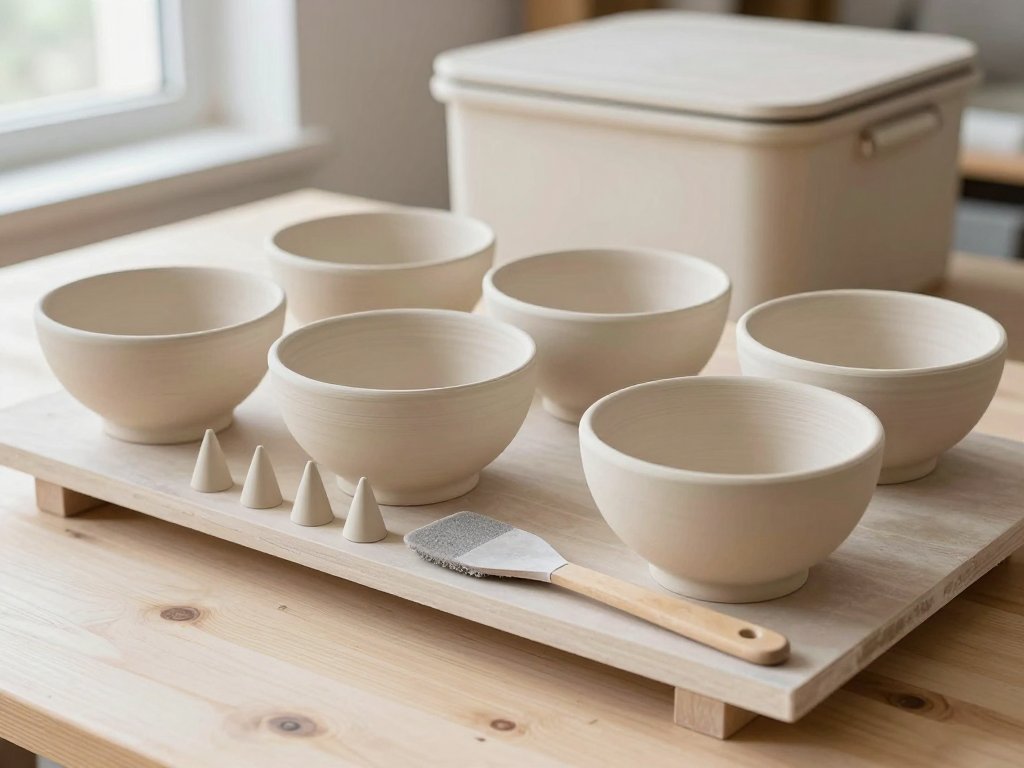
A cone pack is three cones standing together: one at the target, one a number cooler, one a number hotter. This is far more informative than a single cone.
The lower cone should be slumped or touching its base. The target cone should bend to about 90 degrees, tip near the shelf. The higher cone should still be upright or only beginning to lean.
If you get that pattern, the firing reached your intended heat work. If all three are flat, you over-fired. If only the lower one bent, you under-fired.
Self-Supporting Versus Large Cones
Self-supporting cones have a wide clay base and stand on their own. They are convenient, need no cone plaques, and are the easiest choice for beginners.
Large cones are the traditional form and must be set into a wad of clay or a purpose-made plaque at a precise angle. They are cheaper in bulk and common in shared studios.
Either works. What matters is consistency — use the same type and the same mounting angle every time, so your readings are comparable from firing to firing.
The Numbering Scale Runs Backwards
This trips up nearly everyone. Cone numbers do not ascend with heat. They descend toward zero and then climb again for high fire.
Low-fire glazes live from cone 022 up to cone 01. The leading zero matters: 022 is cooler than 02, and both are cooler than cone 1.
Mid-range runs from cone 04 up through cone 6. High-fire work sits between cone 8 and cone 14. Notice the oddity: cone 04 is cooler than cone 4, despite the extra digit.
The scale is not a straight line either. The steps grow larger as the numbers climb, which is why cone 5 to 6 covers more heat than cone 05 to 04.
Why Cones Beat the Dial
Your kiln's dial, controller, or kiln-sitter measures a guess. A thermocouple reads the air temperature at one point. A sitter clicks off when a rod softens. Neither knows what your ware experienced.
Elements wear. A kiln that fired to cone 6 in four hours last year may take six hours this year, and the dial will not mention it. Cones do.
This is why potters say the kiln does not know what cone it fired to until the cones are read. The cone pack is your record, your evidence, and your calibration.
Reading a Fired Cone
Cone 1, barely tipped: the kiln fell short. Cone 2, bent to 90 degrees with the tip reaching the shelf: the kiln arrived. Cone 3, collapsed into a puddle: the kiln went too far.
Note which cone you placed where. A pack near the top of the kiln often reads a cone hotter than one near the bottom, and that difference is useful information for how you load next time.
If your target cone is barely bent, raise the top temperature slightly or add a soak at the end. If it has fallen past the shelf, lower your target by one cone and lengthen the hold instead.
Loading the Kiln
Loading is quiet, spatial work. Done well, it gives every pot even exposure and leaves nothing touching what it should not touch.
Shelves and Kiln Wash
Kiln shelves get a coat of kiln wash — a refractory coating that keeps dripped glaze from fusing to the shelf. Apply it thin and even, and recoat when it looks patchy.
Never load a pot with glaze on its foot. Wipe the foot ring clean with a damp sponge before the piece goes in. A glaze drip is a small tragedy with a large cleanup cost.
Posts, Stilts, and Spacing
Posts hold shelves apart and come in matched sets. Use three posts per shelf, evenly spaced, and make sure all three are the same height so the shelf sits level.
Stilts lift a glazed piece slightly so its base does not fuse to the shelf. They leave small marks, so use them only where that is acceptable, typically on the underside.
Leave a finger's width between pieces. Air and radiant heat need to move around each form. Crowded kilns fire unevenly and glaze can bridge between touching pots.
Why Height Changes Results
Heat rises. The top of a kiln is usually hotter than the bottom, sometimes by a full cone in an older kiln. Elements are also closer to the edges than the center.
Put your most forgiving pieces low and your most precious pieces in the middle. Keep tall work away from elements, and never let anything touch the kiln's interior walls.
Save the Top Shelf for Tests
Test tiles belong on the top shelf, where the heat is hottest and most variable. If a glaze runs or blisters there, you learn it cheaply on a tile instead of expensively on a bowl.
Line up four or five tiles with different thicknesses of the same glaze. After the firing you will know exactly how it behaves at that heat — knowledge you can carry into the next load.
Firing Schedules in Plain Terms
A firing schedule is written in three movements: ramp, hold, and cool. Once you can hear those three words in your head, kiln controllers stop feeling like a foreign language.
Ramp: How Fast It Climbs
Ramp is the rate of climb, usually written in degrees per hour. A gentle bisque ramp might be 100°F per hour to 200°F, then faster once the moisture is gone.
Fast ramps crack greenware, because steam and expansion happen faster than the clay can accommodate. Slow ramps give the body time to adjust.
Hold or Soak
A hold is time spent at one temperature before climbing again, or at the top before cooling. Candling is a hold. A soak at peak heat evens out the kiln and lets glaze smooth over.
Soaking is how potters get cone 6 results without pushing to cone 7. Time does work that raw temperature cannot do gracefully.
Cooling Rate Matters Too
Fast cooling can cause cracking, dunting, and glaze crazing. Slow cooling, especially through the 1,200°F to 1,600°F range, can improve glaze surface and reduce defects.
Many kilns cool faster than we intend because the lid is cracked too early. Let the kiln come down on its own. Patience here costs nothing and protects everything.
Safety and the Small Rituals
Firing is safe when treated with respect and unwise when treated casually. A few habits cover almost every risk.
- Ventilate the kiln area. Fumes from glazes and organics need somewhere to go, and a garage corner is not enough.
- Wear gloves when handling fired ware, and eye protection when reading cones or cleaning shelves.
- Never load damp, cold, or recently rained-on ware. Room temperature and bone dry, every time.
- Keep the kiln clear of paper, fabric, shelves of finished work, and anything a curious child might reach.
- Stay in the building while the kiln is climbing, and never leave a firing unattended overnight on a first run.
- Keep a firing log: date, cone, schedule, load notes, and how the cones actually read.
The log is the ritual that pays best. Six firings from now, that notebook will tell you more about your kiln than any manual.
Troubleshooting Common Firing Problems
Most firing failures have recognizable causes. Learning them turns panic into diagnosis.
Cracking
Cracks usually trace back to a ramp that was too fast or moisture that was still in the wall. Thick pieces and joined work are the first to suffer.
Slow the early ramp, extend the candle, and give hand-built work more drying time before it ever enters the kiln.
Pinholing and Blisters
Small craters or raised bubbles in the glaze mean gas escaped while the surface was already sealing over. Firing too fast is the usual culprit.
Slow the climb through the glaze's melting range, add a soak at peak, or check that the glaze layer is not too thick. Application coverage matters too, and the beginner's guide to glazing at home covers thickness well.
A Piece That Blew Up
A violent break leaves shards across the shelf and, sometimes, fragments fused to other pots. It almost always means trapped moisture or an aggressive early ramp.
Let the kiln cool fully, vacuum carefully with a HEPA filter, and re-level the shelf. Do not fire again until the chamber is clean of debris.
A Cone That Reads Wrong
If the cone pack does not match what you expected, believe the cones. A target cone still standing means your kiln is running cooler than its dial suggests.
Note the discrepancy, adjust the schedule, and fire again with a fresh pack. Two consistent readings tell you more than one surprising one.
Glaze Stuck to the Shelf
Running glaze fuses to kiln wash and sometimes to the shelf itself. Prevent it by wiping feet clean, leaving clearance at the base, and testing runny glazes on tiles first.
If it happens, let it cool completely, then work the piece free gently. Chipping a shelf is annoying; chipping a pot you spent a weekend on is worse.
Thermal Shock From Opening Early
Fine cracks and a dull click instead of a ring are the signatures. The piece survived the firing and was lost to the cooldown.
Wait for the kiln to fall below 200°F, and open the lid in stages rather than all at once.
A Reassuring Word About Your First Firing
Your first firing will probably not be perfect, and that is not a failure of preparation. It is simply how kilns teach.
You will learn what your cone pack looks like when it has truly arrived. You will learn where your kiln runs hot. You will learn which of your pieces needed more time in the candle.
Those lessons are cumulative, and they cannot be learned any other way. Every experienced potter you admire has a shelf of early disappointments somewhere behind them.
So load the kiln, place your cones, write it down, and let it run. Then read the pack honestly and fire again. The second firing is always calmer than the first, and the tenth is calmer still.