Introduction
There is something quietly transformative about knitting a garment you can wear on a warm summer morning — a top so light and airy it feels like a second skin, the cotton fibers breathing with every movement, the stitches catching the sunlight in a rhythm of your own making.
For centuries, women have turned to plant fibers when the weather turned warm, reaching for linen in the ancient Mediterranean, hemp in East Asia, and eventually cotton — that soft, absorbent gift from the tropics that changed how we dress.
Today, when I sit down with a skein of fingering-weight Pima cotton and a pair of US size 4 needles, I feel myself joining a conversation that stretches back thousands of years, mothers and grandmothers who understood that the best summer garments are not bought but made, stitch by patient stitch.
This guide is for you — the knitter who may be balancing nap schedules and school runs, who craves a project that is both satisfying and wearable.
The easy knit summer top I will walk you through is built on simple stitches, straightforward shaping, and the wisdom of knitters who came before us.
By the time you finish, you will have not only a beautiful lightweight cotton top but also a deeper appreciation for the materials that make summer knitting such a pleasure.
A Brief History of Cotton in Hand Knitting
Before we choose our yarn and cast on, let us consider the remarkable plant that makes our summer knitting possible.
Cotton has been spun and woven for human adornment for at least seven thousand years.
Archaeologists have uncovered cotton fibers in the Indus Valley dating to around 5000 BCE, and the ancient Egyptians also cultivated cotton along the Nile.
Yet for much of knitting history, wool was the default fiber. Wool has a natural elasticity that makes stitch definition crisp and shaping predictable.
Cotton, by contrast, has no memory — it stretches and drapes but does not bounce back.
Early knitters in northern Europe rarely bothered with it, preferring warm wools for the sweaters and stockings that kept them alive through brutal winters.
The relationship between cotton and knitting changed dramatically with the Industrial Revolution. Eli Whitney's cotton gin of 1793 made cotton production vastly more efficient, and by the mid-nineteenth century, cotton yarn was widely available and affordable.
Knitting pattern books from the Victorian era began to feature cotton garments — baby layettes, christening gowns, doilies, and summer shawls worked in fine cotton thread on steel needles so thin they could scarcely be seen.
But cotton still had a reputation as a difficult fiber for garment knitting: it was slippery, had no give, and if your gauge was off, the whole garment would sag unflatteringly.
What changed everything was the development of modern cotton processing in the twentieth century, particularly the production of long-staple cottons like Pima and Egyptian.
Long-staple fibers — those measuring one and a half inches or more — can be spun into smoother, stronger, and more lustrous yarns.
When I work with Pima cotton today, I feel the difference immediately: the strand is supple without being limp, and the finished fabric has a subtle sheen that no mercerized treatment can quite replicate.
Modern cotton yarns are also often blended with small percentages of other fibers — a touch of nylon for strength, a hint of elastic for recovery — that address the historical drawbacks while preserving cotton's glorious breathability.
Why Cotton Is Ideal for Summer Garments
I have knitted summer tops in linen, bamboo, hemp, silk, and every imaginable blend, and I return to cotton again and again for one simple reason: it breathes.
Cotton fibers are hollow, trapping air and allowing it to circulate, creating a microclimate against your skin that stays cool even when the mercury climbs.
Wool insulates by trapping warm air; cotton ventilates by letting it escape. On a day when the thermostat reads ninety degrees and the humidity is thick, a cotton knit top is a small mercy.
Cotton is also remarkably absorbent — it can hold up to twenty-seven times its own weight in water without feeling wet, wicking moisture away from your skin and keeping you comfortable even on the hottest days.
Unlike synthetic fibers, cotton does not develop that peculiar odor on warm days; it stays fresh longer and washes beautifully, softening with every trip through the laundry.
There is, of course, the matter of drape. A cotton knit garment behaves differently than a wool one.
Where wool stands up, cotton hangs down. A stockinette swatch in worsted-weight wool will be firm and structured; the same swatch in DK-weight cotton will be fluid and soft, skimming the body rather than hugging it.
This is precisely what we want in a summer top — a garment that does not cling, that allows air to move between the fabric and the skin.
We lean into cotton's nature rather than fighting it.
Selecting the Right Cotton Yarn Weight for Your Summer Top
The single most important decision you will make for your summer top — more important than the stitch pattern, more important even than the color — is the weight of your yarn.
Cotton yarns come in the same standard weights as wool, but because cotton lacks elasticity, the hand of the finished fabric can vary dramatically from one weight to another.
For the easy knit summer top I recommend here, I suggest a fingering-weight cotton (sometimes labeled as sock-weight or 4-ply) or a sport-weight cotton.
These lighter weights produce a fabric that is airy, drapey, and comfortable against the skin on even the hottest days.
A fingering-weight cotton knit on US size 3 or 4 needles will yield approximately 7 to 8 stitches per inch in stockinette, creating a fabric with a lovely, fine hand that feels almost like a woven textile.
A sport-weight cotton on US size 5 or 6 needles will give you about 6 stitches per inch, a slightly more substantial fabric that still breathes beautifully and works up a little faster — a meaningful consideration when you are squeezing in rows during naptime or after the children are asleep.
I would caution against using worsted-weight or bulky cotton for a summer top unless you are going for a very specific, more structured look.
Worsted-weight cotton is wonderful for market bags, dishcloths, and home decor, but on the body it can feel heavy and stiff.
It does not drape the way we want a summer garment to drape, and it can trap heat rather than releasing it.
If you have a skein of worsted-weight cotton languishing in your stash, save it for a tote bag or a set of coasters — your summer top deserves something lighter.
Within the fingering and sport categories, the specific type of cotton makes a difference. Pima cotton (also called Supima in the United States) is grown from extra-long-staple fibers and produces a yarn that is noticeably softer, stronger, and more lustrous than standard cotton. Egyptian cotton, also long-staple, is similarly luxurious, though be aware that "Egyptian" is not a legally protected term in the same way that "Pima" is. Organic cotton is grown without synthetic pesticides or fertilizers, and many organic cotton yarns are now spun from long-staple fibers as soft as their conventional counterparts — a lovely choice if you are knitting for sensitive skin.
Mercerized cotton is another option worth considering. The mercerization process, developed by John Mercer in 1844, treats cotton fibers with sodium hydroxide under tension, causing them to swell and develop a permanent lustrous sheen.
Mercerized cotton yarns are smooth, shiny, and take dye beautifully, and they are less likely to pill.
However, mercerized cotton can be less absorbent and slightly stiffer than unmercerized. I would suggest trying a single skein before committing to a garment's worth — you may fall in love with the sheen or find yourself missing the soft, matte feel of unmercerized fiber.
Essential Stitch Patterns for Breathable Summer Knitting
The stitch pattern you choose for your summer top is as important as the yarn itself.
A dense fabric, no matter how lightweight the yarn, will trap heat. We want movement, air, openness — stitches that allow the breeze to pass through.
Happily, some of the simplest stitch patterns in knitting are also the most breathable.
Stockinette stitch — that familiar landscape of smooth V-shaped rows — is the foundation of so much knitting, and it makes a perfectly good summer fabric when worked in fine cotton.
The stockinette surface lies flat against the skin, and because cotton does not cling, it allows air to circulate.
A top knit entirely in stockinette is simple, classic, and forgiving. The reverse stockinette side — all those tidy purl bumps — can be used as the right side for a subtler, more textured look.
But if you want a little more visual interest without sacrificing breathability, consider lace patterns.
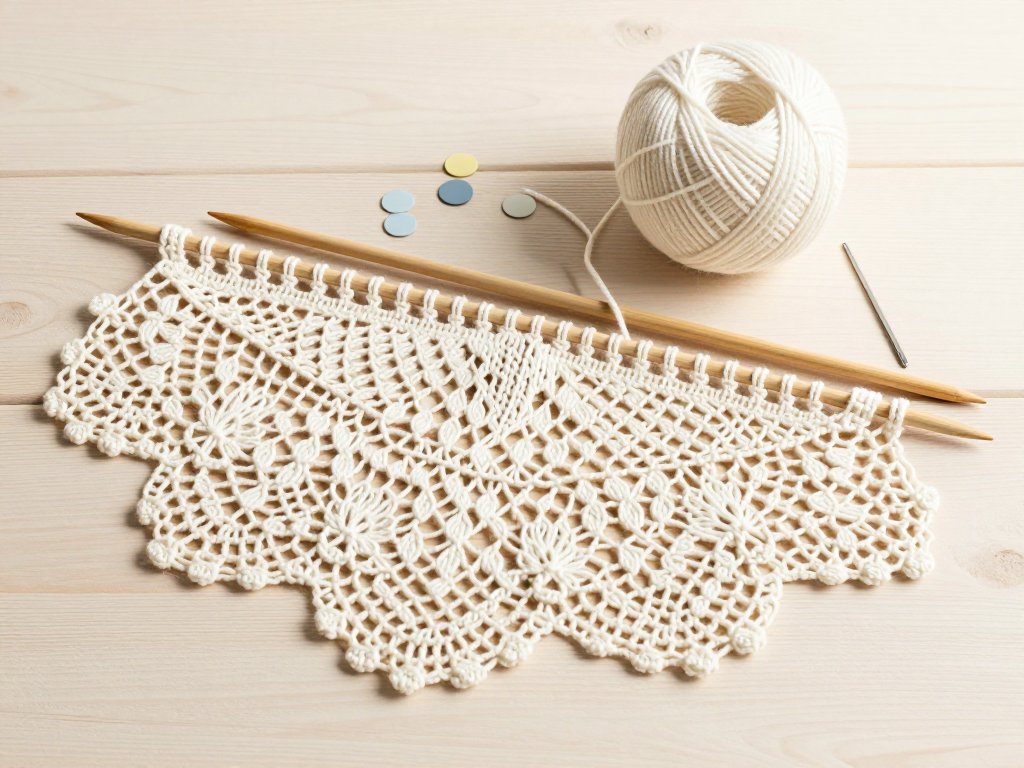
And here is the secret: lace does not have to be complicated. A simple eyelet pattern — a yarn over followed by a knit-two-together, repeated across the row — creates delicate little openings that let the air flow through.
You can work eyelets in vertical columns, scattered randomly, or arranged in diamond patterns that recall traditional Shetland lace.
The basic eyelet is accessible to beginners: on a right-side row, you knit two together, then yarn over (or vice versa), and on the wrong-side row, you purl everything.
Two stitches, one repeat, and the effect is charming.
A feather-and-fan stitch, also known as Old Shale, is another lovely option. This classic pattern — worked over a multiple of eighteen stitches — pairs decreases with yarn overs to create gentle waves across the fabric.
The waves are structural as well as decorative; the yarn overs create tiny openings that keep the fabric airy, while the decreases pull the fabric slightly inward, creating a natural A-line shape without any shaping at the side seams.
I have knit summer tops in feather-and-fan where the stitch pattern did all the shaping work for me — no increasing, no decreasing at the side seams, just a gentle flare that moved with the body.
The pattern dates back to the nineteenth century, and its enduring popularity is a testament to how well it serves a summer garment.
Do not underestimate the humble garter stitch, either. Garter stitch in a fine cotton produces a fabric with beautiful texture and give, and because every ridge is slightly raised, there is air trapped between the fabric and your skin.
A top with garter stitch sections at the shoulders or hem can be both breathable and durable — the garter provides structure where you need it, while stockinette or lace provides flow where you want it.
Choosing a Construction Method: The Beauty of Seamless Top-Down Knitting
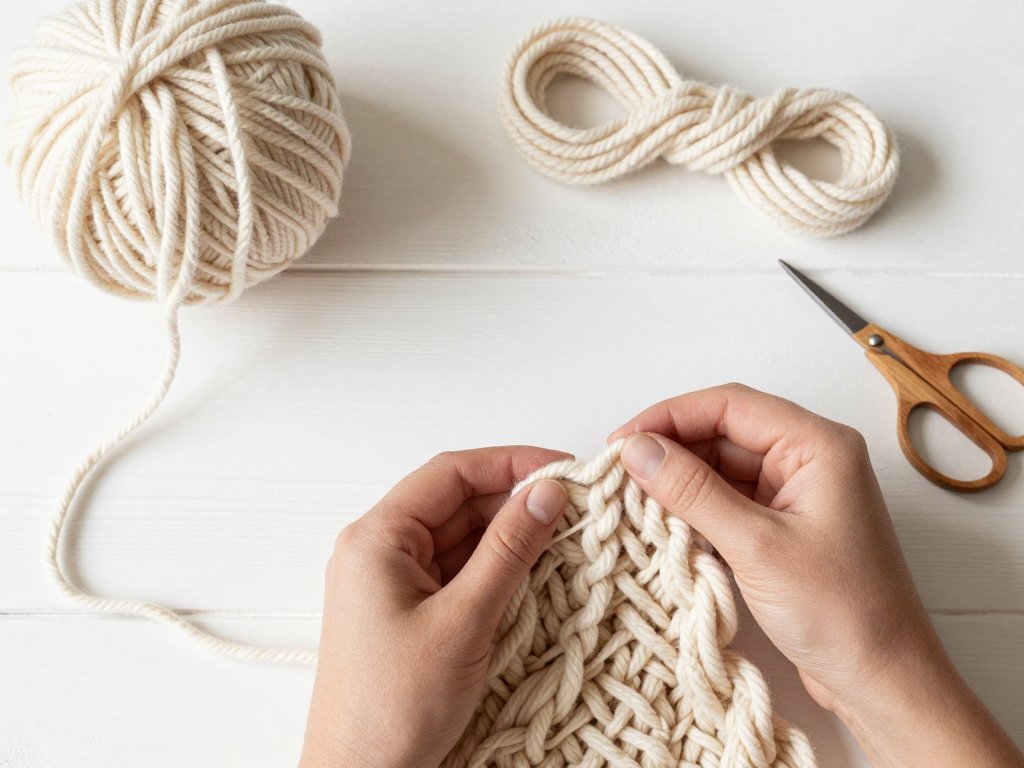
When I learned to knit garments, the standard method was to knit the back, then the front, then the sleeves, and then spend hours seaming them together with mattress stitch.
I do not say this to disparage seamed construction — a well-seamed garment has a structure that seamless garments sometimes lack.
But for a summer top knit in precious stolen moments between carpool and bath time, I believe seamless top-down construction is the kinder, more rewarding choice.
In seamless top-down construction, you begin at the neckline — casting on just enough stitches to fit comfortably around your neck and shoulders — and work downward, increasing at the raglan or saddle shoulder lines until you reach the underarm, then separating the sleeves from the body and continuing each piece in the round.
There is no seaming. There is no cutting. There is no moment of truth when you hold two separate pieces together and hope they match.
The garment grows in your hands as a single, unified piece, and when you bind off, you are done.
For a summer top, this construction offers particular advantages. Because there are no seams, there are no bulky ridges pressing into your skin on a hot day.
The raglan shaping — those diagonal lines running from the neck to the underarm — creates a natural, flattering silhouette that accommodates a range of body types without complex math.
And if you need to try the garment on as you knit (which I recommend you do, frequently and without apology), you can simply slip the live stitches onto a length of waste yarn and hold it up.
The raglan increase technique itself is simple: on every other row, depending on your gauge and body measurements, you work a make-one (M1) increase on either side of a stitch marker at each of the four raglan lines — front left, front right, back left, back right.
That is eight increases every increase row. The increases can be worked as lifted increases (M1L and M1R) for an invisible effect, or as yarn-overs for a decorative line of tiny eyelets along the raglan seams — the latter being especially charming in a summer top, where those small openings add to the garment's breathability.
Sizing, Gauge, and the Mathematics of Fit
Let me speak plainly about gauge: it matters more for cotton than for almost any other fiber.
Because cotton does not spring back into shape the way wool does, your gauge must be accurate from the very first row.
A too-loose gauge in cotton will not tighten up with blocking — it will stretch further.
A too-tight gauge will produce a fabric that feels stiff and boardlike, lacking the fluid drape we want in a summer garment.
Before you cast on for your top, knit a generous swatch — at least four inches by four inches, worked in the stitch pattern you plan to use for the body.
Wash and block it exactly as you will wash and block the finished garment. Cotton swatches behave differently before and after washing; the stitches may relax, the fabric may grow, and you need to know this before you make any calculations.
Measure your swatch after blocking, not before. Count your stitches and rows over four inches and divide by four to get your per-inch gauge.
Write it down. Trust it.
For a fingering-weight cotton on US size 3 or 4 needles, you will typically see a gauge of 7 to 8 stitches and 10 to 11 rows per inch in stockinette.
For sport-weight on US size 5 or 6, you will see about 6 stitches and 8 rows per inch.
These are guidelines — your personal tension will vary, and your swatch is the truth-teller.
When it comes to sizing, pick a size based on your chest measurement plus two to four inches of positive ease.
A summer top should skim your body, allowing air to move between the knit fabric and your skin.
Measure yourself around the fullest part of the bust, add three inches for comfort, and find the pattern size that matches that finished measurement.
If you are between sizes, size up — a loose cotton top is charming; a tight one is uncomfortable and unflattering.
The beauty of a simple top-down raglan is that you can adjust the fit as you go.
If you reach the underarm and the body feels too wide, you can decrease a few stitches evenly around the next round.
If it feels too narrow, you can increase. You are the architect of your own garment, and the knitting will follow where you lead it.
Blocking and Care: Making Your Summer Top Last
Blocking a cotton garment is not optional — it is the step that transforms a rumpled collection of stitches into a polished, wearable piece of clothing.
When you bind off your top, it will look a bit sad, frankly. The edges will curl, the stitches will look uneven, and the fabric will have a slightly tubular, unshaped quality.
This is normal. Cotton needs to be blocked to show you what it can really do.
To block your summer top, fill a clean basin or sink with lukewarm water and add a drop or two of mild wool wash or a gentle shampoo.
Submerge the garment completely and let it soak for twenty to thirty minutes — long enough for the fibers to relax and absorb the water.
Do not agitate, do not scrub, do not wring. Cotton is strong when dry but weaker when wet, and rough handling can distort the stitches.
After soaking, press the water out gently by rolling the garment in a clean, dry towel and pressing firmly.
Do not twist or wring.
Lay the top flat on a blocking mat or a clean towel, and gently shape it to the dimensions you recorded from your swatch.
Pay special attention to the neckline — you want it to lie flat and not gap — and the hem, which should be even all the way around.
Use blocking pins or T-pins to hold the edges in place if needed. Then walk away.
Leave it to dry completely, which for a cotton garment may take a full day or more, depending on your climate.
Resist the temptation to move it or pick it up before it is fully dry — the shape you set during blocking is the shape the garment will hold until you wash it again.
Thereafter, care is simple. Cotton does not need to be washed after every wear; a good airing out is usually sufficient.
When it does need washing, hand wash or use a gentle machine cycle in cold water.
Cotton shrinks in hot water, so keep everything cool. Lay flat to dry — hanging a cotton knit top while wet will stretch it out of shape, particularly if it is a finer weight.
With proper care, a well-knit cotton top will last for years, softening and improving with each wash like a favorite pair of jeans.
Styling Your Hand-Knit Summer Top
A hand-knit summer top, even a simple one worked in stockinette with a few decorative eyelets at the yoke, has a presence that store-bought garments lack.
It is not about perfection — it is about the evidence of the human hand, the slight irregularities that make it yours, the story of the hours you spent knitting it while the children played or napped or read books beside you.
A white or cream cotton top is the most versatile garment you will ever make.
It pairs with everything — denim shorts for a day at the park, a linen midi skirt for a summer wedding, tailored trousers for an evening out.
Tuck it in or leave it loose, depending on the silhouette you want. Layer it over a strappy bralette or a thin cotton camisole for modesty (remember that lace and eyelet patterns may require a layer underneath).
If you choose a color, think about what makes you feel happy on a summer morning.
A soft sage green, a dusty rose, a pale butter yellow, a sky blue — these colors recall the gardens and skies of summer.
Deep jewel tones work too; a sapphire or amethyst cotton top is striking against summer tanned skin.
Accessorize thoughtfully. A hand-knit top needs little adornment — let the stitches speak for themselves. A simple necklace that falls just above the neckline, a pair of woven leather sandals, a straw bag. The goal is effortless grace, which is exactly what your easy knit summer top provides.
Conclusion
I have been knitting for more than thirty years, and I still feel a small thrill every time I cast on for a summer top.
There is something about working with cotton in the spring and early summer — the clean feel of the fiber sliding through my fingers, the knowledge that every stitch is a preparation for the warm days ahead — that feels like a ritual as old as civilization itself.
Every knitter who has ever sat in the shade on a July afternoon, working a cotton thread into something beautiful, is part of that long, unbroken line stretching back to the Indus Valley and beyond.
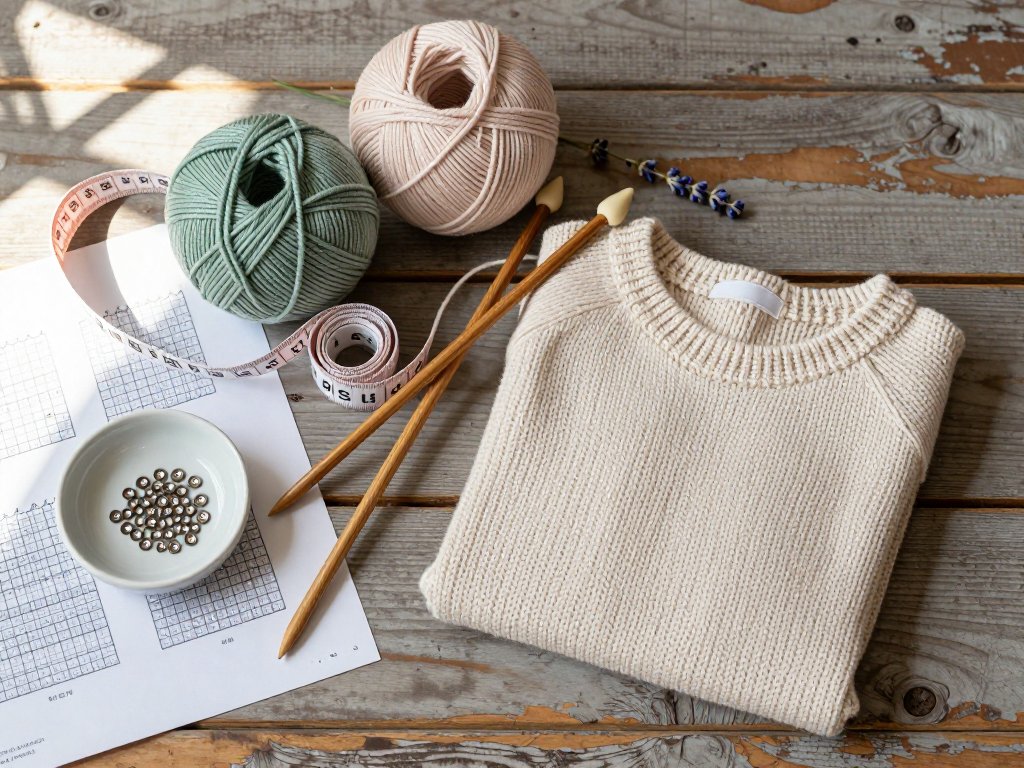
The easy knit summer top I have described here — worked in fingering or sport-weight cotton, knit seamlessly from the top down, adorned with simple eyelet or feather-and-fan patterning, blocked with care and worn with joy — is more than a garment.
It is a repository of your time and attention, a tangible record of hours spent making something with your own hands.
When you put it on, you are wearing the history of cotton, the wisdom of knitters past, and the satisfaction of having created something beautiful for yourself.
So choose your yarn. Cast on with a long-tail cast-on — that ancient, reliable method dating back to the Middle Ages — and begin.
The summer is waiting, and every stitch brings you closer to the day you will slip your top over your head, step outside, and feel the breeze through your handmade fabric.