Introduction
There is a peculiar ache that comes with the end of a doomscrolling session. You look up from your phone, blinking into the real world, and realise you have spent forty minutes absorbing headlines that made your chest tight, your jaw clenched, and your spirit depleted.
You have consumed volumes of information and yet feel emptier than when you began. It is a uniquely modern exhaustion, and one that an increasing number of people are deciding they no longer want to participate in.
The solution, as it turns out, has been hiding in plain sight — tucked away in sewing baskets, passed down through generations, and patiently waiting on the shelves of charity shops and craft stores.
Needle and thread. A length of linen. A pattern, perhaps, or simply an impulse to make a mark on fabric with your own two hands.
Across the Western world, traditional handcrafts — embroidery, cross-stitch, knitting, crochet, quilting — are experiencing a renaissance so pronounced that it has become one of the most quietly powerful cultural shifts of the past decade.
These are the crafts your grandmother, or perhaps your great-grandmother, practised by the firelight on a winter evening.
They are back, and they are not merely surviving. They are thriving.
This article is about why that is happening, what it means, and how you can be part of it — even if you have never held an embroidery hoop in your life.
The Quiet Rebellion of Hand Stitching
Let us begin with a confession: I did not come to embroidery through a grand artistic awakening.
I came to it through sheer desperation. I was, in the autumn of 2022, a person who could not stop refreshing news feeds.
My hands were restless without a phone in them. My attention span had fractured into something I barely recognised.
I needed something to do with my hands that did not involve a screen.
A friend handed me a small hoop, a piece of plain cotton, a needle, and a skein of DMC embroidery floss in a shade called "Ecru." She showed me one stitch — the split stitch — and left me to it.
That first evening, I stitched a wobbly, lopsided line that looked nothing like the graceful curves on her sampler.
And yet, when I looked up, an hour had passed. I had not thought about the news.
I had not refreshed a single feed. I had simply moved a needle through fabric, over and over, in a rhythm older than electricity.
This experience is not unique to me. It is being replicated in living rooms, dorm rooms, and cafés across the country.
The numbers tell a striking story: according to data from the Craft Yarn Council and various industry reports, participation in needlecrafts among adults under thirty-five has risen by more than thirty percent since 2020.
Embroidery starter kit sales on platforms like Etsy and Amazon have seen sustained year-over-year growth.
Instagram tags like #embroidery, #crossstitch, and #grandmahobbies collectively hold tens of millions of posts, many of them from creators who were not even born when these crafts were last considered mainstream.
What is driving this? The answer, I believe, is both simple and profound: we are hungry for something real. Something that cannot be swiped away. Something that demands our full presence, rewards our patience, and leaves behind a physical object that testifies to our time and care.
Why Embroidery Speaks to a Screen-Weary Generation
The Meditation of the Needle
There is a reason that the repetitive motion of stitching has been compared to meditation.
Neurologists and occupational therapists have studied the effects of handcrafts on the brain, and the findings are consistent: rhythmic, repetitive fine-motor activities activate the parasympathetic nervous system — the "rest and digest" branch that counters the fight-or-flight response triggered by the constant drip of alarming news.
When you stitch, your heart rate slows. Your breathing deepens. Your brain waves shift from the high-frequency beta state associated with active, anxious thought into the lower-frequency alpha and theta states associated with calm, focused awareness.
This is not mystical language. It is measurable physiology. The psychologists call it "flow state." The stitchers I interviewed for this article call it "the feeling of finally being able to breathe."
"I started cross-stitching during the pandemic," says Marisol, a twenty-six-year-old software engineer from Portland. "I needed something that wasn't measured in lines of code or sprint velocity.
Something that couldn't be optimised. Just a little X, and then another X, and then another.
It was the first time in years that my brain went quiet."
Tangible Progress in a Digital World
One of the cruel paradoxes of modern digital life is that we work harder than ever and yet have very little to show for it at the end of the day.
Emails are answered only to multiply. Social media posts vanish into algorithmic ether. The to-do list never shrinks; it only reorganises itself.
There is no closing time, no final page, no finished object.
Embroidery offers the opposite experience. Every stitch is a small, measurable unit of progress. When you finish a row, you can see it.
When you complete a motif, you can trace its outline with your finger. When you snip the final thread and pull your work out of the hoop, you are holding something that did not exist before you began.
It is yours. You made it. No algorithm can take it away.
This is, I think, a deeply radical act in an age of intangibility. To sit down with a needle and thread is to declare that your time and attention still belong to you — that you are not merely a consumer of content, but a creator of meaning.
From Granny Square to Graphic Statement — The New Embroidery
If the image that comes to mind when you hear "embroidery" is a demure sampler of pastel flowers stitched by a Victorian lady, it is time to update your mental picture.
The embroidery of 2026 bears little resemblance to the craft your grandmother might have learned in school.
It is bold, it is irreverent, it is political, and it is unapologetically contemporary.
Meme Stitching and Political Cross-Stitch
One of the most delightful developments in modern embroidery is the rise of what might be called "meme stitching." A quick scroll through the #crossstitch hashtag on Instagram reveals patterns that quote TikTok catchphrases, reproduce internet memes in thread, and stitch unprintable sentiments into delicate floral frames.
There is a wonderful tension in this juxtaposition — the painstaking, centuries-old technique applied to the ephemeral language of the internet.
Political embroidery, or "craftivism," has also surged. Stitchers are using needle and thread to comment on everything from climate change to reproductive rights to the state of democracy.
The embroiderer and activist Rosa Martyn, whose work has been featured in galleries across the UK, describes her practice as "slow protest." "A placard is gone in a day," she told me.
"A stitched piece, if cared for, can outlast the movement it was made for. It becomes a document.
A record that says: we were here, we cared, we made something of our anger."
This is embroidery as witness. Embroidery as archive. Embroidery as a middle finger, beautifully rendered in French knots.
Bold Colors, Abstract Designs, and Breaking the Rules
The technical rules of traditional embroidery — smooth satin stitches, evenly spaced backstitch, neat and tidy finishing — are being joyfully dismantled by a new generation of stitchers.
Contemporary embroidery embraces rough edges, visible knots, and experimental materials. Designers are stitching on denim, on canvas bags, on thrifted shirts.
They are using yarn instead of floss, incorporating beads and found objects, and treating the fabric surface as a free-form canvas rather than a grid to be followed.
Colour palettes have shifted dramatically, too. Where traditional embroidery often favoured muted, natural tones, today's stitchers reach for neon pinks, electric blues, and saturated oranges. The result is work that feels alive, urgent, and entirely of its moment.
Fergus, a twenty-three-year-old embroidery artist based in Manchester, describes his work as "aggressively colourful." "I want people to stop scrolling when they see my work," he says. "I want the colours to grab them by the collar and say, 'Look. Someone made this. Someone spent hours on this. It matters.'"
Craftivism: Stitching as a Form of Protest
The marriage of craft and activism is not new — one need only look at the suffragettes, who embroidered banners and stitched their demands into textiles that survive to this day.
But the current wave of craftivism feels distinct in its scale and its demographic. Young stitchers are using embroidery to process political grief, to build community around shared values, and to create objects of resistance that double as objects of beauty.
The term "craftivism" was coined by writer and crafter Betsy Greer in the early 2000s, but it has found its fullest expression in the past five years.
Online communities dedicated to craftivism have sprung up on every platform. Patterns for protest pieces circulate freely.
Stitch-ins and craft circles double as political organising spaces. To embroider, in this context, is not to retreat from the world but to engage with it on your own terms.
"I can't go to every march," says Aisha, a thirty-one-year-old teacher from Leeds who runs a small Etsy shop selling feminist embroidery patterns.
"But I can stitch every evening. And when I finish a piece and put it on my wall, it's a reminder that I'm still fighting.
Even if I'm just sitting on my sofa, surrounded by thread ends, I am still part of something."
There is a particular power in the slowness of stitched protest. A screenprinted T-shirt can be mass-produced in seconds.
A stitched piece takes hours, days, sometimes weeks. That investment of time becomes part of the message.
It says: I care about this enough to give it my hours. My hands. My full attention.
Visible Mending and the Slow Fashion Revolution
Alongside the rise of embroidery as self-expression, a parallel movement has been gaining momentum: visible mending.
Rooted in the Japanese tradition of sashiko and the broader "make do and mend" ethos of wartime thrift, visible mending treats repair not as a chore to be hidden but as an aesthetic choice to be celebrated.
Sashiko: The Japanese Art of Beautiful Repair
Sashiko, which translates roughly to "little stabs" or "small piercing," is a Japanese embroidery technique that originated in the rural communities of the Edo period.
Farmers and fishermen used it to reinforce worn areas of their clothing, layering running stitches in geometric patterns that strengthened the fabric while creating stunning decorative effects.
The utilitarian origins of sashiko are part of its appeal. It was never meant to be precious.
It was meant to be practical, durable, and beautiful.
Contemporary stitchers have embraced sashiko with enthusiasm. The technique requires only a needle, thick white cotton thread, and indigo-dyed fabric — materials that are easy to source and forgiving for beginners.
The patterns, from simple parallel lines to intricate interlocking geometries, are meditative to stitch and visually striking.
A pair of jeans repaired with sashiko stitching becomes more interesting, more personal, and more valuable than it was before the repair.
This reframing of repair as enhancement is one of the most powerful ideas in the modern craft revival.
It challenges the logic of fast fashion, which treats clothing as disposable and replacement as the default response to wear.
To mend visibly is to reject that logic in the most literal way possible. You are not hiding the repair.
You are making it the focal point.
Upcycling with Intention
Visible mending extends far beyond sashiko. Embroiderers are adding floral motifs to cover stains, stitching patches over holes in creative shapes, and transforming thrifted garments into one-of-a-kind wearable art.
The environmental implications are significant. The fashion industry is responsible for an estimated ten percent of global carbon emissions, and textile waste fills landfills at staggering rates.
Every garment that is mended rather than discarded represents a small victory for the planet.
But the appeal of upcycling goes beyond environmental virtue. There is a deep satisfaction in transforming something ordinary into something personal.
A plain denim jacket becomes a canvas. A stained shirt becomes an opportunity for a embroidered bouquet.
A pair of trousers with a torn knee becomes a showcase for your growing stitching skills.
"I used to feel embarrassed when I wore mended clothes," says Elena, a twenty-nine-year-old graphic designer from Barcelona.
"Like it showed that I couldn't afford new things. Now I feel the opposite. Every mend is a story.
Someone will ask, 'Where did you get that jacket?' and I get to say, 'I fixed it myself.' That feels better than anything from a shop."
Getting Started: Your Embroidery Journey Begins Here
Perhaps the most encouraging thing about the current embroidery revival is how accessible it has become.
When I first picked up a needle, I was intimidated by the elaborate samplers I saw online.
Surely, I thought, you needed years of practice and a studio full of specialised equipment to produce work like that.
The truth is much simpler. Embroidery is one of the most beginner-friendly crafts in existence.
You can start tonight, with materials that cost less than a takeaway meal.
What You'll Need
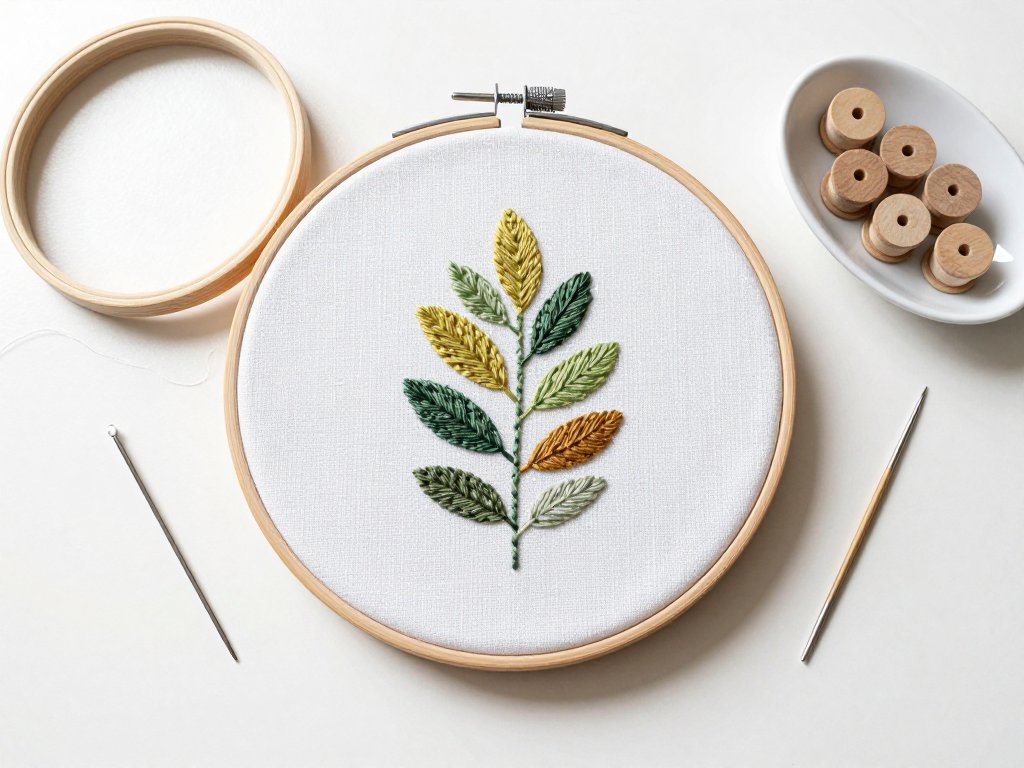
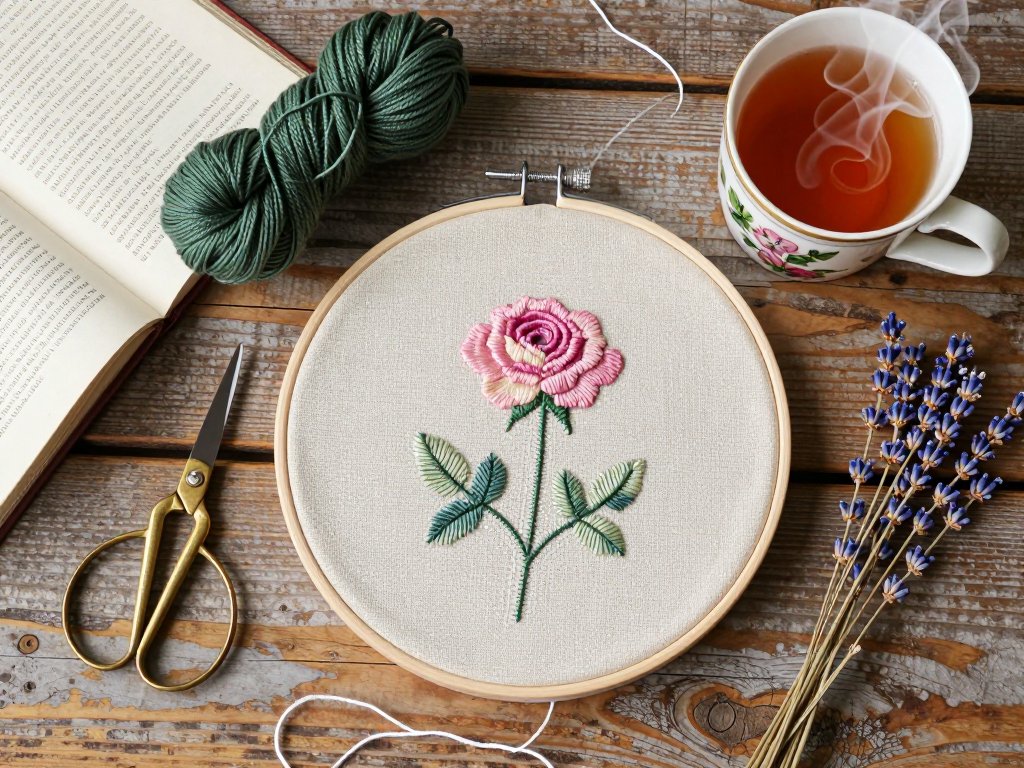
The starter kit for embroidery is disarmingly small. You will need an embroidery hoop — a wooden or plastic ring that holds your fabric taut.
A pack of embroidery needles, which have larger eyes than sewing needles and are designed for thicker thread.
A skein or two of embroidery floss — DMC is the gold standard, but any stranded cotton will do.
A piece of fabric: cotton or linen, light-coloured so you can see your stitches, and large enough to fit in your hoop with some margin.
And a pair of small scissors.
That is it. You can buy an entire beginner's kit on Etsy for under fifteen pounds, or source the materials individually from a craft shop for even less.
Many of the best kits come with pre-printed patterns, so you do not even need to transfer a design.
You simply start stitching.
For those who want to explore sashiko, starter kits are widely available online and include pre-printed fabric panels with geometric patterns, specialised sashiko needles, and the thick white thread that gives the technique its distinctive look. The total cost is comparable to a standard embroidery starter.
Finding Your First Pattern
The internet is a treasure trove of embroidery patterns, many of them free. Pinterest boards overflow with designs ranging from simple flowers to elaborate portraits.
Etsy shops sell downloadable patterns for a few pounds each. Instagram and TikTok are rich with video tutorials that show you exactly how each stitch is formed.
My advice for the absolute beginner is this: pick a pattern that genuinely delights you.
Do not worry about whether it is "beginner enough." If you love the design, you will find the patience to learn the stitches it requires.
Start with the basic moves — backstitch for outlines, satin stitch for filling, French knots for texture — and build from there.
Every expert stitcher you admire started exactly where you are now, with a needle, some thread, and a lot of wobbling.
Joining the Community
One of the most heartening aspects of the embroidery revival is the community that has grown around it.
Online forums, Discord servers, and social media groups connect stitchers across continents. There are subreddits dedicated to cross-stitch and embroidery where beginners post their first efforts and receive encouragement rather than critique.
There are YouTube channels devoted entirely to stitch tutorials. There are Instagram accounts that function as virtual stitch-alongs, guiding hundreds of thousands of followers through the same pattern in real time.
If you prefer in-person connection, look for a local craft circle or stitching group. Many libraries, community centres, and yarn shops host regular gatherings where stitchers of all levels sit together and work on their projects.
The conversation flows. The tea is made. The stitches accumulate. It is a form of socialising that does not require you to perform or to be interesting — only to show up and to stitch.
The Deeper Meaning of Grandma Hobbies
There is, I think, something quietly radical in the embrace of "grandma hobbies" by a generation that was supposed to be too busy, too digital, too sophisticated for such things.
The term itself, once dismissive — used to suggest that a craft was old-fashioned, irrelevant, out of touch — has been reclaimed.
To call embroidery a grandma hobby now is to state a fact with pride, as in: yes, I am stitching like a grandmother, and I am happier for it.
What these crafts offer is a connection to a slower, more deliberate way of living.
Grandmothers knew things that we, in our screen-saturated haste, had forgotten. They knew that making something with your hands was a form of rest.
They knew that the company of other makers was a kind of medicine. They knew that a finished object, no matter how imperfect, was a testament to time well spent.
There is a passing-down happening here, but it is not one-directional. Grandmothers are learning from their granddaughters, too — new patterns, new techniques, new ways of combining traditional stitches with contemporary aesthetics.
The craft circle has become a multigenerational space where knowledge flows in every direction. I have watched a seventy-four-year-old retired nurse teach a twenty-two-year-old graphic design student how to manage tension in her thread, and I have watched the same student teach the nurse how to use Pinterest to find patterns.
This exchange is precious. It is also, quietly, a form of resistance against a culture that segregates us by age and isolates us in our individual screens.
Conclusion
If you have made it to the end of this article, you are probably already halfway to picking up a needle.
Something in you recognises what I recognised that autumn evening with my wobbly split stitch — that there is a different way to spend your hours.
A way that leaves you full rather than drained. A way that produces thread and fabric and colour instead of fatigue and anxiety and numb thumbs.
So here is my invitation to you. This evening, put down your phone. Not forever — I am not a Luddite, and this newsletter you are reading is evidence that I believe in the good that technology can do.
But for an hour. Find a hoop. Find a needle. Find a single skein of thread in a colour that makes you happy.
Make one stitch. Then another. Then another.
You do not need to be good at it. You do not need to finish anything. You do not need to show anyone. You only need to be present — with your hands, with your breath, with the small and ancient act of pulling thread through fabric.
The world will still be there when you look up. The news will still be cycling.
The feeds will still be refreshing. But you will have changed, if only a little.
You will have reminded yourself that you are a maker, not just a consumer. That your hands are capable of creation, not only of scrolling.
And that the quiet, repetitive wisdom of a grandmother's hobby might, in the end, be exactly what this frantic century needs.
Happy stitching.